
ADAS stands for Advanced Driver Assistance System. It’s a bundle of cameras, radar and sensors that watch the road and either warn you or actively brake, steer or slow the car down to avoid an accident. The common ADAS features you’ll see on Indian cars in 2026 are Automatic Emergency Braking (AEB), Adaptive Cruise Control, Lane Keep Assist, Forward Collision Warning, Blind Spot Monitoring, and Driver Attention Warning. Think of it as an extra pair of eyes. Not a self-driving system, and definitely not a replacement for paying attention on Indian roads.
Here’s what most ADAS explainers gloss over: the brochure pitch and what you’ll actually experience on the road are two very different things in India. So this guide does both. What each feature really does, which cars under ₹20 lakh come with it in 2026, and an honest read on which features earn their keep on Indian highways and which ones you’ll probably end up switching off in city traffic.
What Is ADAS?
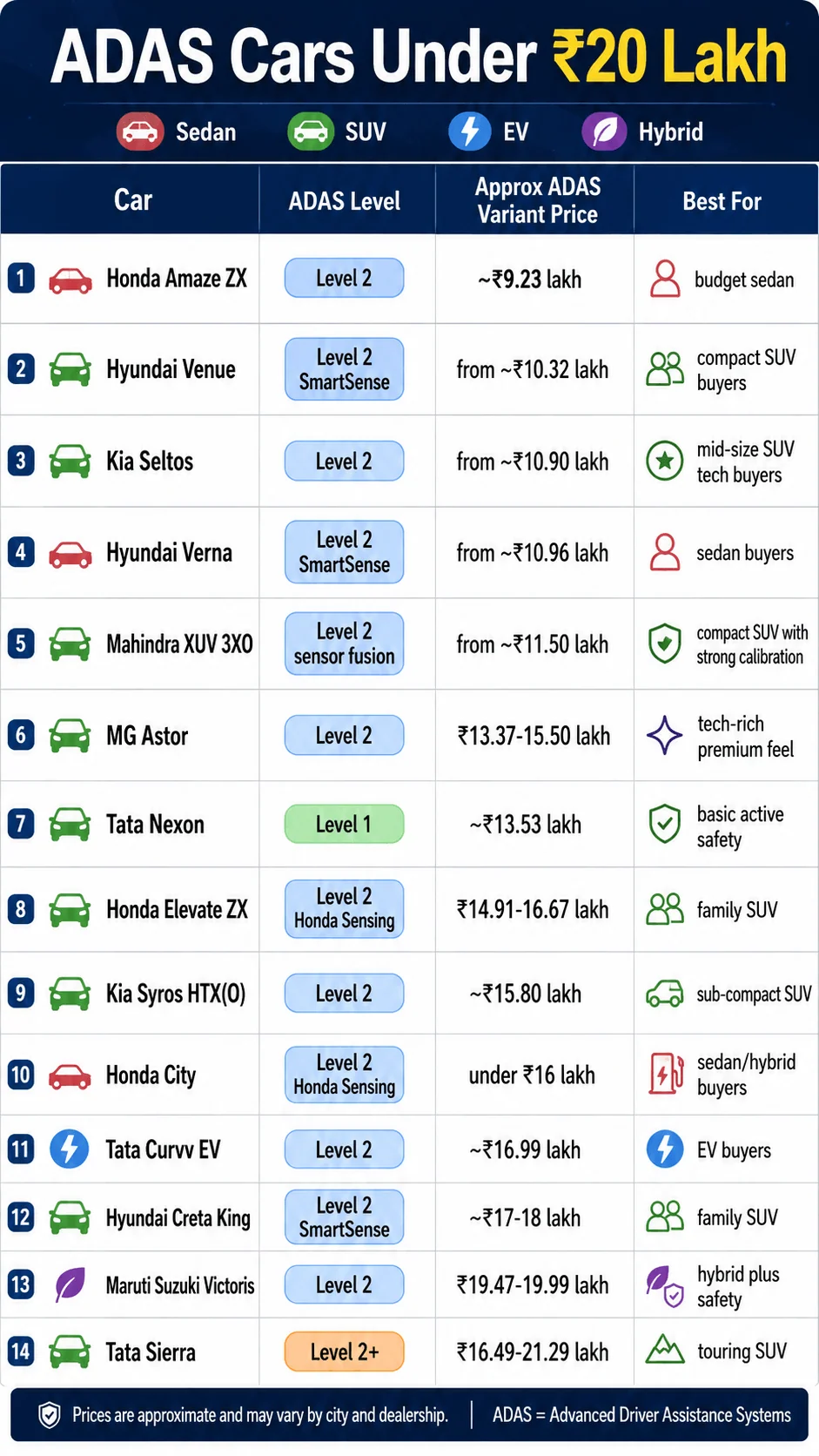
ADAS is an active safety system. That distinction matters.
Airbags, crumple zones, seatbelts. Those are passive safety. They reduce injury after a crash happens. ADAS is engineered to prevent the crash from happening in the first place, or at least slow your car enough before impact that the airbags have less work to do.
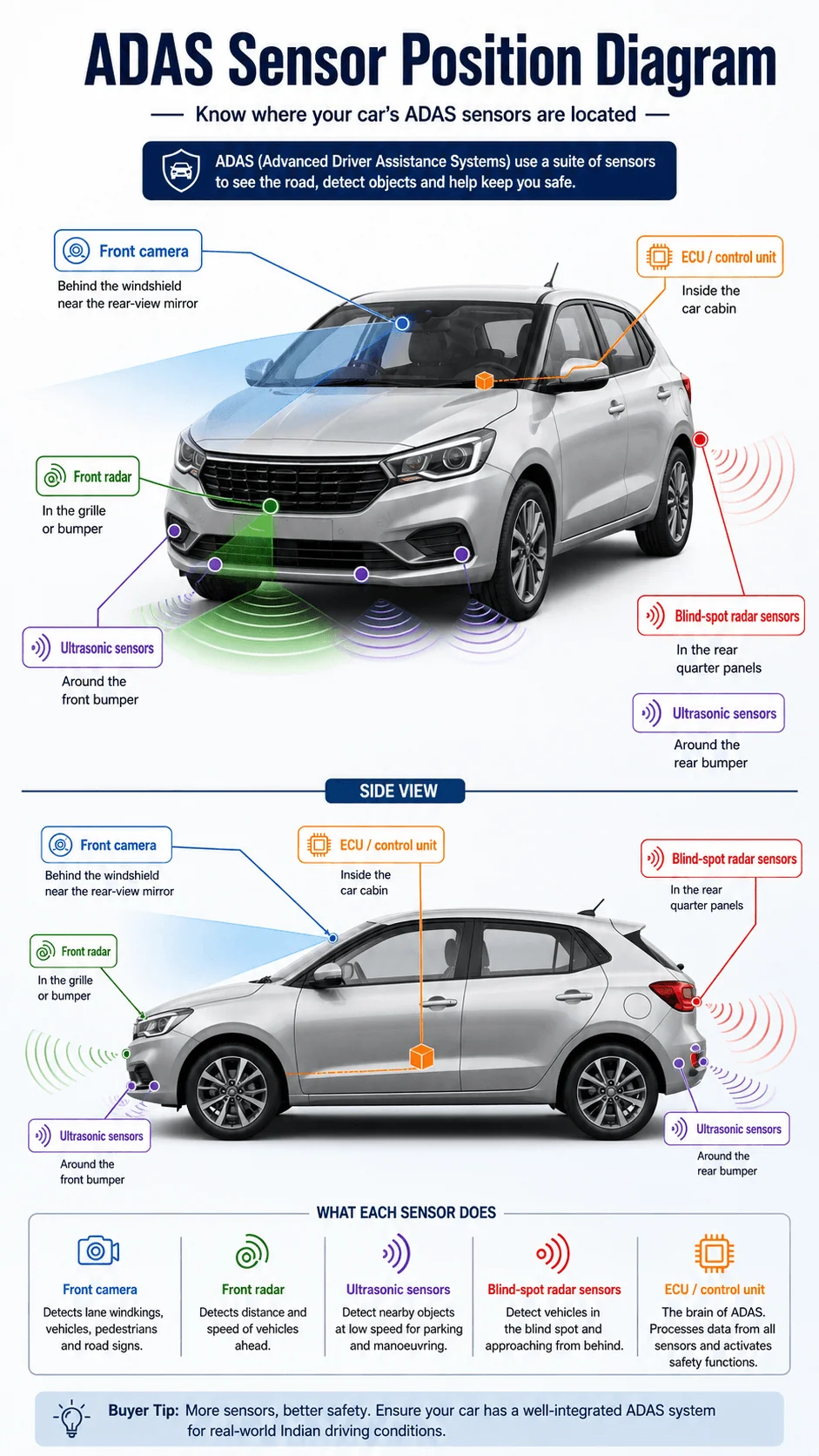
How does it actually work? Forward-facing cameras (usually mounted behind the rearview mirror), millimetre-wave radar (in the front bumper or grille), and ultrasonic sensors around your car’s body all feed data to an electronic control unit (ECU). The ECU runs AI algorithms that calculate the position, speed and trajectory of everything around you. Every few milliseconds. If it spots a collision risk or a lane drift, it warns you with a chime or a steering vibration. If you don’t react fast enough, it can apply the brakes or nudge your steering itself.
But here’s the part dealerships gloss over. ADAS does not make your car self-driving. Even on the most advanced Level 2 systems sold in India in 2026, you remain 100% legally and practically responsible for your vehicle. Hands on the wheel, eyes on the road. The system monitors your steering wheel torque, and on some cars even your eye movement, to make sure you’re paying attention. Lift your hands off for too long? The car will beep at you, then disengage the system entirely.
So why is ADAS suddenly everywhere in 2026? Three reasons. Consumer demand for active safety has grown sharply. The Bharat NCAP testing protocol now rewards cars that include active safety features. And the Ministry of Road Transport and Highways (MoRTH) has mandated ADAS on commercial and heavy passenger vehicles from 2026 onwards. With India recording over 1.68 lakh road fatalities every year, regulators want active safety in every new car they can push it into.
Key ADAS Features Explained
Indian carmakers love putting “Level 2 ADAS” on the brochure and leaving it at that. The catch? “Level 2 ADAS” can mean anything from 6 features to 22 features depending on the manufacturer. Here’s what each of the common features actually does, and which ones earn their keep on Indian roads.
Forward Collision Warning (FCW)
A front-facing camera or radar (or both) scans the road for traffic ahead. If it calculates your closing speed is too high relative to the car in front, it flashes a warning and chimes loudly.
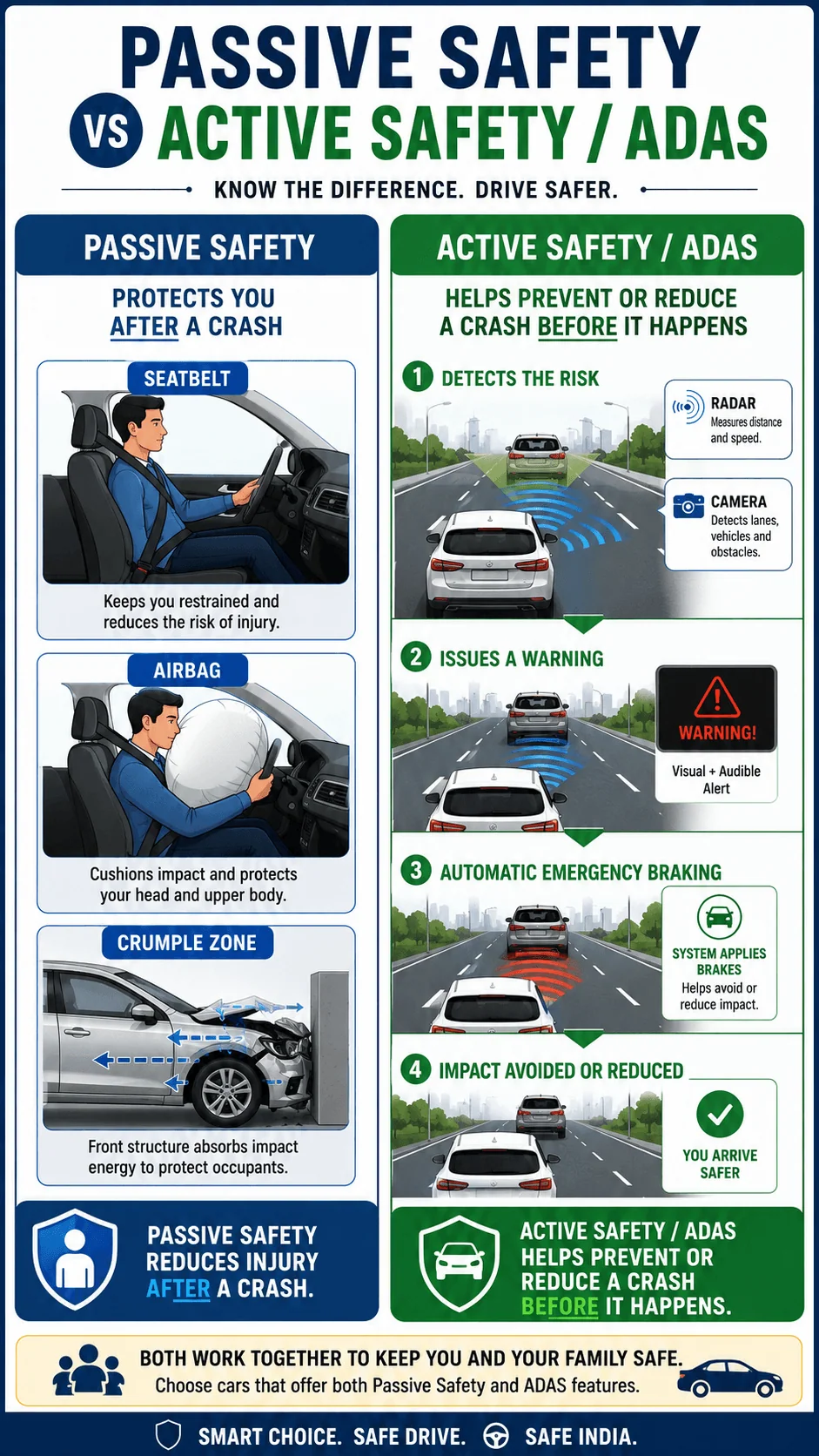
India reality: Genuinely useful on highways and expressways, especially when traffic suddenly piles up because of a broken-down truck or an animal on the carriageway. Less useful in bumper-to-bumper city crawls, where tight gaps between cars are standard practice. The system reads them as collision risks and false-alarms constantly.
Automatic Emergency Braking (AEB)
The mechanical step beyond FCW. If you don’t brake in time, the car does it for you. The hydraulic system pre-charges and the brakes slam to prevent or soften the impact.
India reality: Arguably the single most valuable life-saving feature in the suite. But it has a darker side here. Phantom braking. When a two-wheeler darts across your bumper with inches to spare (a daily reality in Mumbai and Bengaluru), AEB can read it as an imminent crash and apply full braking force. That sudden stop can cause the car behind you to rear-end yours. Safety experts still recommend keeping AEB on. Just adjust the sensitivity to “low” or “late” if your car lets you.
Adaptive Cruise Control (ACC)
Regular cruise control just locks your speed. ACC uses radar to maintain a set speed and a safe gap from the car ahead. It slows down automatically when the car in front does, and speeds up again when traffic clears. Modern systems include Stop-and-Go, which can bring the car to a full halt and resume on its own.
India reality: Brilliant on the Mumbai-Pune, Delhi-Mumbai, Bengaluru-Mysuru, and other access-controlled expressways. Hundreds of kilometres of cruising with your foot off the pedal. In dense city traffic? Useless. The safe-following gap the system maintains gets immediately exploited by other drivers and auto-rickshaws cutting in. That forces the car to brake repeatedly. Most owners end up turning it off in cities.
Lane Departure Warning (LDW) and Lane Keep Assist (LKA)
LDW is the passive alert. A chime or steering vibration when the camera detects you drifting out of your lane without indicating. LKA goes further. It actively applies steering torque to nudge the car back into the lane centre.
India reality: Both depend entirely on visible, contrasting lane markings. On well-marked NHs and expressways, LKA reduces fatigue noticeably during long-distance driving. On state highways and most urban arterials where lane markings are faded, missing, or covered in dust, LKA is either useless or it actively fights your steering when you swerve around a pothole or a parked truck. Owners frequently disable it.
Blind Spot Monitoring (BSM)
Small radar sensors in the rear bumper continuously scan the area to either side of your car that you can’t see in the mirrors. An amber icon lights up in the side mirror when a vehicle is there. If you indicate to change lanes while a vehicle is in the blind spot, the warning flashes and beeps.
India reality: One of the most universally useful ADAS features for Indian conditions. Two-wheelers filter past cars at high speed all the time, and BSM helps you avoid side-swipes during lane changes. It works independently of lane markings, holds up in city and highway equally, and the failure modes are minimal.
Rear Cross Traffic Alert (RCTA)
Uses the same rear radars as BSM to scan for vehicles or pedestrians approaching from either side as you reverse. Sounds an alert and shows directional arrows on the reverse camera screen.
India reality: Hugely helpful when you’re reversing out of perpendicular parking at malls, apartment blocks, or tight commercial streets. The kind of spaces where you genuinely can’t see what’s coming. Effective and reliable. Can miss very fast-moving objects, so still look over your shoulder.
High Beam Assist (HBA)
Camera reads ambient light and oncoming headlights, automatically toggling between high and low beam for you.
India reality: Mixed. The concept is great for the highway misery of being blinded by aftermarket LEDs on trucks. In practice? The unregulated mix of ultra-bright aftermarket lighting confuses the sensor, and in urban areas streetlights mimic vehicle lights. You’ll still find yourself flicking the stalk manually.
Driver Attention Warning (DAW)
Monitors steering inputs (and on advanced systems, your eye movement via an interior camera) for signs of fatigue. Throws a coffee-cup icon and an audible alert when it thinks you’re getting drowsy.
India reality: Useful as a nudge on long intercity drives. It’s not a medical-grade fatigue detector. If you’re dangerously sleepy, stop the car.
Traffic Sign Recognition, Surround-View Camera, Safe Exit Warning, Drowsiness Detection
Most Level 2 packages bundle these in too. Traffic Sign Recognition reads speed-limit signs and shows them in the cluster. Useful for avoiding overspeed challans on national highways with variable speed limits. 360° surround-view cameras are gold in narrow Indian gullies and crowded mall parking. Safe Exit Warning stops you from opening the door into an approaching two-wheeler. Niche, but very Indian. Drowsiness detection overlaps with DAW.
| Feature | Best Use Case | Indian Road Reality |
|---|---|---|
| AEB | Sudden stop ahead | Useful, but phantom-brake risk |
| Forward Collision Warning | High-speed highway | Genuinely lifesaving |
| Adaptive Cruise Control | Expressways | Frustrating in city traffic |
| Lane Keep Assist | Well-marked highways | Needs clear lane markings to work |
| Blind Spot Monitoring | City and highway | Excellent. Works with two-wheelers |
| Rear Cross Traffic Alert | Reversing in parking | Highly effective |
| High Beam Assist | Night highways | Mixed reliability |
| 360° Surround Camera | Tight parking | Universally useful |
ADAS Cars Available in India Under 20 Lakhs
A decade ago, ADAS was an Audi or Volvo flex. By 2026, you can get a Level 2 ADAS suite for under ₹10 lakh ex-showroom. The democratisation is real. It’s driven by Bharat NCAP’s 5-star scoring criteria and aggressive feature one-upmanship between Hyundai, Kia, Mahindra, Tata and Honda.
Honda Amaze (Most Affordable Sedan With ADAS)
The 3rd-gen Honda Amaze, launched in late 2024, is currently the most affordable car in India with a full Level 2 ADAS suite. The ADAS variant? ZX with CVT. Sits at around ₹9.23 lakh ex-showroom. Honda Sensing on the Amaze includes Collision Mitigation Braking, Adaptive Cruise Control, Lane Keeping Assist and Road Departure Mitigation. It’s a camera-only system, which means it can struggle in heavy monsoon visibility. Something to keep in mind if you’re a Mumbai or Kerala buyer.
Mahindra XUV 3XO (Cheapest SUV With Level 2 ADAS)
Mahindra has aggressively pushed Level 2 ADAS down to the ₹11.50 lakh range in the compact SUV segment. The XUV 3XO uses a sensor-fusion setup that combines radar and camera, which means it holds up better in rain than camera-only competitors. Features include Smart Pilot Assist, Traffic Sign Recognition and AEB across 12+ functions. Paired with its 5-star Bharat NCAP rating, this is one of the strongest value picks for safety-first buyers.
Hyundai Venue and Hyundai Verna
The Venue brought ADAS to the compact SUV segment first. ADAS-equipped Venue variants start at around ₹10.32 lakh. Looking at sedans? The Verna SmartSense setup starts at ₹10.96 lakh and includes Forward Collision Avoidance, Blind Spot Assist, Lane Keep, and Adaptive Cruise with Stop-and-Go.
Hyundai Creta (Now King-Only)
The 2026 Creta refresh discontinued the SX Tech and SX(O) trims. What does that mean for you? ADAS is now restricted to the top King variant, which pushes your entry price for an ADAS Creta into the ₹17-18 lakh range. The SmartSense suite is full-fat. 19 features including pedestrian and cyclist detection. If you want a Creta with ADAS in 2026, your price floor has gone up.
Kia Seltos and Kia Sonet / Syros
Seltos with ADAS starts around ₹10.90 lakh. The 2026 Kia Syros, launched in early 2026, gets a Level 2 suite on its top HTX(O) variant at approximately ₹15.80 lakh. Interesting for sub-compact SUV buyers who want full ADAS without stepping up to a Seltos. The Sonet offers Level 1 ADAS on its higher trims.
MG Astor
A Level 2 pioneer in the Indian market. The ADAS suite is reserved for Sharp Pro and Savvy Pro trims, in the ₹13.37-15.50 lakh range. 14 autonomous features including Lane Keep, Speed Assist, AEB. Camera-centric architecture.
Honda Elevate and Honda City
Both use Honda Sensing, the same camera-based architecture as the Amaze. The Elevate’s ADAS sits in the ₹14.91-16.67 lakh VX and ZX trims. City hybrid offers Honda Sensing under ₹16 lakh. Same monsoon caveat applies. Camera-only systems shut down in heavy rain.
Tata Harrier, Safari, Curvv EV, Nexon and Sierra
Tata’s ADAS suite on the Harrier and Safari is bundled into the XZA+(O) trim. Features include AEB, Lane Departure Warning, Lane Change Assist, Adaptive Steering Assist, Traffic Sign Recognition. The Tata Curvv EV Accomplished X variant brings Level 2 ADAS to EV buyers at ₹16.99 lakh. The new Tata Sierra (relaunched in 2026) gets a Level 2+ suite with 22 features in the ₹16.49-21.29 lakh bracket. And the Tata Nexon, India’s best-selling SUV, now offers Level 1 ADAS (FCW + AEB only) on the Fearless+ PS DCA variant at ₹13.53 lakh. A meaningful shift for the budget SUV segment.
Maruti Suzuki Victoris
Maruti’s first proper ADAS-equipped car in 2026. The hybrid ZXI+ trims sit in the ₹19.47-19.99 lakh range with a Level 2 suite tuned for highway commuting. Useful if you want Maruti reliability with active safety on top.
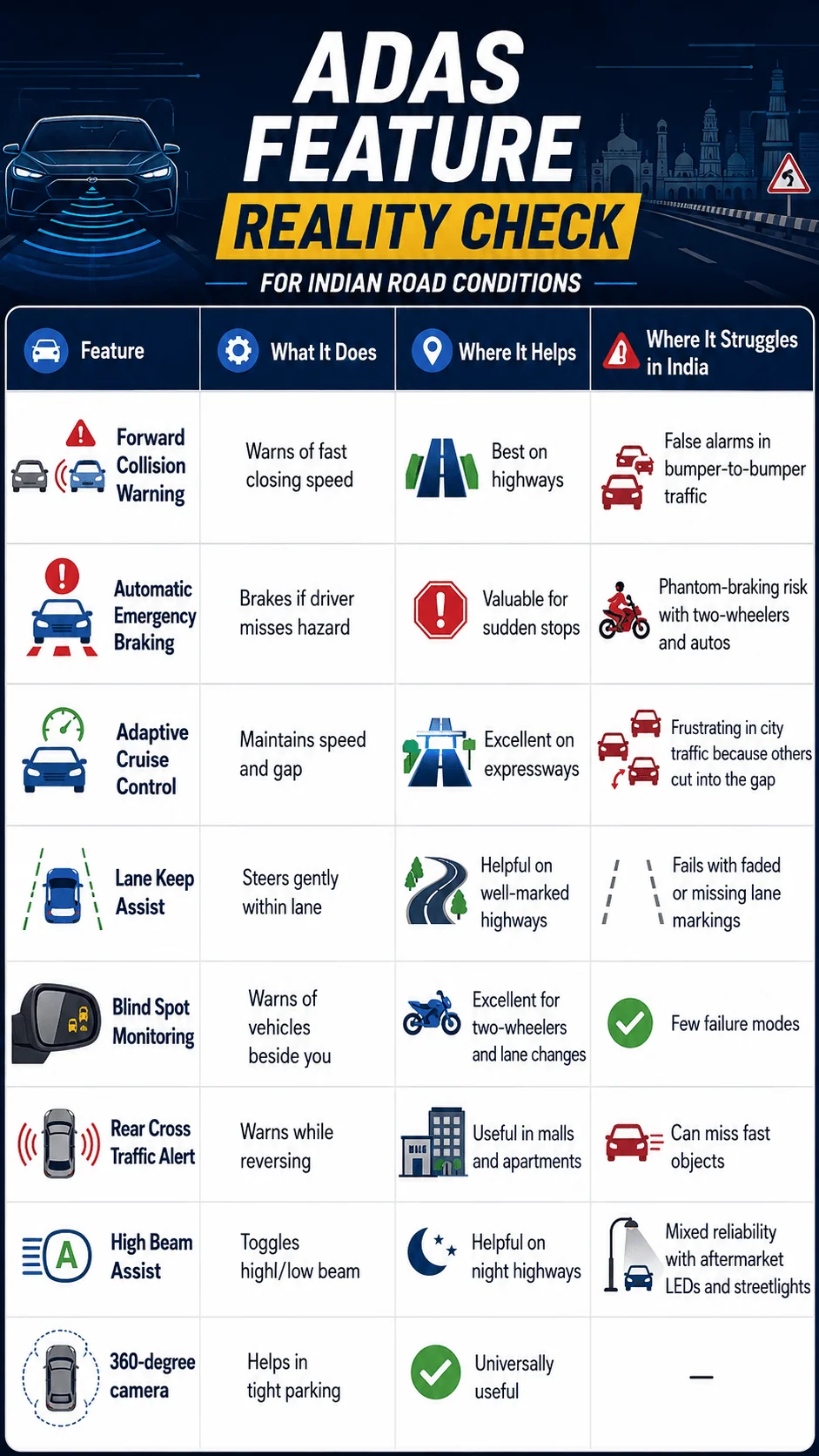
| Car | ADAS Level | Approx ADAS Variant Price | Best For |
|---|---|---|---|
| Honda Amaze ZX | Level 2 | ~₹9.23 lakh | Budget sedan, segment-first |
| Mahindra XUV 3XO | Level 2 (fusion) | From ~₹11.50 lakh | Compact SUV, well-calibrated |
| Hyundai Venue | Level 2 SmartSense | From ~₹10.32 lakh | Compact SUV buyers |
| Hyundai Verna | Level 2 SmartSense | From ~₹10.96 lakh | Sedan buyers |
| Kia Seltos | Level 2 | From ~₹10.90 lakh | Mid-size SUV, tech buyers |
| MG Astor | Level 2 | ₹13.37-15.50 lakh | Tech-rich premium feel |
| Tata Nexon | Level 1 | ~₹13.53 lakh | Best-seller, basic active safety |
| Honda Elevate ZX | Level 2 (Honda Sensing) | ₹14.91-16.67 lakh | Family SUV, camera-only |
| Kia Syros HTX(O) | Level 2 | ~₹15.80 lakh | Sub-compact SUV, latest launch |
| Honda City | Level 2 (Honda Sensing) | Under ₹16 lakh | Hybrid sedan |
| Tata Curvv EV | Level 2 | ~₹16.99 lakh | EV buyers wanting ADAS |
| Hyundai Creta King | Level 2 SmartSense | ~₹17-18 lakh | Family SUV (top variant only post-2026) |
| Tata Sierra | Level 2+ | ₹16.49-21.29 lakh | Well-built touring SUV |
| Mahindra XUV 7XO | Level 2 | From ₹20.44 lakh (AX5 Select) | Premium 7-seater (was XUV700 till Jan 2026) |
| Maruti Suzuki Victoris | Level 2 | ₹19.47-19.99 lakh | Hybrid + safety combo |
How Reliable Is ADAS on Indian Roads?
Here’s the part most car magazines won’t say plainly. ADAS in India is highly polarising. Independent owner surveys consistently show roughly 55% of Indian ADAS owners find their systems either useless or actively annoying in daily use. The other 44% find them genuinely useful and lifesaving. That gap doesn’t exist in the European or US markets. Why? Because ADAS was designed for highways with clean lane markings, predictable traffic and sparse pedestrian density. None of which describe an average Indian road.
Where ADAS Works Well in India
So where does ADAS genuinely earn its keep?
- Access-controlled expressways and well-marked national highways. Mumbai-Pune, Delhi-Mumbai, Eastern Peripheral, Bengaluru-Mysuru, Vande Bharat e-corridors. ACC genuinely reduces your fatigue for hundreds of kilometres at a stretch.
- Long-distance intercity touring. Lane Keep helps you in crosswinds, when overtaking large trucks, or during momentary distractions.
- Reversing and tight parking. BSM, RCTA, 360° camera are all universally effective across road types.
- Night highway driving. High Beam Assist and radar-based FCW help when your eyes and standard headlights run out of range.
Where ADAS Struggles in India
The list is longer than the carmakers admit.
Faded or missing lane markings. Camera-based LKA and LDW need clean, high-contrast lane lines. State highways and most rural roads? Markings are washed off, painted over, or dust-covered. Your lateral assistance simply fails to engage.
Two-wheelers and pedestrians. Bikes filter through impossibly tight gaps. Pedestrians cross multi-lane roads outside designated zones. AEB algorithms (even those trained on Indian data) can misread these as imminent crashes (causing phantom braking) or fail to react at all if the trajectory is too unpredictable.
Construction zones with overlapping markings. Old paint under new paint confuses lane-centering systems, which can yank your steering toward a stale lane line.
Stop-and-go city traffic. ACC maintains a safe gap. Auto-rickshaws and other cars immediately fill that gap. The system brakes to restore it. Repeat. Forever. Exhausting.
Heavy monsoon and dust storms. Pure camera-based systems (Honda Sensing on the Amaze, City and Elevate, plus MG Astor) often shut themselves off when rainfall exceeds about 20mm/hr. Water on the windshield destroys the optical contrast the camera needs to detect markings and obstacles. Radar-based systems hold up better.
Phantom Braking. The Big India Complaint
The single most reported issue from Indian ADAS owners? Phantom braking. Sudden, unprovoked emergency braking. Common triggers? A two-wheeler filtering through. A slow-moving auto-rickshaw. An awkwardly parked truck. Even a metallic road sign. The vehicle behind you doesn’t know your car is about to slam its brakes, which is exactly how some Indian owners have ended up rear-ended because of their ADAS. Both Hyundai Creta and Kia Seltos have well-documented phantom-braking complaints from owners in city traffic.
The recommendation from automotive safety experts is consistent. Don’t switch AEB off. Just adjust its sensitivity to “low” or “late” if your car offers that setting. The trade-off? Fewer false alarms for slightly later genuine interventions.
The Hidden Cost Most Buyers Miss. Calibration
Here’s something dealerships almost never mention. The forward-facing ADAS cameras sit flush behind the windshield. If your windshield ever cracks from a stray pebble on the highway (and it will, eventually), replacement isn’t just a new piece of glass. The entire ADAS sensor array has to be recalibrated to sub-millimetre precision. Either statically (in a climate-controlled service centre using laser targets) or dynamically (a technician driving the car at specific speeds with diagnostic equipment).
A standard windshield replacement on a non-ADAS car costs roughly ₹4,500 to ₹7,500 in India. On an ADAS car? Expect an additional ₹15,000 to ₹40,000 for the recalibration alone. The exact amount depends on whether your car uses just a camera or a full camera+radar fusion setup. Insurance usually covers this if you have full cover. Just factor it into your total cost of ownership before you sign.
| Indian Road Situation | ADAS Reliability | Practical Advice |
|---|---|---|
| Well-marked expressway | High | Use ACC + LKA, hands lightly on wheel |
| City bumper-to-bumper traffic | Low to medium | Don’t rely on it |
| Faded or missing lane markings | Low | Lane features will fail silently |
| Heavy rain or fog | Reduced | Drive manually. Don’t trust camera systems |
| Two-wheeler-heavy roads | Mixed | Keep full attention. BSM helps |
| Highway cruising | Good | ACC and lane assist genuinely useful |
| Reversing in parking | High | RCTA and 360° camera are gold |
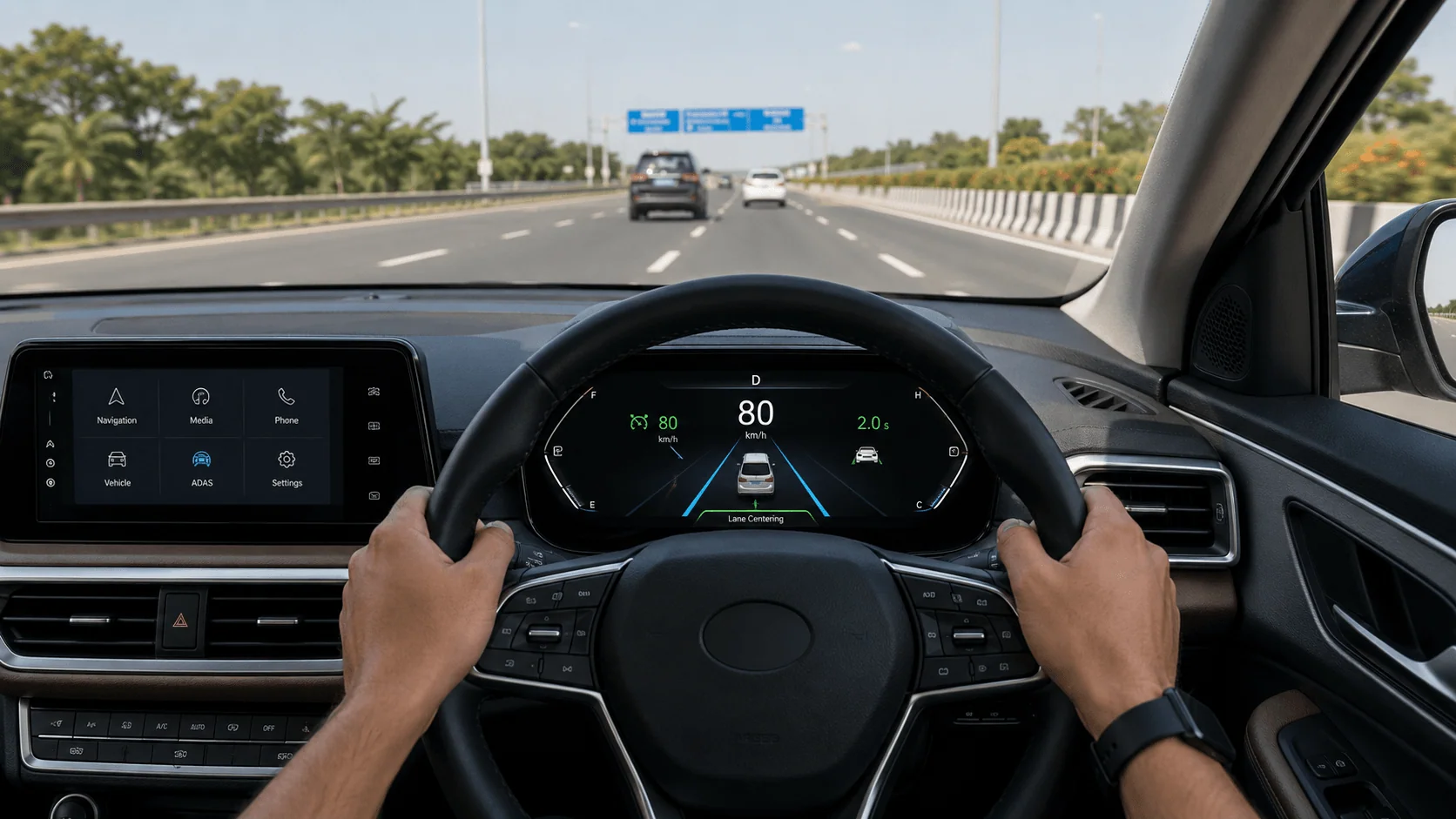
ADAS Level 1 vs Level 2
Dealerships will throw around “Level 2 ADAS” as if it means the car drives itself. It does not. There are six SAE-defined levels of driving automation, from Level 0 to Level 5. In the Indian mass market in 2026, you’re choosing between Level 1 and Level 2. No car under ₹20 lakh, and no car sold in India period, currently offers true Level 3 or above.
Level 1 ADAS
The car can assist with either longitudinal control (acceleration and braking) or lateral control (steering). Never both at the same time. A car with Adaptive Cruise Control alone, but no Lane Keep Assist, is Level 1. You handle steering while the car manages speed and gap. Tata Nexon’s new ADAS package (FCW + AEB only) is a Level 1 system.
Level 2 ADAS
The car can assist with both longitudinal and lateral control simultaneously. When you engage Level 2 on a highway, the car holds its lane centre, modulates throttle and brake to maintain your set following distance, and lets you take your hands lightly off the wheel for a few seconds at a time. This is the “partial automation” tier currently available on the Honda Amaze, XUV 3XO, Creta, Seltos, Verna, MG Astor, Tata Harrier and Safari and Sierra and Curvv EV, Honda City and Elevate, Kia Syros, and Maruti Victoris.
Level 2 is still legally a “hands-on, eyes-on” system. The ECU monitors steering wheel torque, and on premium variants your eye movement via a cabin camera, to confirm you’re paying attention. Disengage for too long and the system warns, then disengages itself.
| ADAS Level | What It Can Do | Driver Responsibility | Example |
|---|---|---|---|
| Level 1 | Assists with either steering OR speed | Driver controls most of the driving | Adaptive Cruise alone, or LKA alone |
| Level 2 | Assists with steering AND speed together | Driver must supervise continuously | Lane centering + adaptive cruise (Creta, XUV 3XO, Amaze) |
| Level 3 | Conditional automation, hands-off in limited domains | Driver takes over when prompted | Not legally permitted in India |
| Level 4 | Full automation in defined areas | Driver optional in those areas | Not on sale anywhere in India |
| Level 5 | Full automation everywhere, no driver needed | None | Doesn’t exist commercially |
So Which Level Should You Buy?
Honestly? Software tuning matters more than the level number. A well-calibrated Level 1 system that behaves predictably will inspire far more driver confidence than a poorly tuned Level 2 that fights your steering and false-alarms every five minutes. The Mahindra XUV 3XO’s Level 2 setup, for instance, is consistently praised for its calibration. Some Level 2 implementations from less-experienced players feel intrusive and end up getting switched off.
Bottom line. Don’t pay ₹1.5 lakh extra to upgrade from a strong Level 1 to a half-baked Level 2. Pay it for a well-reviewed Level 2 that owners aren’t constantly complaining about.
Should You Pay Extra for ADAS?
Most cars charge a ₹1 lakh to ₹2 lakh premium to step up from a non-ADAS trim to a fully ADAS-equipped one. Whether that’s a good buy comes down to how you actually drive.
Pay for ADAS if you:
- Do regular intercity highway runs or long-distance touring where fatigue management matters.
- Are buying a primary family car and want an active backup against the worst-case sudden hazard.
- Do a lot of night highway driving.
- Value spatial awareness. BSM and RCTA pay you back regardless of where you drive.
Skip the ADAS premium if you:
- Drive almost entirely in dense low-speed city traffic. The systems will overwhelm you and you’ll end up switching them off.
- Are based in or driving regularly through rural areas with poor road infrastructure.
- Would be forced to compromise on a structurally safer base model or essential safety hardware to afford the upgrade.
- Get easily annoyed by frequent warning chimes and steering vibrations.
One non-negotiable rule. Never buy ADAS at the expense of foundational safety. Your car needs to first have a 5-star Global NCAP or Bharat NCAP rating, six airbags, ABS with EBD, ESC and decent tyres. ADAS is a useful technological capstone on top of solid passive safety. Not a substitute for it. If structural safety is what you’re prioritising, start with our list of the safest cars in India 2026 sorted by NCAP scores and price.
Also worth knowing: most Indian insurers now offer 10-15% discount on the full insurance premium for ADAS-equipped cars. Slightly offsets both the upfront price premium and the recalibration cost down the line.
FAQs
What does ADAS do in a car?
ADAS uses cameras, radar and sensors to constantly monitor what’s happening around your car. It warns you about hazards like a vehicle in your blind spot or an imminent forward collision. On more advanced systems, it can actively brake, slow down, or nudge the steering to keep you in your lane or avoid an accident.
What is the full form of ADAS?
ADAS stands for Advanced Driver Assistance System.
Is ADAS useful on Indian roads?
Depends entirely on where you drive. On access-controlled expressways and well-marked national highways, ADAS (particularly Adaptive Cruise Control, Forward Collision Warning, AEB, and Blind Spot Monitoring) is genuinely useful. It can reduce fatigue and prevent accidents. In dense city traffic with poor lane markings, unpredictable two-wheeler movement and tight following distances, features like Lane Keep Assist and ACC tend to false-alarm. Many owners end up switching them off.
Which cars have ADAS under ₹20 lakh in India?
In 2026, you can buy Honda Amaze, Mahindra XUV 3XO, Hyundai Venue, Hyundai Verna, Kia Seltos, Kia Syros, MG Astor, Honda Elevate, Honda City, Tata Nexon, Tata Curvv EV, Tata Harrier/Safari (top trim), Maruti Suzuki Victoris, and Hyundai Creta (only the King variant after the 2026 facelift). All with ADAS, all under ₹20 lakh ex-showroom.
Is ADAS the same as self-driving?
No. ADAS is strictly driver-assist technology. The human driver remains fully responsible for monitoring the road and controlling the vehicle at all times. Even the most advanced Level 2 ADAS cars sold in India in 2026 are “hands-on, eyes-on” systems. They assist. They don’t drive.
What is Level 2 ADAS?
Level 2 ADAS combines longitudinal control (acceleration and braking) with lateral control (steering). The car can hold its lane centre and maintain a set distance from the vehicle ahead at the same time. You still have to supervise continuously and be ready to take over.
Does ADAS work in heavy rain or fog?
Radar-based ADAS holds up reasonably well in fog and rain because radio waves pass through water droplets. Pure camera-based systems (like Honda Sensing on the Amaze, City, and Elevate) often shut themselves off when rain exceeds about 20mm per hour. Optical visibility drops too low for the camera to read lane markings and vehicles reliably.
Can ADAS cause sudden braking?
Yes. “Phantom braking” is the most-reported ADAS complaint in India. A two-wheeler filtering through a tight gap, an awkwardly parked truck, or even a metallic road sign can trigger the AEB system to apply full braking force unexpectedly. It’s more frequent on poorly-tuned systems, rare on well-calibrated ones like the XUV 3XO.
Should I turn off ADAS in city traffic?
Many drivers manually disable Lane Keep Assist and Adaptive Cruise Control in dense traffic to avoid false alerts. But automotive safety experts strongly recommend keeping Automatic Emergency Braking active even in cities. It’s the single most life-saving feature in the suite. Just lower the sensitivity if your car allows it.
Which ADAS feature is most useful in India?
Blind Spot Monitoring and Rear Cross Traffic Alert are universally praised in India because they work independently of lane markings and directly help with two-wheelers filtering through traffic. Forward Collision Warning and AEB on highways are also genuinely lifesaving.
Is ADAS better than a 5-star safety rating?
No. A 5-star structural crash safety rating with six airbags is the non-negotiable foundation. ADAS is an active preventative layer on top. Useful, but never a substitute for crashworthy passive safety. Always prioritise structural safety, then add ADAS if your budget and driving style justify it.