You’ve waited weeks, maybe months, for your new car. The dealer calls, says it’s ready. You’re excited. And that’s exactly when mistakes happen.
Scratched panels. A chassis number that doesn’t match your insurance policy. A 2025-manufactured car sold as 2026 stock. These aren’t rare stories. They happen at Indian dealerships constantly. The fix? A proper pre-delivery inspection. Takes about 45 minutes. Could save you lakhs.
Print this checklist. Take it to the showroom. Go through every single point before you sign that delivery challan. And if you haven’t already, run through our pre-purchase inspection checklist too.
Before You Reach the Dealership
Preparation is what separates a smooth delivery from an expensive regret. Do this homework the day before.
Schedule delivery for a weekday morning. Why morning? Natural daylight. You can’t spot paint mismatches or fine scratches under showroom tube lights. Evening deliveries are worse because staff rush to close shop, and you’ll feel pressured to wrap up quickly.
Bring a friend. Someone calm, ideally with some car knowledge. You’ll be too excited to notice small things. A second pair of eyes catches what yours won’t.
Charge your phone. You’ll photograph every panel, record the VIN, snap the odometer. If something goes wrong weeks later, these photos are your proof.
What to carry:
- ☐ Printed copy of this checklist
- ☐ Booking receipt and payment confirmations
- ☐ Phone flashlight (for checking under the bonnet)
- ☐ A coin or credit card to test panel gap consistency
- ☐ Pen for notes
Audit the invoice before you visit. Ask for the proforma invoice a day or two early. Go through every line. Dealers often slip in “handling charges” or “logistics fees” between ₹7,000 and ₹15,000. Cross-check the total against the on-road price for your car and city to spot inflated line items. Here’s the thing: these are illegal. The Supreme Court has ruled that the ex-showroom price covers all costs to get the vehicle to the showroom floor. If you spot them, demand removal. Dealer won’t budge? Escalate to the OEM’s regional office.

Exterior Inspection Checklist
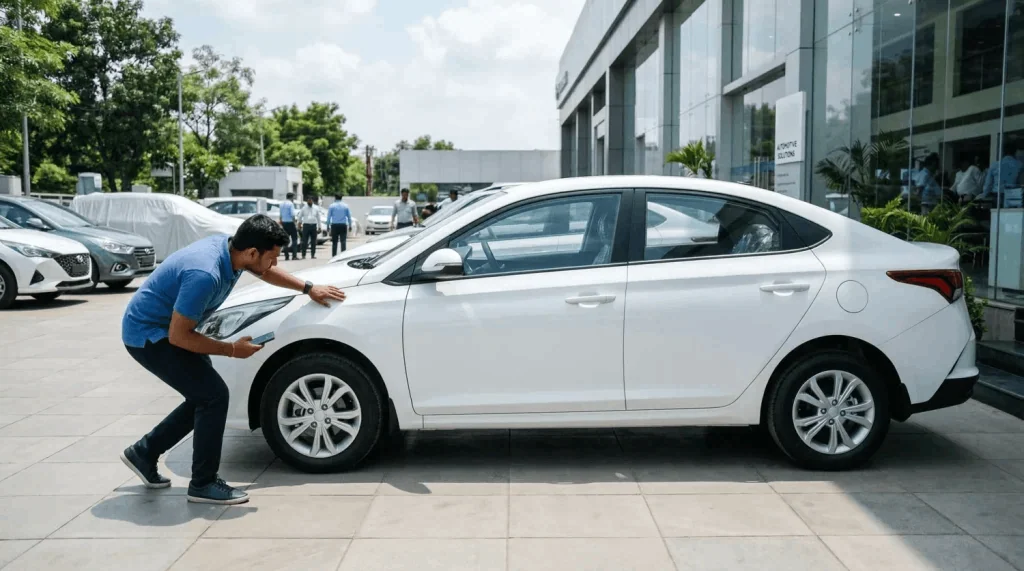
Move the car to an open area with natural sunlight. Don’t inspect it inside the showroom or under covered parking. Ever.
Paint and body:
- ☐ Walk around the car slowly, twice, from multiple angles
- ☐ Look for scratches, dents, dimples, or ripples on every panel
- ☐ Check for paint colour differences between panels. Different shades signal a respray
- ☐ Crouch and inspect from oblique angles. You’re looking for “orange peel” texture, swirl marks, or uneven clear coat
- ☐ Test panel gaps with a coin or card along the doors, bonnet, boot lid. Uneven gaps mean transport damage or hasty repair work
Glass and lights:
- ☐ Check every window for micro-cracks or stone chips
- ☐ Verify the manufacturer’s mark on each window pane. Batch number and year should match across all windows
- ☐ Inspect headlamp and tail lamp housings for moisture or condensation inside. Water droplets inside a sealed unit? That’s a broken weather seal. Don’t accept this
- ☐ Test all lights: low beam, high beam, indicators, brake lights, reverse light, fog lamps, hazard
Tyres and wheels:
- ☐ Confirm all four tyres are the same brand and size per the spec sheet
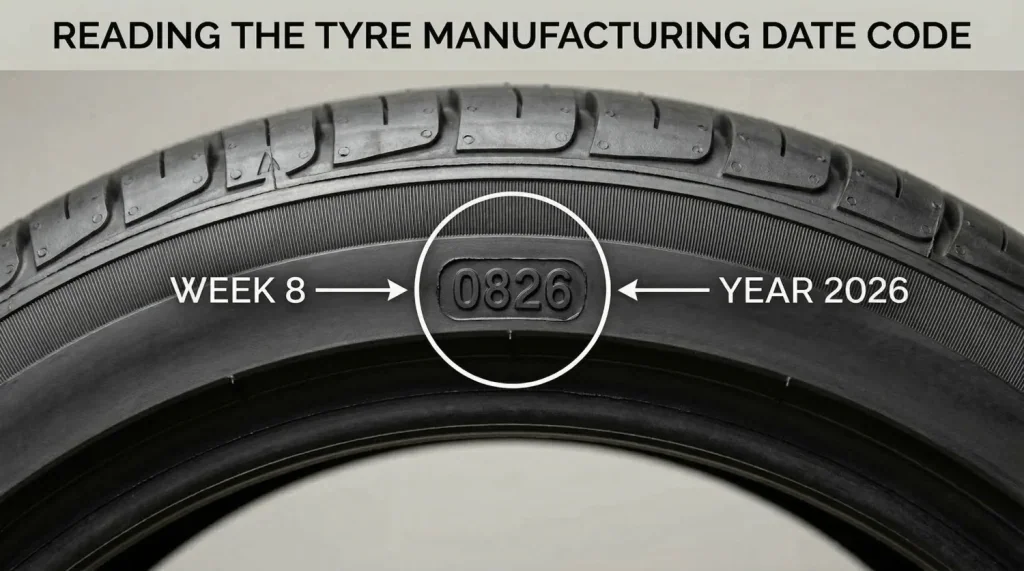
- ☐ Read the tyre manufacturing date. Find the 4-digit code in a small oval on the sidewall. Example: “0826” means week 8 of 2026. Anything older than 6 months? Ask why
- ☐ Check tyre pressure. Dealers overinflate to 45-50 PSI for storage. Your car probably needs 32-35 PSI
- ☐ Spare tyre: present, inflated, fresh
- ☐ Toolkit: jack, wheel spanner, tow hook, puncture repair kit if applicable
VIN and manufacturing date:
- ☐ Find the VIN plate. It’s in the engine bay, windshield cutout on the driver’s side, or B-pillar sticker
- ☐ Look at the 10th character. For 2026, it should be “T.” If it’s “S,” that’s a 2025-manufactured car
- ☐ Cross-check against Form 22 from the manufacturer. Ask for this before registration
- ☐ Manufacturing date more than 3 months old? Question the dealer. They sometimes push older inventory as current-year stock
Interior and Electronics Check
- ☐ Odometer should read under 50 km. Above 100-150 km? That car was likely used as a test drive unit or driven between stockyards
- ☐ Inspect seats, dashboard, door pads for scratches, stains, tears
- ☐ Pull up the floor mats. Any moisture or mold underneath?
- ☐ Open and close every door, the bonnet, the boot. They should work smoothly
- ☐ Seatbelts all locking properly?
- ☐ Pop the bonnet. Check for fluid leaks, dirt, rat droppings, cracked or dried rubber hoses. Rubber that’s hardened or cracked means the car’s been sitting in a stockyard for months
Electronics and infotainment:
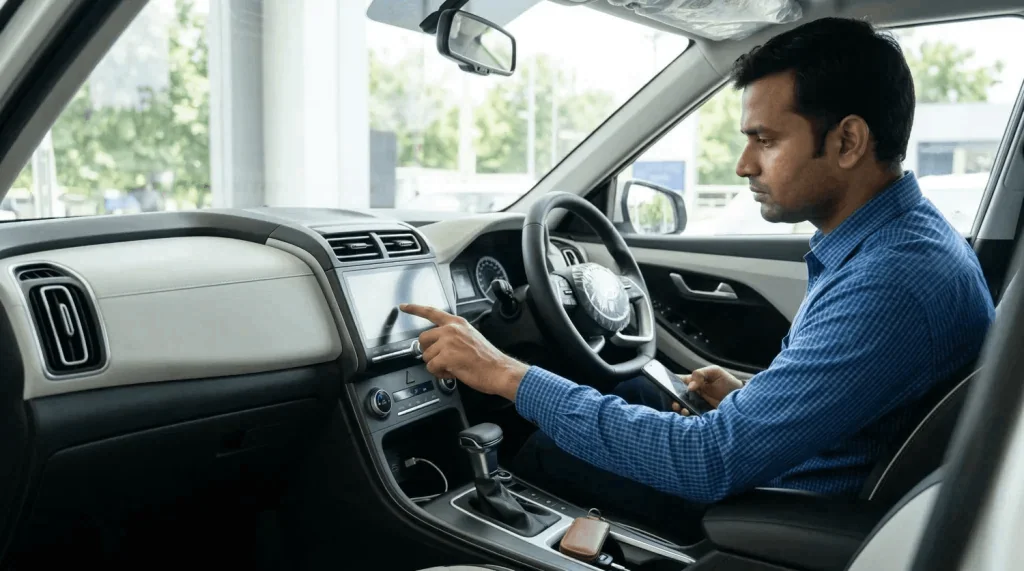
- ☐ AC: set to auto, wait a few minutes. It should cool quickly with no musty smell
- ☐ Operate all power windows at the same time. Motors shouldn’t struggle
- ☐ Infotainment: touchscreen response, Bluetooth pairing, audio through all speakers using fader controls, Apple CarPlay or Android Auto
- ☐ Reverse camera: engage reverse gear, check it activates instantly
- ☐ Horn, wipers, washer spray, sunroof (if fitted), interior lights
- ☐ Plug a cable into every USB port. Charging? Data transfer?
- ☐ Both keys working? Remote lock/unlock, boot release, ignition
Got ADAS features?
- ☐ Open the ADAS settings in the infotainment or instrument cluster
- ☐ Automatic Emergency Braking and Lane Departure Warning should be set to “Active,” not “Warning Only” or “Off”
- ☐ Get the dealer to walk you through how each feature behaves
Documents to Collect at Delivery
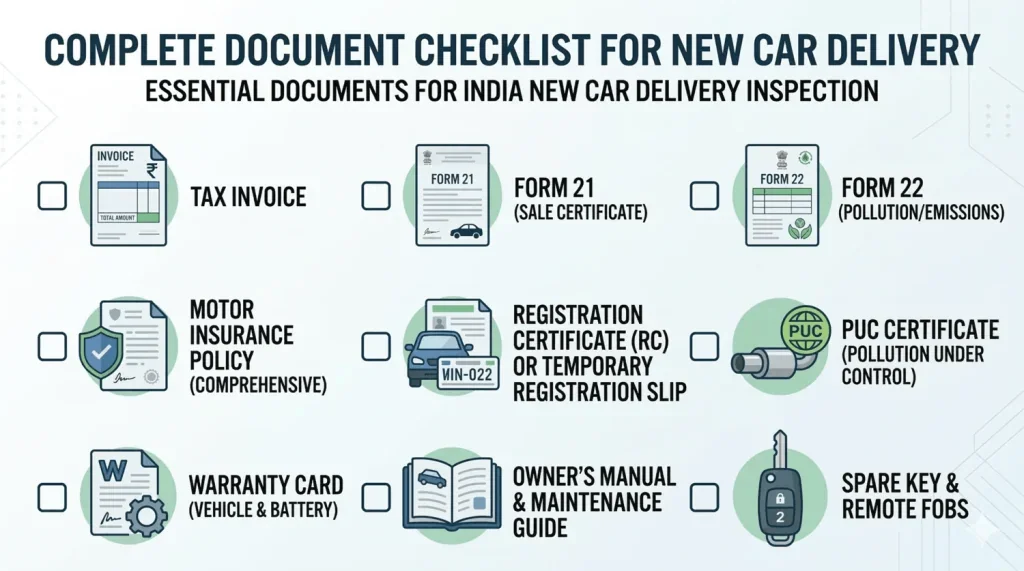
Don’t skip this. Missing documents or wrong numbers on your insurance can cost you seriously later.
Must-collect:
- ☐ Tax invoice with correct VIN, engine number, chassis number, your personal details
- ☐ Form 22 (manufacturer’s certificate) with manufacturing date and vehicle origin
- ☐ Form 21 (sale certificate) as proof of ownership transfer
- ☐ RC (Registration Certificate) or temporary registration slip
- ☐ Insurance policy (verified, see below)
- ☐ Warranty card showing start date, duration, kilometre limit
- ☐ Owner’s manual and service booklet with first-service date/km noted
- ☐ Spare key
- ☐ PUC certificate
- ☐ Roadside assistance details if included
- ☐ Accessory warranty cards for any dealer-installed items, battery, tyres
Insurance: the checks that actually matter:
- ☐ IDV (Insured Declared Value): Should be roughly 95% of ex-showroom price on a new car. Lower IDV means cheaper premium but you’re underinsured
- ☐ Engine and chassis numbers on the policy must match the vehicle exactly. One wrong digit can void your entire claim
- ☐ Deductible: ₹1,000 for engines up to 1500cc. Higher than that? The insurer padded it without telling you
- ☐ Add-ons: Verify Zero Depreciation and Engine Protect are there if you paid for them. Engine Protect matters especially in flood-prone cities like Mumbai or Chennai
- ☐ Remember: you can buy insurance from any provider. Dealer-bundled policies typically run 20-40% more expensive
First Drive Home Tips
Everything checks out on paper. Now drive it.
Insist on a 10-15 minute test drive before you officially accept delivery. This is your last shot at catching something mechanical.
- ☐ Accelerate and brake normally. No jerks, no vibrations, no strange sounds
- ☐ On a flat road, briefly let go of the steering. Car should track straight, not pull left or right
- ☐ Shift through all gears including reverse. Smooth engagement, no grinding
- ☐ Try the handbrake on a slight incline
- ☐ Listen for rattles, squeaks, tapping from the suspension or cabin trim
- ☐ Manual transmission? Check that the clutch engages smoothly without excessive play
Before signing the delivery challan:
- ☐ Photograph every panel, the odometer, VIN plate, all four tyres
- ☐ Snap photos of every document you received
- ☐ Confirm FASTag is linked to your bank account
- ☐ Ask about connected car subscription: how long is the free period, what does renewal cost?
What if you find something wrong?
You can refuse delivery. That’s your right. Don’t let the dealer convince you they’ll “sort it out at the first free service.” The moment you sign the delivery challan, ownership transfers. Your bargaining power is gone.
If the car isn’t RTO-registered yet, tell the dealer in writing to stop the registration process. Escalate to the OEM’s customer care. Still no resolution? File a complaint with the District Consumer Disputes Redressal Commission.
Quick-Reference: Printable Delivery Day Checklist
Print this page. Take it to the dealership.
- Invoice audited, no unauthorized handling or logistics charges
- Delivery on a weekday morning, natural daylight only
- Phone charged, checklist printed, a friend to help
- Paint: no scratches, dents, respray signs, colour mismatch
- Panel gaps uniform across doors, bonnet, boot
- Glass intact, no lamp condensation
- All exterior lights tested
- Tyres: correct brand, date code under 6 months, pressure at spec
- Spare tyre, jack, spanner, toolkit present
- VIN 10th character = “T” for 2026, Form 22 cross-checked
- Odometer under 50 km
- Seats, dashboard, carpet undamaged
- No moisture under floor mats, no rubber degradation under bonnet
- AC, infotainment, Bluetooth, camera, USB ports all functional
- Both keys tested: lock/unlock, boot, ignition
- ADAS features set to “Active” if your car has them
- All documents collected: invoice, Form 21, Form 22, RC, PUC, warranty
- Insurance: IDV at 95%, engine and chassis numbers match perfectly
- Test drive done: smooth acceleration, braking, straight tracking, no rattles
- FASTag linked to your bank account
- Connected car subscription terms confirmed
- Photos of every panel, odometer, VIN, all documents
- Delivery challan signed only after you’re fully satisfied
45 minutes. That’s all it takes to protect a multi-lakh purchase.
Still researching which car to buy? Start with our pre-purchase checklist. Already driving off? Make sure you insure your new car correctly from day one.
Planning to buy a new car? Make sure you’ve covered everything on our pre-purchase checklist before heading to the dealership for delivery.