Bought a new car? The registration process in 2026 is mostly digital now. Dealers handle most of it, and you probably won’t need to step inside an RTO office at all.
Here’s how it works, start to finish:
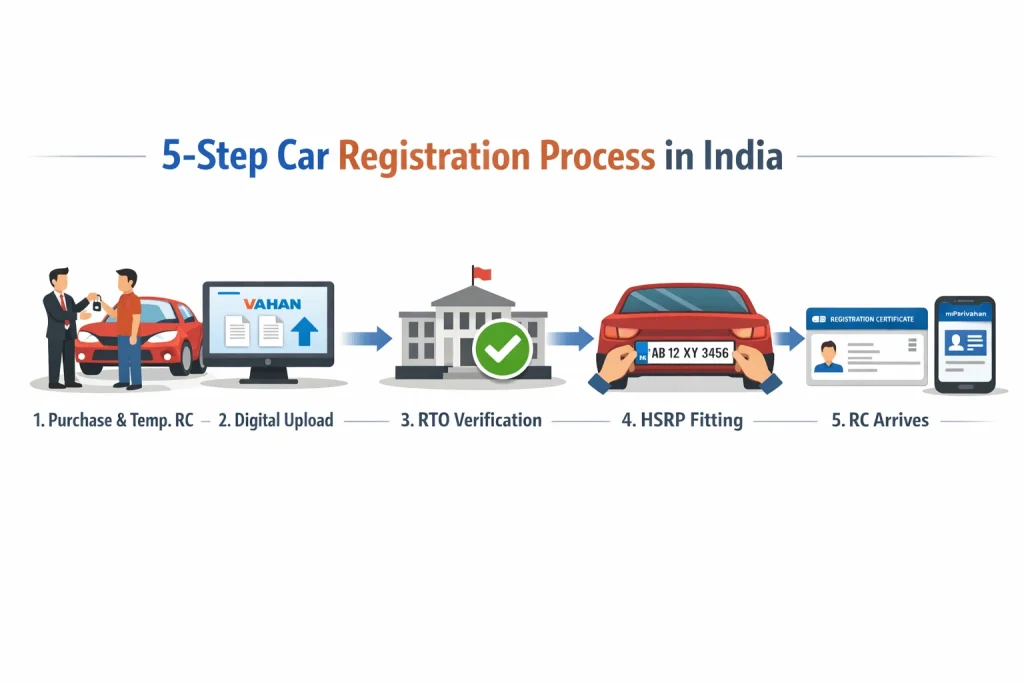
- Buy the car and get temporary registration from the dealer (valid 30 days)
- Dealer uploads Form 20 and all documents digitally to the Vahan portal
- RTO verifies documents and assigns a permanent registration number within 2 working days
- HSRP plates get fitted at the dealership itself
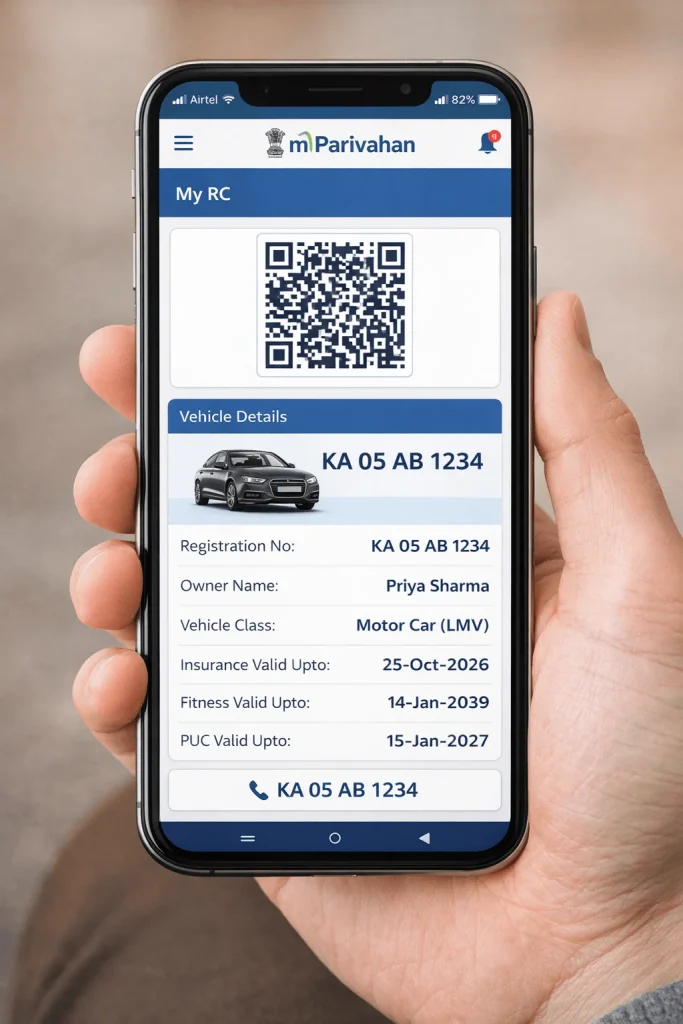
- Your RC Smart Card arrives by post in 45-60 days, but the Virtual RC on the mParivahan app is legally valid from day one
That’s the quick version. Below is everything you actually need to know, whether the dealer is doing the legwork or you’re handling it yourself.
Documents Required for Car Registration
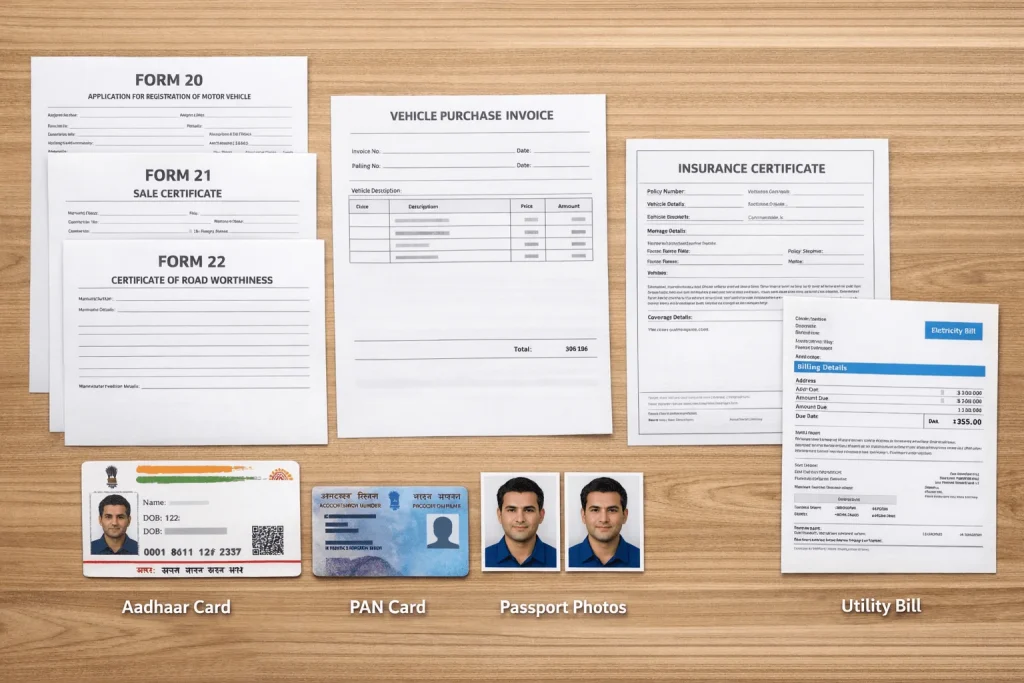
You’ll need two sets of documents. Most come from the dealer. You only need to arrange a few from your end.
What the Dealer Provides
| Document | What It Is |
|---|---|
| Form 21 (Sale Certificate) | Issued by the dealer or manufacturer. Contains vehicle model, manufacturing date, invoice amount |
| Form 22 (Road Worthiness Certificate) | Issued by the manufacturer. Confirms the vehicle meets safety and emission standards |
| Invoice | Purchase invoice with ex-showroom price, GST breakup, chassis number, engine number |
| Temporary Registration | The TR number assigned at delivery. Valid for 30 days |
| Insurance Certificate | Must be valid for at least one year. Engine and chassis numbers should match the invoice |
What You Need to Arrange
| Document | Notes |
|---|---|
| Form 20 (Registration Application) | The main application form. Dealer fills it, you sign. Uploaded digitally to Vahan in 2026 |
| Aadhaar Card | Primary ID and address proof in most states |
| PAN Card | Mandatory for transactions above ₹50,000 |
| Passport-size photos | 2-4 copies depending on the state |
| Address proof | Aadhaar usually works. If registering at a different address, carry a utility bill or bank statement |
Living on rent? Be careful here. Most RTOs don’t accept rent agreements alone as address proof. You’ll typically need a utility bill in your name, a landlord NOC, or police verification. Some states require two different address proofs. Check with your local RTO before delivery day so you’re not scrambling at the last minute.
Buying in one state, registering in another? The invoice must show IGST (inter-state GST), not CGST + SGST. Ask the dealer to bill it as an inter-state sale. Without this, your home state RTO will reject the application.
Step-by-Step RTO Registration Process
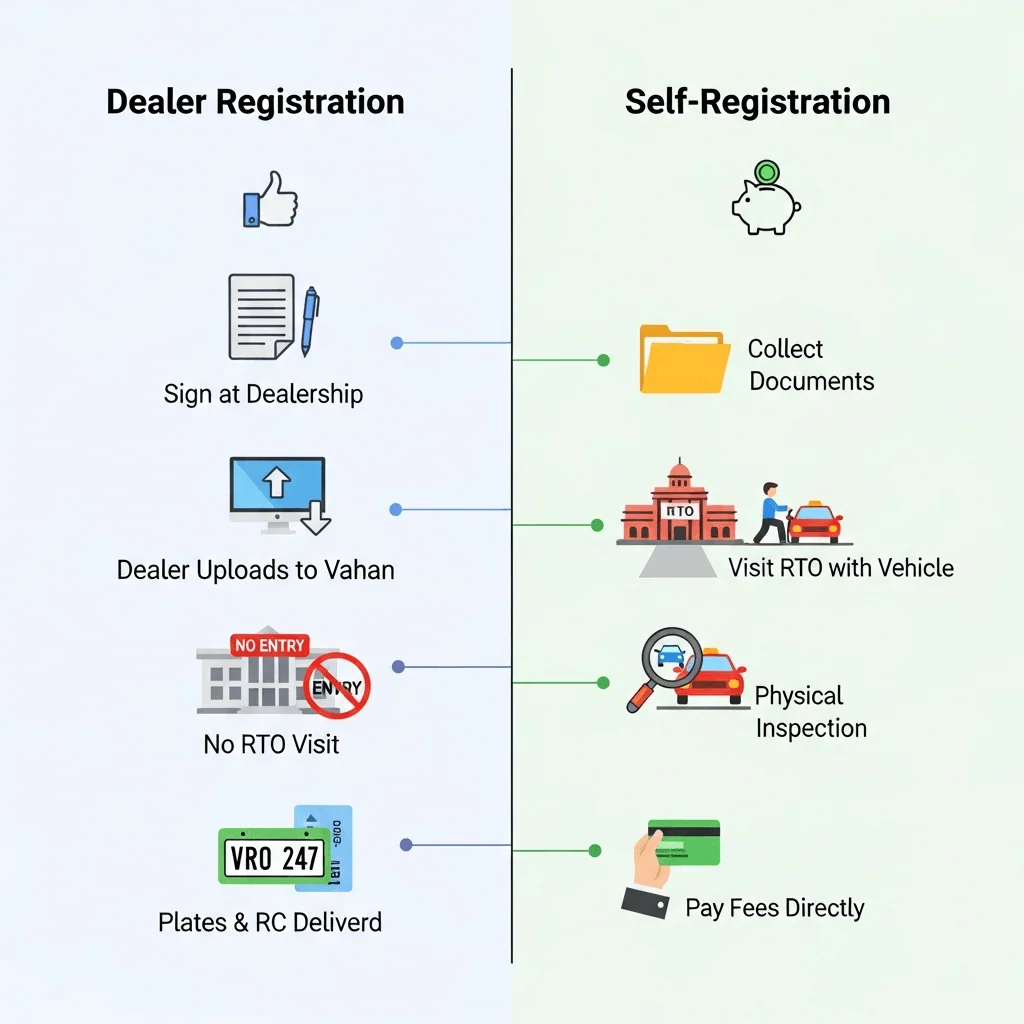
Two paths here. Dealer handles everything, or you do it yourself at the RTO. Which one makes sense for you?
Path 1: Dealer-Handled Registration (How Most Cars Get Registered)
The Dealer Point Registration system has replaced physical RTO visits for brand-new, non-transport vehicles across most states. Roughly 90% of new car registrations go through this route.
Step 1: Sign the documents at the dealership. The dealer prepares Form 20. You sign it and hand over your Aadhaar, PAN, photos, address proof.
Step 2: Dealer uploads everything to the Vahan portal. Since March 2026, physical submission of Form 20 isn’t accepted in most states. Dealers upload scanned, digitally verified copies of all documents directly to Vahan. Form 20, Form 21, Form 22, insurance details, your identity documents. All digital.
Step 3: Pre-registration safety check. Before uploading, the dealer completes a Pre-Delivery Inspection confirming mandatory safety features. All new passenger cars in 2026 must have six airbags and ABS. The dealer verifies this through the vehicle manual and physical inspection.
Step 4: RTO verification. RTO officials scrutinize the uploaded documents digitally. The current service-level agreement gives them 2 working days to assign a permanent registration number after receiving the complete submission.
Step 5: HSRP fitting. High Security Registration Plates are fitted at the dealership or an authorized HSRP centre. No RTO visit needed for this.
Step 6: Temporary registration. You get the TR number on delivery day itself, even before permanent registration comes through. Valid for 30 days. Lets you drive legally while the permanent RC is processed.
Step 7: Permanent RC arrives. The RC Smart Card gets printed and dispatched via India Post Speed Post. You can track dispatch status on the Vahan portal. Realistically? Expect 45-60 days for the physical card because of printing backlogs. But your Virtual RC on mParivahan is active and legally valid immediately.
So what does the dealer charge for this? The actual RTO fees are fixed (breakup below). On top of those, dealers charge a service or handling fee. Usually ₹2,000-₹5,000 above the government fees. Is that reasonable? Debatable. More on that later.
Path 2: Self-Registration at the RTO
Want to save on the dealer’s handling fee? Or buying in one city and registering in another? Self-registration still works.
Step 1: Collect all documents from the dealer before taking delivery. Form 21, Form 22, invoice, insurance copy, temporary registration slip. Don’t drive off without these.
Step 2: Visit your jurisdictional RTO with the vehicle. Drive the car to the RTO that covers your residential address.
Step 3: Fill and submit Form 20 with all supporting documents at the registration counter.
Step 4: Pay the registration fee and road tax at the cash counter.
Step 5: Vehicle inspection. An Inspector of Motor Vehicles physically examines the car. They verify the chassis number and engine number against your documents. Everything has to match.
Step 6: Registration number assigned. After verification, the RTO assigns your permanent number. The RC Smart Card follows by post.
Tip for self-registration: Go early on a weekday. RTOs get extremely crowded toward month-end. Carry originals plus two sets of photocopies. Some RTOs still ask for physical copies despite the digital push.
Dealer vs Self-Registration: Quick Comparison
| Factor | Dealer-Handled | Self-Registration |
|---|---|---|
| Convenience | High. Sign and wait | Low. Multiple RTO visits possible |
| Cost | RTO fees + dealer service charge (₹2,000-₹5,000 extra) | Only actual RTO fees |
| Time | 2-7 working days | Can take longer depending on RTO queue |
| RTO visit needed? | No | Yes, mandatory |
| Best for | Same-city registration | Inter-state purchases, saving money |
Registration Fees and Road Tax Overview
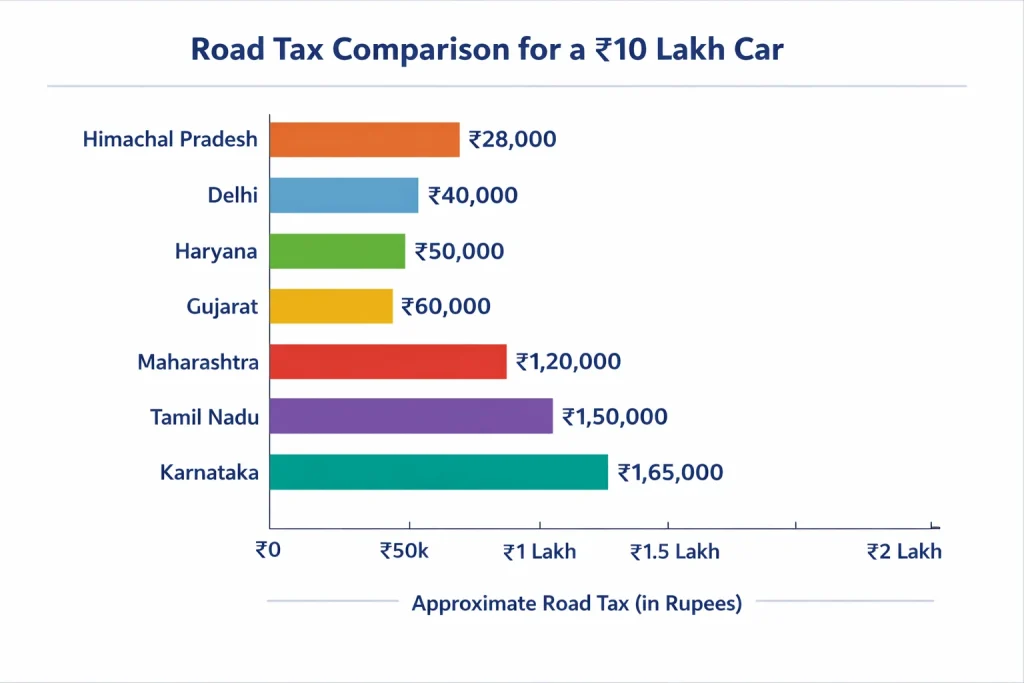
Two components. Fixed RTO fees (same everywhere) and road tax (varies wildly by state). Guess which one stings more?
Fixed RTO Charges
| Fee Component | Amount |
|---|---|
| Registration fee | ₹600 |
| HSRP (number plate) | ₹230-₹400 |
| Hypothecation charge (if financed) | ₹1,500 |
| FASTag | ₹500-₹600 |
| RC Smart Card | ₹200 |
| Temporary registration | ₹150-₹200 |
Paying cash? Fixed fees add up to roughly ₹1,700-₹2,000. Taken a loan? Add the hypothecation charge, bringing it to roughly ₹3,200-₹3,500 total. Not bad.
Road Tax: The Part That Actually Hurts
Road tax is a percentage of the ex-showroom price. On a ₹10 lakh car, you could pay ₹40,000 in Delhi or ₹1,80,000 in Karnataka. Same car, wildly different costs depending on where you register.
| State | Approx. Road Tax (₹10L car) | Notes |
|---|---|---|
| Delhi | 4% (₹40,000) | Additional MCD parking fee of ₹4,000 |
| Haryana | 5% (₹50,000) | Flat rate |
| Gujarat | 6% (₹60,000) | Calculated on pre-GST price |
| Assam | 5-6% (₹50,000-₹60,000) | Progressive slab: 5% up to ₹4L, goes up from there |
| Maharashtra | 11% petrol / 13% diesel | Among the highest in the country |
| Karnataka | 13-18% | Price-tiered. Crosses 15% above ₹20L |
| Tamil Nadu | 15% (₹1,50,000) | 100% EV exemption till Dec 2027 |
| Himachal Pradesh | 2.5-3% (₹25,000-₹30,000) | Engine capacity-based. Among the lowest |
For a complete state-wise breakup with exact slab rates, check our guide on road tax rates in your state.
Buying an EV? As of March 2026, 14 states and UTs still offer 100% road tax exemption. Delhi’s runs till March 2030 (capped at ₹30L ex-factory price). Maharashtra offers 100% exemption till 2030 plus toll waivers on major expressways. But Karnataka has started charging 10% lifetime tax on EVs above ₹25 lakh. UP is reviewing its 100% waiver too, so EV policies are shifting fast. Check your state’s current position before assuming zero road tax.
Got a Certificate of Deposit from Scrapping an Old Car?
If you’ve scrapped a vehicle under the government’s Vehicle Fleet Modernization Program and hold a valid Certificate of Deposit (CoD), you’re looking at significant savings on registration:
- 100% waiver on the registration fee under Rule 81 of CMVR, 1989
- State road tax concessions. Maharashtra, for example, offers 16-30% road tax reduction depending on the emission standard of the scrapped vehicle. Delhi offers up to ₹1 lakh cash incentive for scrapping BS-IV vehicles
- OEM discounts. Some manufacturers offer 4-6% off the ex-showroom price when you present a CoD
The CoD is valid for 3 years from the date of issue. Don’t own an old car to scrap? Doesn’t matter. You can buy a CoD on the open market through platforms like DigiELV. Fully legal, fully tradable.
Temporary vs Permanent Registration
First-time buyer? This section matters. The difference between these two is simpler than it sounds.
Temporary Registration (TR)
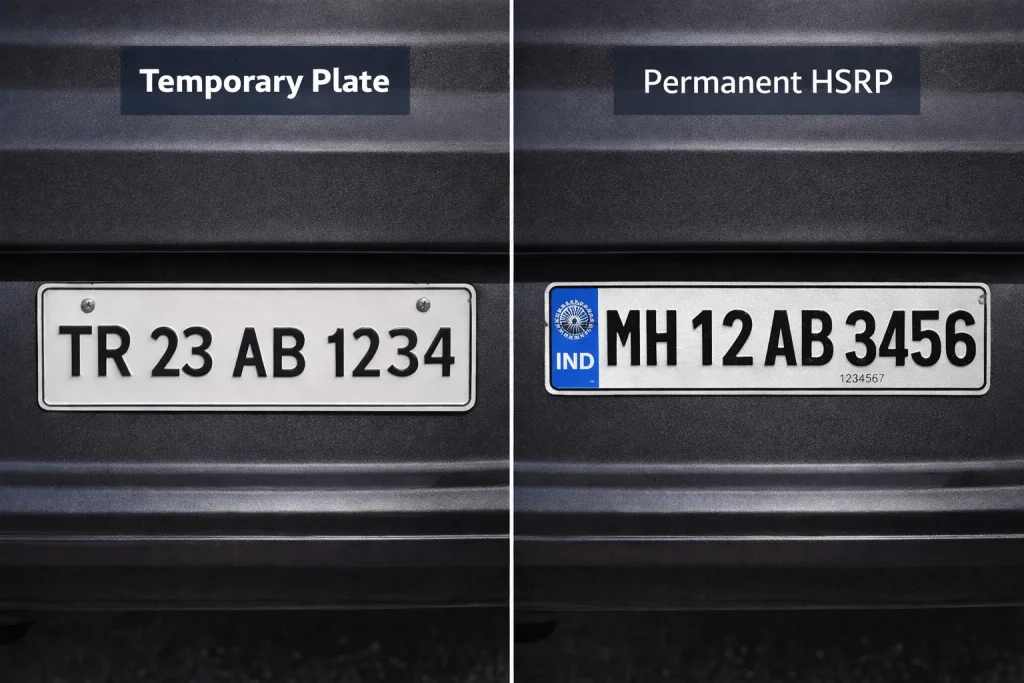
Issued by the dealer on delivery day. Printed on a white plate with the TR number. Valid for exactly 30 days. This lets you drive legally while the permanent number is processed. With the Dealer Point Registration system, your permanent number usually comes through well within this 30-day window.
Permanent Registration
Assigned by the RTO after document verification. Valid for 15 years from the date of issue. Comes with HSRP plates. Your RC Smart Card is the physical proof, but the digital RC on mParivahan carries the same legal weight.
What If Your TR Expires Before Permanent Registration?
This is where penalties get steep. Driving with an expired TR is a violation under Section 39 of the Motor Vehicles Act, 1988.
| Violation | First Offense | Repeat Offense |
|---|---|---|
| Driving without registration | ₹2,000-₹5,000 fine, up to 3 months imprisonment | ₹10,000 fine, up to 1 year imprisonment |
| Driving with expired TR or RC | ₹5,000-₹10,000 fine | Variable, at magistrate’s discretion |
| Driving without HSRP | ₹1,000-₹10,000 fine, vehicle seizure possible | Higher penalties apply |
If the dealer is dragging their feet past 30 days, escalate. Contact the dealership manager first. If that doesn’t work, file a complaint with the RTO or the consumer forum. The delay is the dealer’s fault, but the challan lands on you.
How Long Does Registration Take?
How long from purchase to permanent number? Depends on the route you take.
Dealer-Handled Timeline (2026)
| Stage | Expected Time |
|---|---|
| Temporary registration | Same day as delivery |
| Dealer uploads documents to Vahan | 1-3 days after delivery |
| RTO assigns permanent number | 2 working days after upload (SLA) |
| HSRP plates fitted | 3-7 days after number assignment |
| RC Smart Card dispatched | 45-60 days (printing and postal delays) |
| Virtual RC active on mParivahan | Immediately after permanent number assignment |
Total: 3-10 working days from purchase to permanent number in most cases.
Why does the physical RC take so long? Semiconductor supply chain issues affect the chip-embedded polycarbonate Smart Cards. Printing backlogs are common across state RTOs. But does it matter practically? Not really. Your Virtual RC on mParivahan is legally valid.
Self-Registration Timeline
Add 1-3 extra working days for the RTO visit and vehicle inspection. Registering in Mumbai or Bengaluru? Expect longer queues. Delhi’s better, but still plan for a full morning.
Tracking Your RC Status
Go to vahan.parivahan.gov.in, enter your registration number, and check the status. Once it updates to “Dispatched by RTO/Printing Agency,” you’ll also get an India Post Speed Post tracking number.
The Virtual RC: Why You Don’t Need to Stress About Smart Card Delays
The mParivahan app connects directly to the central Vahan database. Download it, enter your registration number and last 5 digits of your chassis number, verify via mobile OTP. Your Virtual RC shows real-time ownership details, vehicle class, insurance validity, fitness expiration, PUC status.
Under the Information Technology Act, 2000 and amendments to the Motor Vehicles Act, 1988, this Virtual RC is an officially recognized legal document. Traffic police verify it by scanning the encrypted QR code against central government servers. So even if your physical card takes two months? You’re fully covered.
2026 Rules That Affect New Car Buyers
A few new rules kicked in this year. Some of them could catch you off guard at the dealership if you’re not prepared.
The “Clean Slate” Rule (January 2026)
The Central Motor Vehicles (Second Amendment) Rules, 2026 now link your FASTag status directly to the Vahan portal. What does this mean?
Unpaid toll fees show up on the Vahan portal, complete with photographic evidence from toll plaza cameras. If you have unpaid FASTag arrears, they can block your NOC for inter-state vehicle transfer and halt ownership transfer processes. You get a 7-day window to pay dues or raise objections through the portal.
This is critical if you’re buying a used car. Always check the vehicle’s Vahan status for FASTag arrears before completing any purchase.
5 Unpaid E-Challans = Registration Blocked
A rule that catches many buyers off guard. You cannot register a newly purchased vehicle if there are 5 or more unpaid traffic e-challans linked to your driving license or Aadhaar on the Parivahan portal. Clear your pending challans before heading to the dealership. Seriously.
BH Series: For Transferable Jobs
If your job requires frequent interstate transfers, the Bharat (BH) Series registration could save you real money. Instead of paying full lifetime road tax upfront (13-18% in expensive states like Karnataka), BH series vehicles pay road tax in two-year installments. No NOC needed when you move states. No re-registration hassle.
Who’s eligible? Central and State government employees, defence personnel, PSU employees. Private sector employees qualify too, but only if their employer has permanent offices in 4 or more states. You’ll need Form 60 (the official Employer Certificate) with a corporate stamp and authorized signatory confirming multi-state presence. RTOs verify this carefully, especially at high-volume offices in Delhi and Noida.
Fancy Numbers via E-Auction
Want 0001 or 9999? The old system of negotiating with RTO agents is gone. All fancy numbers are now allocated through the MoRTH Fancy Parivahan portal at fancy.parivahan.gov.in.
Applications open Monday through Saturday at 4 PM. If multiple buyers want the same number, an e-auction runs from Saturday 4 PM to Monday 10:30 AM. Base prices start at ₹3,000 for standard choice numbers. Bids go up in ₹1,000 increments. Elite single-digit numbers can run into lakhs.
Dealer Handling Charges: Know Your Rights
Dealers often add “handling charges” or “logistics fees” of ₹5,000-₹30,000 to the invoice. These are not sanctioned by any transport department. The ex-showroom price already includes freight and dealer margin.
Consumer courts have consistently ruled against this. In January 2026, in Varun Shankar v. M/s Jai Auto Vehicles Pvt Ltd, the District Consumer Disputes Redressal Commission ordered a refund of ₹6,000 in logistics charges. The court was clear: dealers have no statutory authority to levy logistics fees under the Motor Vehicles Act.
What should you do if the dealer insists? Ask for a written breakup of every charge. Point to consumer court rulings. If they won’t budge, pay under protest, take delivery, then file a complaint with the consumer forum separately. You can also choose your own insurance provider instead of the dealer’s marked-up policy. That’s your right under IRDAI guidelines.
Hypothecation: If Your Car Is on a Loan
Took a car loan? Then the bank or NBFC gets recorded as a co-owner on your Registration Certificate. This is called hypothecation. The charge for this is ₹1,500, added to your registration fees. The financier’s details get permanently embedded in the digital RC record on Vahan.
The step most people forget: Even after your last EMI, the bank’s name stays on the RC until you formally remove it. For that, you need a No Objection Certificate from the bank, Form 35 from the bank, and then upload both to the Vahan portal under “Hypothecation Termination.” There’s a nominal fee of ₹150-₹300 depending on the state.
Until you complete this, you can’t sell the vehicle or claim total loss insurance without the bank getting involved. So don’t skip it once the loan is paid off.
FAQs
Can the dealer handle my entire registration?
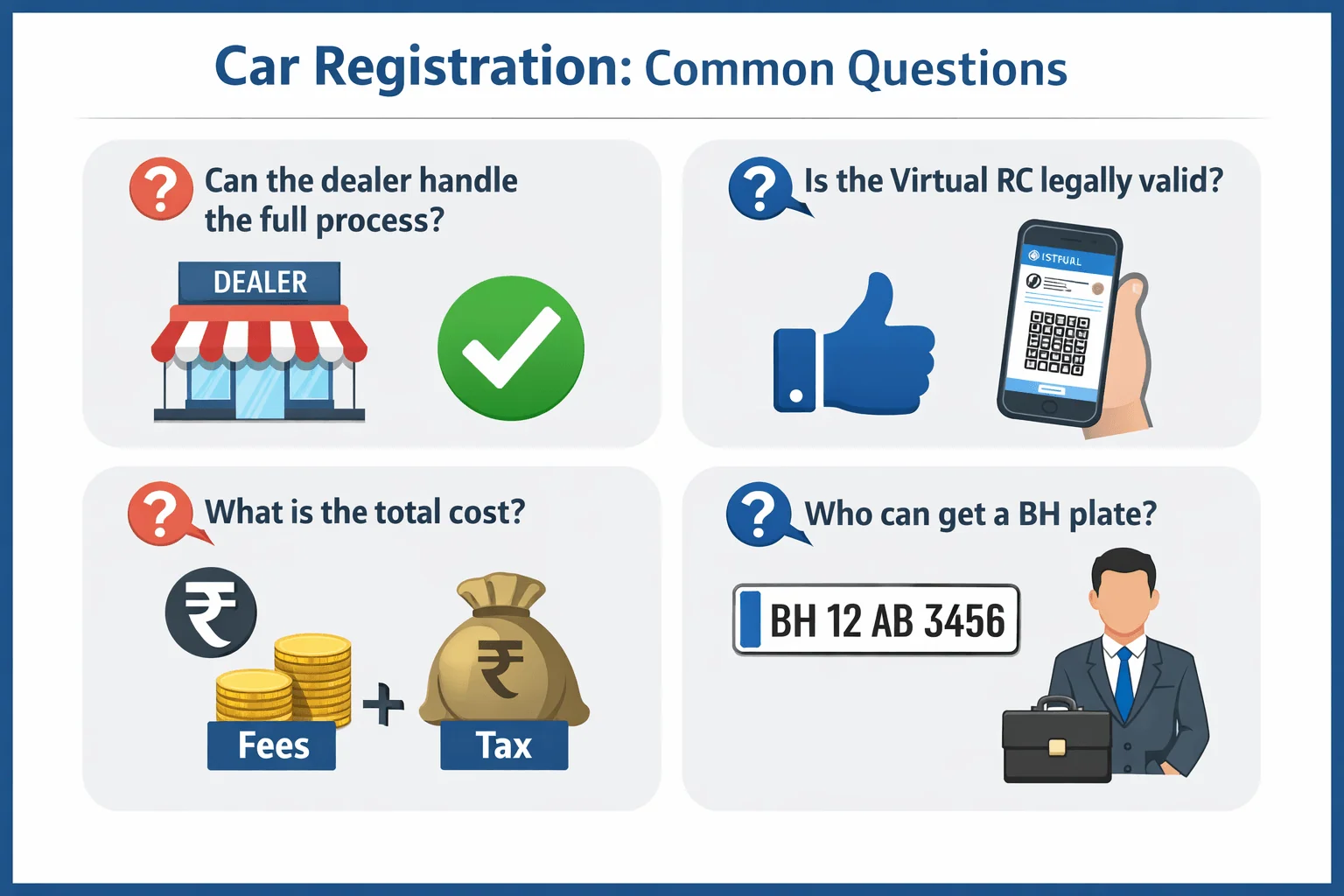
Yes. In 2026, this is the standard. The Dealer Point Registration system means the dealer uploads all documents digitally to Vahan, the RTO assigns the number remotely. You don’t visit the RTO.
What if I want to register in a different state from where I bought the car?
Self-registration is the way. Make sure the invoice shows IGST, not CGST + SGST. Drive the car to your home state RTO with the temporary registration and complete the process there.
Is the digital RC on mParivahan legally valid?
Yes, fully. Under the IT Act, 2000 and MV Act amendments, the Virtual RC on mParivahan or DigiLocker is a recognized legal document. Police verify it using the QR code.
How much does registration cost in total?
Fixed RTO fees are ₹1,700-₹3,500 (depending on whether the car is financed). Road tax is the bigger number, ranging from 2.5% to 18% of the ex-showroom price depending on your state. On a ₹10 lakh car, total registration cost (fees + road tax) could be anywhere from ₹27,000 in Himachal Pradesh to ₹1,83,000 in Karnataka. For exact figures, see our guide on on-road price breakdown.
What’s the penalty for driving without registration?
First offense: ₹2,000-₹5,000 fine with potential imprisonment up to 3 months. Repeat offenses: ₹10,000 fine, up to 1 year imprisonment. Sections 39 and 192 of the Motor Vehicles Act.
Can I get a BH series number plate?
Only if you’re a government employee, defence personnel, PSU employee, or work for a private company with permanent offices in 4 or more states. You’ll need an official employer certificate confirming multi-state presence.
How long is a Registration Certificate valid?
15 years from the date of registration for private vehicles. After that, renewal is required.
How do I check if my RC has been dispatched?
Visit vahan.parivahan.gov.in, enter your registration number, check the dispatch status. Once it shows “Dispatched,” you’ll get a Speed Post tracking number.