
Sunroof cars under 15 lakhs in India have multiplied in 2026. More than 20 variants now offer the feature ex-showroom. The cheapest is the Hyundai i20 Magna Executive at ₹7.51 lakh with a single-pane unit. The cheapest panoramic sunroof car is the Tata Nexon Pure+ PS at ₹9.59 lakh, launched on 8 May 2026. It’s the first car in India to break the ₹10 lakh barrier for a panoramic roof. At the top of this budget, the Hyundai Creta S(O) and Kia Seltos HTK(O) both offer panoramic glass overhead under ₹15 lakh.
Most automakers lock sunroofs behind specific trims. Base variants almost never get the feature. The price jump for a sunroof trim is usually ₹40,000 to ₹1.5 lakh, and you’ll often get cruise control, alloys, or 6 airbags bundled alongside the glass. This guide lists every sunroof variant available under ₹15 lakh, its exact name, the roof type (single-pane or panoramic), the ex-showroom price, and what else comes with that trim.
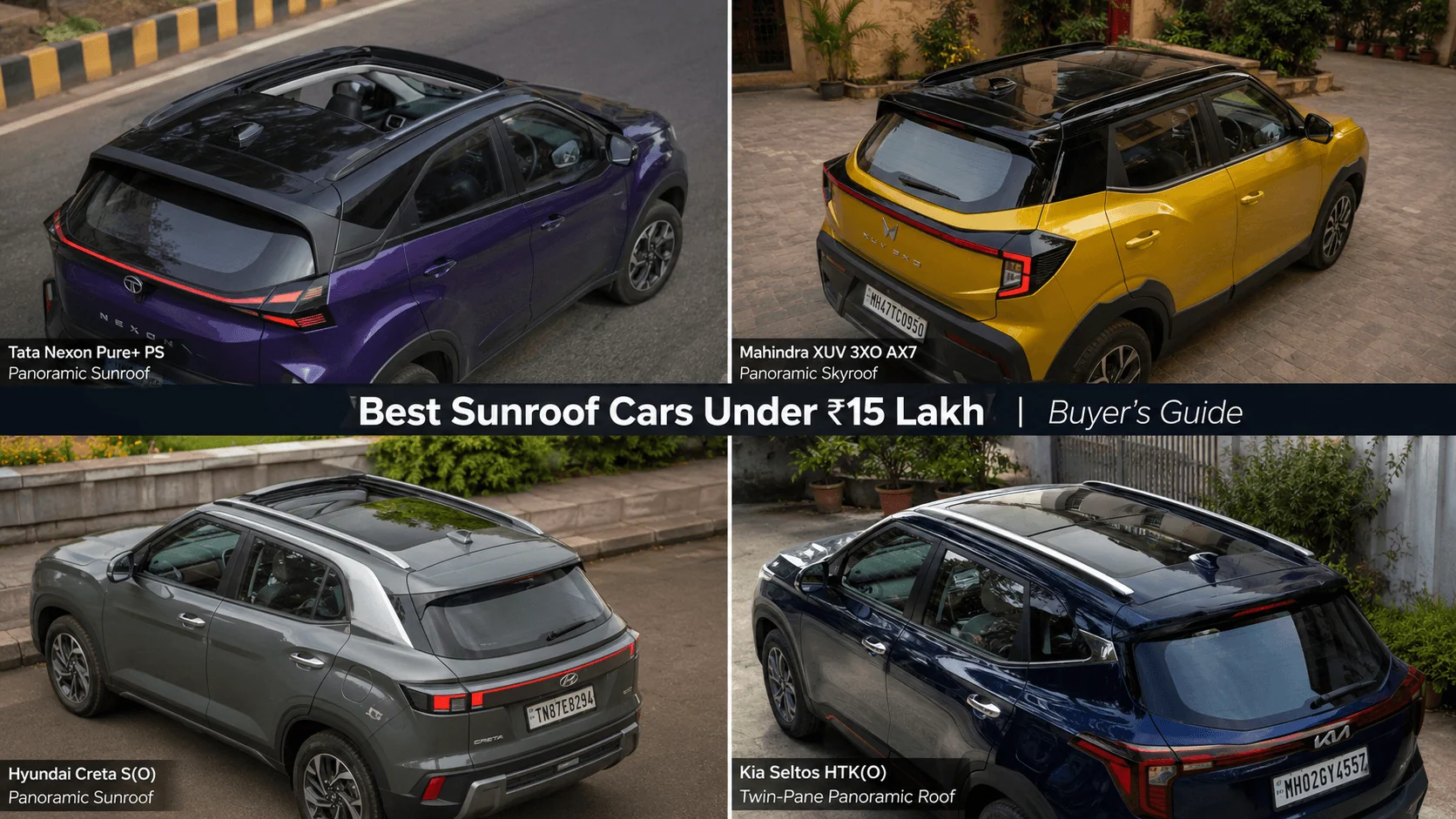
Cars With Sunroof Under 15 Lakhs: Complete List
Here’s the variant-wise master list of every car currently sold in India that offers a factory sunroof in a variant priced below ₹15 lakh ex-showroom. Models are arranged by ascending price so you can quickly find what fits your budget.
| # | Car | Body Type | Sunroof Variant | Roof Type | Ex-Showroom Price | Transmission |
|---|---|---|---|---|---|---|
| 1 | Hyundai i20 | Hatchback | Magna Executive | Single-pane electric | ₹7.51 lakh | MT / CVT |
| 2 | Tata Punch | Micro SUV | Adventure S | Single-pane (voice) | ₹7.59 lakh | MT / AMT |
| 3 | Tata Altroz | Hatchback | Pure S | Single-pane (voice) | ₹7.42 lakh | MT / DCA |
| 4 | Kia Sonet | Compact SUV | HTK(O) | Single-pane electric | ₹9.38 lakh | MT |
| 5 | Hyundai Exter | Micro SUV | SX Tech | Single-pane electric | ₹8.51 lakh | MT / AMT |
| 6 | Skoda Kylaq | Compact SUV | Classic Plus | Single-pane electric | ₹8.25 lakh | MT / AT |
| 7 | Mahindra XUV 3XO | Compact SUV | MX2 Pro | Single-pane | ₹8.99 lakh | MT / AT |
| 8 | Hyundai Venue | Compact SUV | HX5 / HX5+ | Single-pane (voice) | ₹9.35 lakh | MT / AT |
| 9 | Tata Nexon | Compact SUV | Pure+ PS | Panoramic | ₹9.59 lakh | MT / AMT |
| 10 | Kia Syros | Compact SUV | HTK+ | Twin-pane panoramic | ₹10.74 lakh | MT / AT |
| 11 | Mahindra XUV 3XO | Compact SUV | REVX A | Panoramic | ₹10.75 lakh | MT / AT |
| 12 | MG Astor | Midsize SUV | Shine | Panoramic | ₹11.34 lakh | MT / CVT |
| 13 | Tata Curvv | Coupe SUV | Pure+ S | Panoramic | ₹11.65 lakh | MT / DCA |
| 14 | Skoda Kylaq | Compact SUV | Prestige+ | Single-pane electric | ₹11.99 lakh | MT / AT |
| 15 | Mahindra XUV 3XO | Compact SUV | AX7 | Panoramic (Skyroof) | ₹12.08 lakh | MT / AT |
| 16 | Maruti Brezza | Compact SUV | ZXi+ | Single-pane | ₹12.79 lakh | MT / AT |
| 17 | Hyundai Creta | Midsize SUV | EX(O) | Single-pane | ₹13.13 lakh | MT |
| 18 | Hyundai Verna | Midsize Sedan | SX MT | Single-pane | ₹13.19 lakh | MT |
| 19 | Honda Elevate | Midsize SUV | VX MT | Single-pane electric | ₹13.74 lakh | MT |
| 20 | Kia Seltos | Midsize SUV | HTK(O) | Twin-pane panoramic | ₹14.19 lakh | MT |
| 21 | Hyundai Creta | Midsize SUV | S(O) | Panoramic | ₹14.20 lakh | MT |
| 22 | Toyota Hyryder | Midsize SUV | G(O) | Panoramic | ₹14.23 lakh | MT / AT |
| 23 | Maruti Grand Vitara | Midsize SUV | Zeta+ | Panoramic | ₹14.28 lakh | MT / AT |
| 24 | VW Taigun | Midsize SUV | Highline Plus | Single-pane electric | ₹14.30 lakh | MT |
| 25 | Maruti Victoris | Midsize SUV | ZXi+ | Panoramic | ₹14.08 lakh | MT |
Worth flagging the misses too. A few popular sub-₹15L cars don’t offer a sunroof in any trim. The Citroen Aircross skips it entirely. So does the Nissan Magnite, despite its premium positioning in the segment. Renault Kiger? Nope. Same story for the Tata Tiago, Tata Tigor, Maruti Swift, Maruti Baleno, and Hyundai Aura. If you’ve set your heart on one of those, the sunroof simply isn’t coming as a factory option for you.
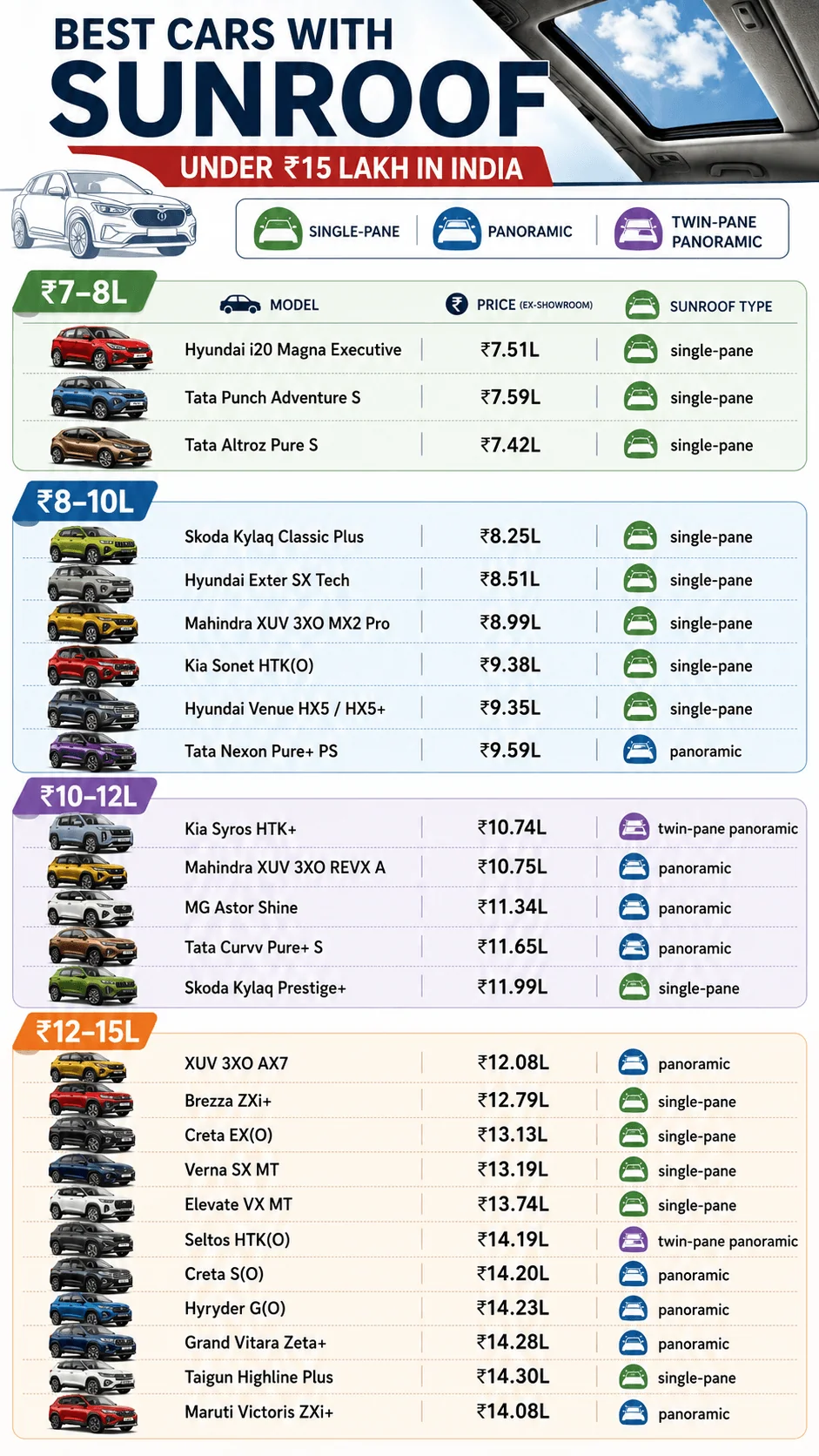
Mini-Reviews of the Strongest Picks
Twenty-five variants is too many to evaluate one by one, isn’t it? These eight cover every meaningful price tier and body type, with both single-pane and panoramic options represented, so you can match the right one to what you actually need.
1. Hyundai i20 Magna Executive: ₹7.51 lakh (Single-pane)
Cheapest sunroof car in India by a clear margin. Magna Executive sits one step above the base Era trim, and Hyundai bundled the electric glass overhead with rear AC vents, LED DRLs, a front centre armrest, and TPMS for your money. Engine choice is fixed: the 1.2L petrol with either manual or CVT automatic gearbox. The sunroof shows up on both. What you’ll skip though: a 10.25-inch touchscreen, wireless charger, and 6 airbags. You get just 2 airbags instead, which is a real compromise if structural safety is your priority. See our safest cars in India 2026 roundup for cars that don’t trade off airbags for features. Ideal for hatchback buyers who want that glass overhead at the absolute lowest entry price. Skip if active safety matters more to you. Asta(O) at around ₹9.4 lakh brings 6 airbags but stays single-pane.
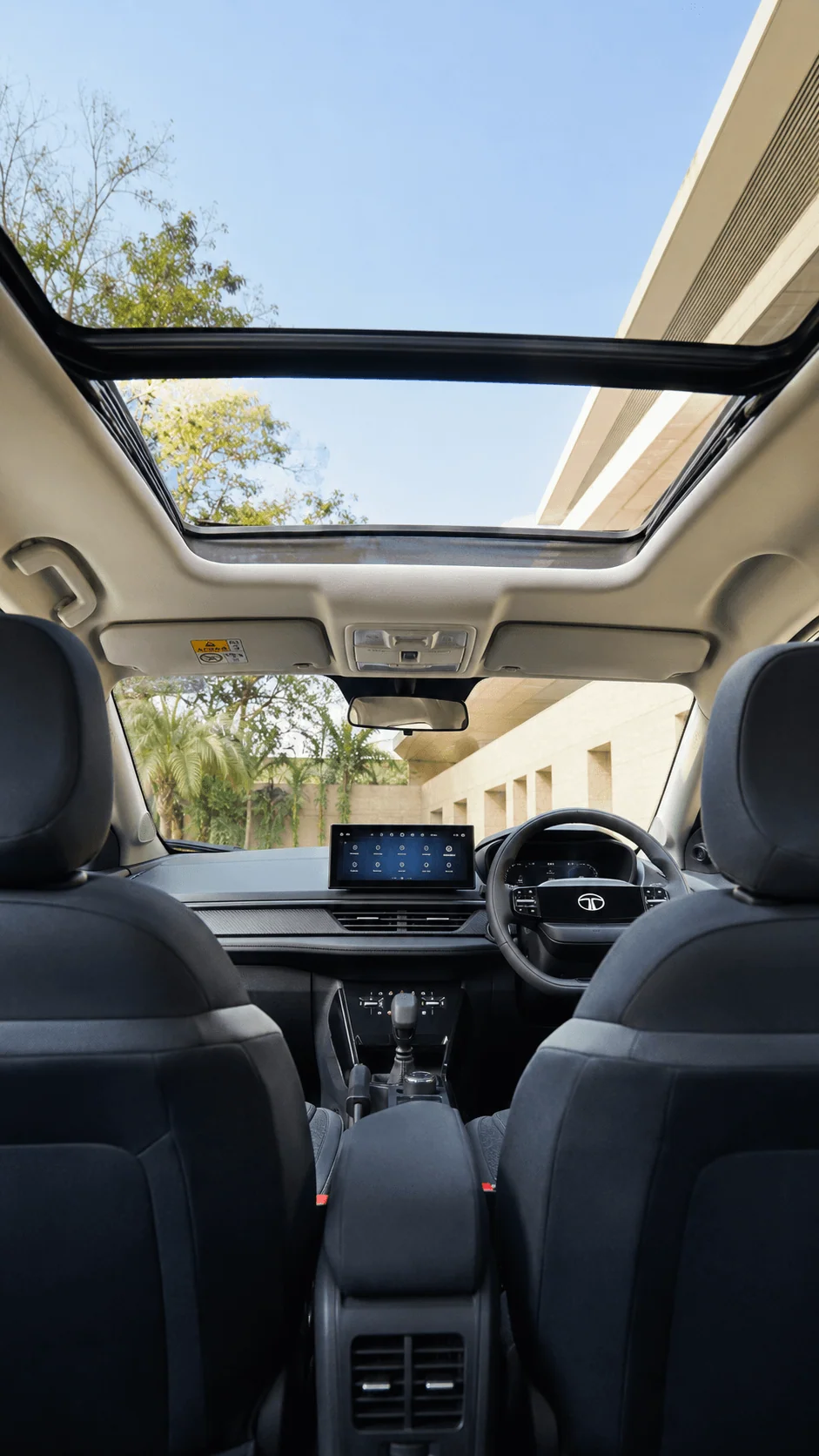
2. Tata Nexon Pure+ PS: ₹9.59 lakh (Panoramic)
This is the headline story of the segment. Launched on 8 May 2026, Tata took a panoramic sunroof, historically a ₹14L+ luxury, and dropped it into a variant under ₹10 lakh. You also pick up a 10.25-inch floating touchscreen, digital instrument cluster, wireless Android Auto and CarPlay, cruise control, plus 6 airbags for your money. The Nexon carries a 5-star Global NCAP rating, so the structural safety is genuine, not marketing fluff. If you’re not sure how NCAP star ratings actually translate to real-world crash protection, our NCAP safety ratings explained guide breaks it down. The premium over the regular Pure+ (no glass overhead) sits around ₹1 lakh. Sharp value for what you’re getting. Skip it if you want a torque-converter automatic. Only manual and AMT are on offer here. For most buyers under ₹11 lakh hunting that twin-row sky view, this is the clear pick.
3. Skoda Kylaq Classic Plus: ₹8.25 lakh MT, ₹9.25 lakh AT (Single-pane)
Probably the best driver’s car on this list. The Kylaq runs the Volkswagen Group’s 1.0L TSI turbo-petrol (115 PS, 178 Nm) with a 6-speed manual or 6-speed Aisin torque-converter automatic. The Classic Plus trim brings you the electric sunroof, cruise control, auto-dimming IRVM, rain-sensing wipers, plus 4 extra speakers over the base Classic. Sharp value. Standard 6 airbags and ESC are on across the entire Kylaq lineup, which is rare at this entry-level price. A real torque-converter automatic paired with a turbo under ₹10 lakh? Almost unheard of in this segment, where every rival is either AMT or manual at this price band. Skip the Classic Plus if you want big touchscreens and ventilated seats. Those start at Prestige.
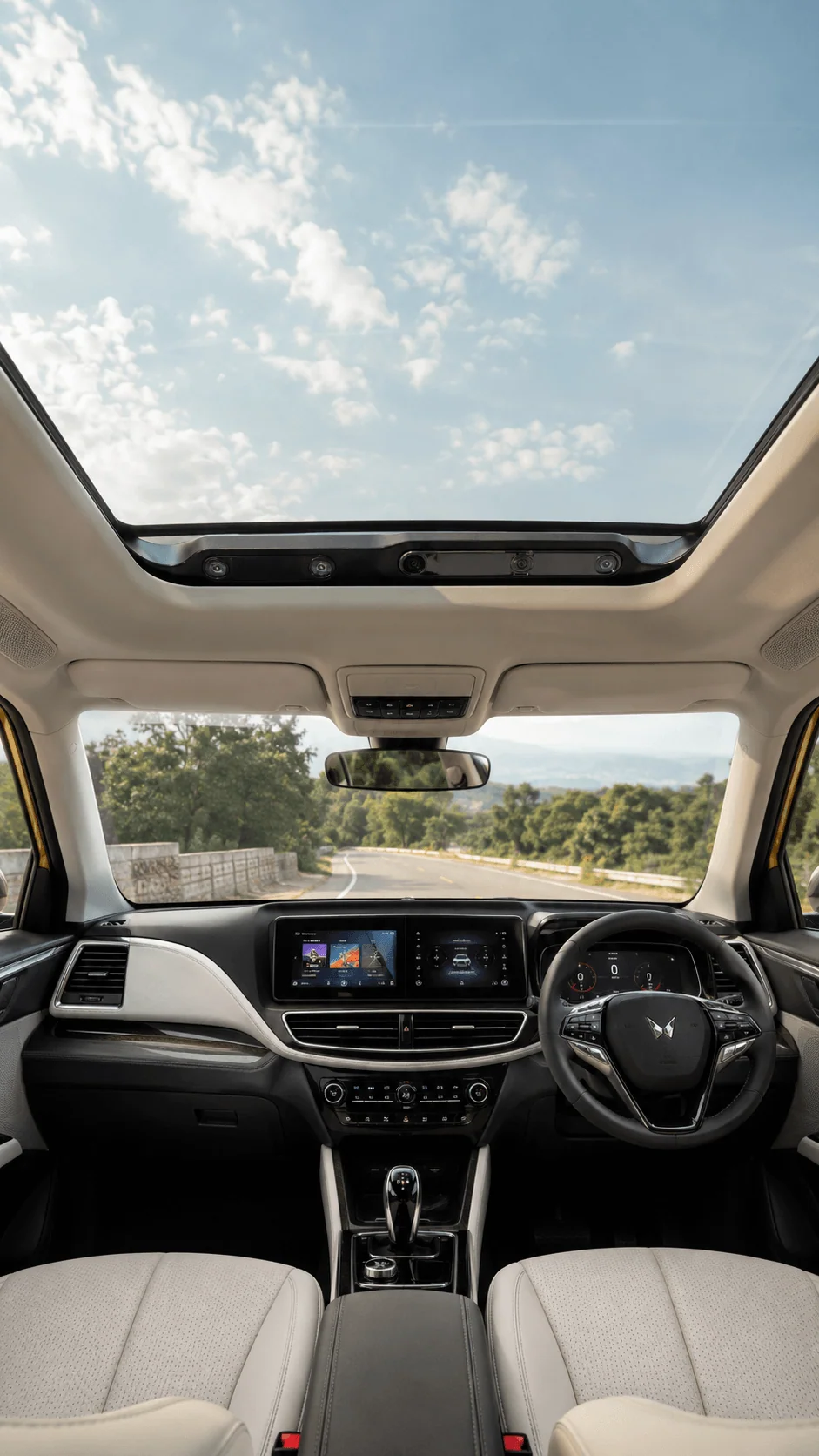
4. Mahindra XUV 3XO AX7: ₹12.08 lakh MT (Panoramic Skyroof)
The XUV 3XO AX7 packs the segment’s largest glass overhead along with Level 2 ADAS, twin 10.25-inch displays, dual-zone climate, leatherette seats, Harman Kardon audio, plus 6 airbags. The 1.2L mStallion TGDi petrol makes 131 PS (class-leading on paper), and the 1.5L diesel offers strong torque. For ADAS, a panoramic Skyroof, and 6 airbags at this price? No rival comes close. If you’re new to driver-assist tech and want to know what features like adaptive cruise control and lane keep assist actually do, our ADAS features explained guide walks through each one. Two compromises to watch for. The boot is small at 364 litres. And the factory roof sunshade is on the thinner side, so your cabin heats up quickly when parked in open sun.
5. Kia Syros HTK+: ₹10.74 lakh (Twin-pane panoramic)
The Syros has carved out a unique slot for itself. It’s the cheapest car in India with a true twin-pane glass roof. HTK+ also brings you a 12.5-inch infotainment display, 6 airbags, ESC, plus Kia’s typically slick cabin finish. The 1.0L turbo-petrol AT trim? Priced at ₹11.92 lakh, still well under budget. Best for buyers who want that airy-cabin feel without crossing into Seltos money. Skip it if you need bigger boot space. The Syros’s tall, compact silhouette is great for headroom but average for cargo.
6. MG Astor Shine: ₹11.34 lakh (Panoramic)
The cheapest midsize-class panoramic in India today. MG dropped the big glass roof down to the Shine trim in the MY2025 update, bundling it with 6 airbags, ESC, cruise, wireless Android Auto and CarPlay, plus a 5-star Global NCAP rating. The 1.5L naturally aspirated petrol (115 PS) with 6MT or CVT is your only powertrain. Skip if your area has limited MG service coverage. That’s still the brand’s weakest link compared with Hyundai and Kia.
7. Hyundai Creta S(O): ₹14.20 lakh MT (Panoramic)
The Creta needs no introduction. The S(O) is the cheapest spec where you get the voice-enabled glass overhead. You also pick up an 8-inch touchscreen, dual-zone climate, cruise control, 6 airbags, ESC, plus a fully digital instrument cluster. What’s missing? Level 2 ADAS, ventilated seats, and the 10.25-inch screen, which all kick in at SX(O), and that trim crosses ₹17 lakh on-road in most states. Best for buyers who want benchmark resale value, butter-smooth ride, and pan-India service backup. One thing to know: the EX(O) trim at ₹13.13 lakh only gets a single-pane unit. If your goal is the full sky view, S(O) is your entry point.
8. Kia Seltos HTK(O): ₹14.19 lakh (Twin-pane panoramic)
Same money as a Creta S(O), but here you’ll get a twin-pane glass overhead versus the Creta’s single large panel. The HTK(O) packs 6 airbags, ESC, an 8-inch touchscreen with wireless Apple CarPlay and Android Auto, automatic climate, plus connected LED tail lamps. It’s manual-only at this price, with the 1.5L NA petrol (115 PS) under the hood. Want an automatic with that big sky view? The closest Seltos AT with the same setup crosses ₹17 lakh. The Creta S(O) is your sensible buy if you also need IVT automatic.
Honourable mentions worth knowing
- Tata Curvv Pure+ S (₹11.65 lakh): if you like the coupe-SUV styling and want a twin-row glass overhead plus ADAS and ventilated seats from the Creative S trim upward.
- Toyota Hyryder G(O) (₹14.23 lakh): the wide cabin-spanning panel plus Toyota’s service network. But the factory sunblind is thin and you’ll likely want aftermarket sun film.
- Maruti Victoris ZXi+ (₹14.08 lakh): Maruti’s first crack at a real twin-pane unit at this price, launched September 2025. Backed by the country’s biggest service network.
- Honda Elevate VX MT (₹13.74 lakh): single-pane only, but you also get Honda Sensing Level 2 ADAS alongside the glass overhead. Rare combination at this price.
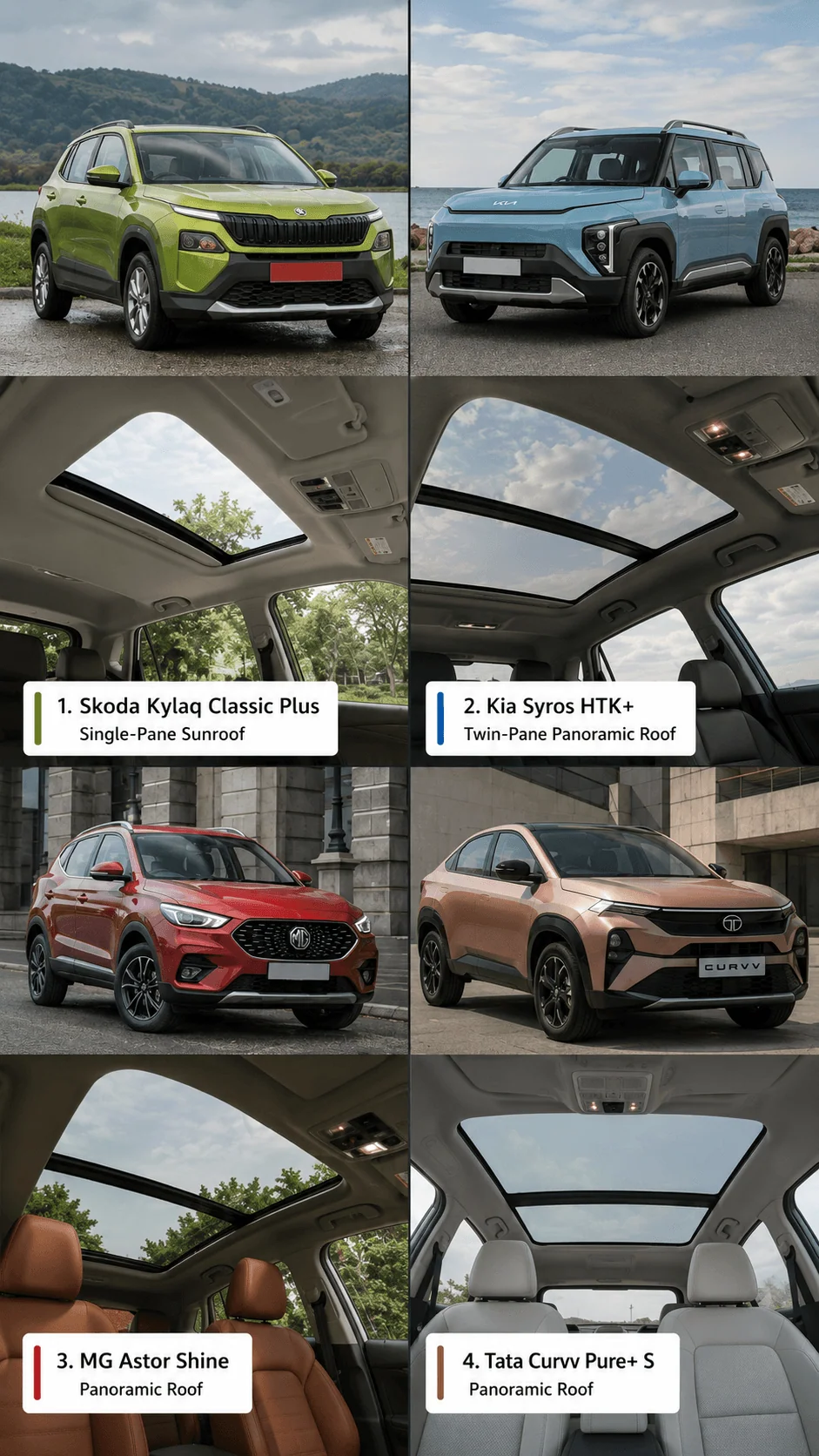
Single-Pane vs Panoramic Sunroof: Which Is Better?
You’re facing a real fork at this budget. Stretch for a panoramic roof, or stay with a single-pane unit and put the saved money toward better safety or an automatic gearbox? The answer isn’t obvious. Here’s what actually differs.
A single-pane sunroof sits over the front row only. It uses a small glass panel that slides back or tilts up, with a thick opaque sunshade above your headliner. It’s lighter, simpler, easier to seal, and dramatically cheaper to repair if something goes wrong. The opaque shade does a genuinely good job of blocking heat when you shut it. Most hatchbacks, sub-4m SUVs, and entry-level compact crossovers use this design.
A panoramic sunroof is a much larger glass area, often two panels, covering both rows. Step inside and the cabin transformation is dramatic, the headliner feels twice as high, and even rear passengers get an open-sky view that a single-pane never delivers. But the trade-offs are real. You’re adding weight up top in your car along with more complex motors and longer drain channels that all add cost when something fails. Repair bills can run high if the glass cracks. And the fabric sunshade most automakers use is often translucent, letting heat radiate down onto your head when you’re parked in the sun. The greenhouse effect? It’s the most common owner complaint on Team-BHP and Reddit forums.
| Factor | Single-Pane | Panoramic |
|---|---|---|
| Glass area | Front row only | Front + rear rows |
| Cabin brightness | Moderate | Dramatic |
| Sunshade type | Thick opaque board | Often thin fabric blind |
| Heat ingress in Indian summer | Lower | Higher (often needs aftermarket film) |
| Replacement glass cost | ₹15,000 to ₹35,000 typical | ₹60,000 to ₹1.5 lakh typical |
| Weight added | About 10 to 15 kg | About 25 to 40 kg |
| Best for | Hot/dusty cities, low-maintenance buyers | Style-first buyers, cooler regions, occasional use |
For a deeper engineering breakdown, see our sunroof types explained guide.
Practical verdict for India: if you live in Delhi, Hyderabad, Chennai, Ahmedabad, or anywhere that crosses 40°C in summer, a single-pane unit with a proper opaque shade will serve you better than a big twin-pane with a thin fabric blind. Bangalore, Pune, Kochi, or any hill town? The full sky-view experience is genuinely worth the extra cost over five-plus years of ownership.
Which Variants Get the Sunroof?
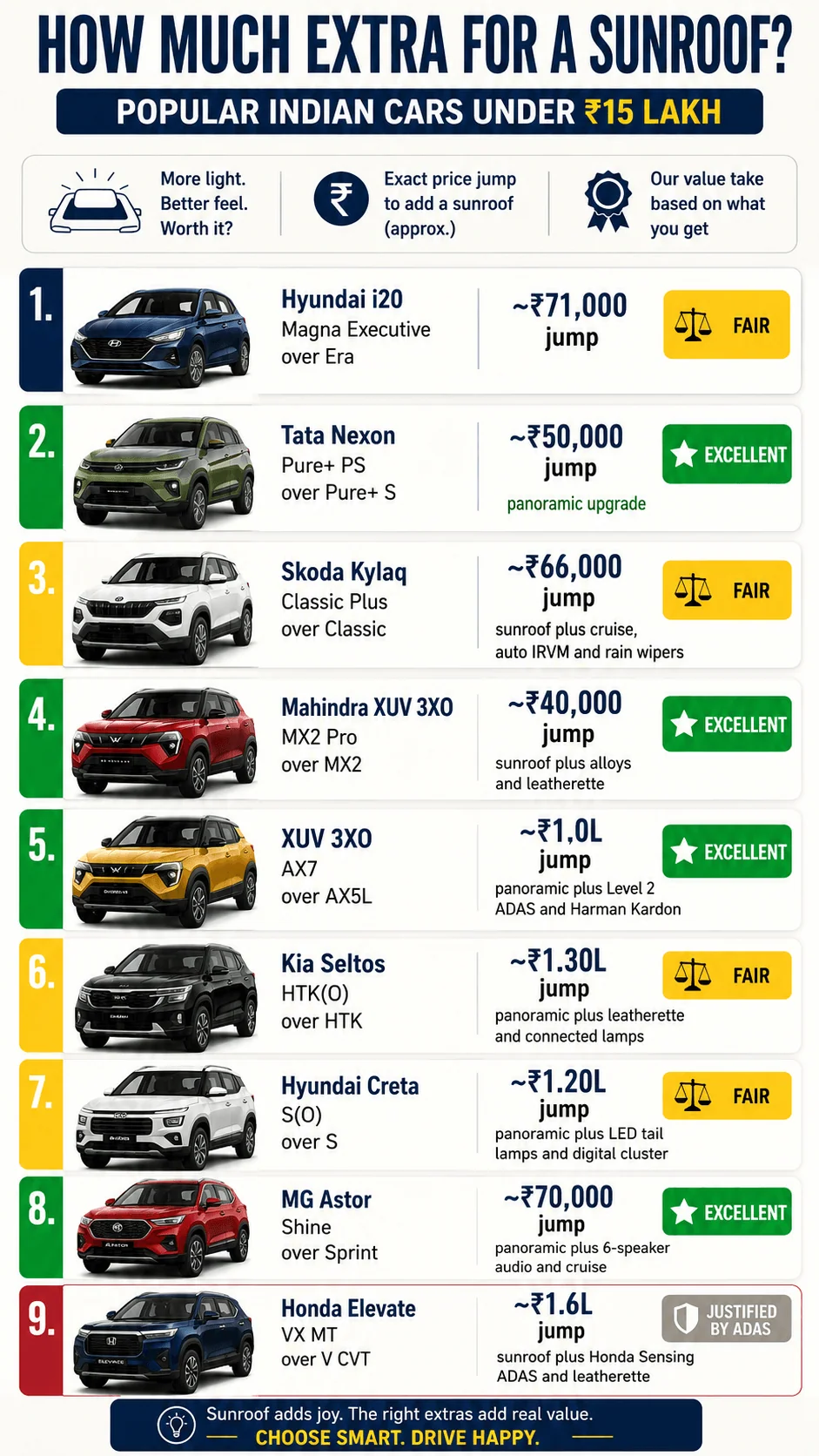
This is where the variant-engineering trap catches buyers. The cheapest sunroof variant of any model is almost never the cheapest variant of that model. So here’s exactly where each lineup starts offering you a roof, what extra features you pick up at that trim, and whether the jump is fair on your wallet.
| Car | Cheapest Sunroof Variant | Step Up From | Approx. Price Jump | What Else You Get | Verdict |
|---|---|---|---|---|---|
| Hyundai i20 | Magna Executive | Era | ~₹71,000 | Sunroof, rear AC vents, TPMS, LED DRLs | Fair |
| Tata Nexon | Pure+ PS | Pure+ S | ~₹50,000 | Panoramic upgrade over single-pane | Excellent |
| Skoda Kylaq | Classic Plus | Classic | ~₹66,000 | Sunroof, cruise, auto IRVM, rain wipers | Fair |
| Mahindra XUV 3XO | MX2 Pro | MX2 | ~₹40,000 | Sunroof, alloys, leatherette | Excellent |
| Mahindra XUV 3XO | AX7 (panoramic) | AX5L | ~₹1.0 lakh | Panoramic + Level 2 ADAS + Harman Kardon | Excellent |
| Kia Seltos | HTK(O) | HTK | ~₹1.30 lakh | Panoramic, leatherette, connected lamps | Fair |
| Hyundai Creta | S(O) | S | ~₹1.20 lakh | Panoramic, LED tail, digital cluster | Fair |
| MG Astor | Shine | Sprint | ~₹70,000 | Panoramic, 6-speaker audio, cruise | Excellent |
| Honda Elevate | VX MT | V CVT | ~₹1.6 lakh | Sunroof, Honda Sensing ADAS, leatherette | Justified by ADAS |
Reading the table: anything under about ₹70,000 for a sunroof addition? Clear-cut yes. Anything over ₹1 lakh needs to bring genuine kit alongside (ADAS, 6 airbags, or a panoramic upgrade) to justify itself for you. The Elevate VX jump looks steep, but Honda Sensing alone is worth ₹1 lakh.
Two warnings worth pausing on.
First, many midsize SUVs (Creta, Seltos, Grand Vitara) don’t offer their sunroof variant with an automatic transmission under ₹15 lakh ex-showroom. You’ll pay ₹1.4 to 1.6 lakh extra for the automatic, which pushes you past your budget. If automatic is non-negotiable for you, look at the Mahindra XUV 3XO AX7 AT (around ₹13.3L), Kia Syros HTK+ AT (around ₹11.9L), or MG Astor Shine CVT (around ₹12L).
Second, ex-showroom price isn’t what you’ll actually pay. A ₹14.20 lakh Creta S(O) will land around ₹16.5 lakh on-road depending on your state’s RTO road tax and insurance rates. Plan for that gap before you fall in love with a specific variant.
Sunroof Maintenance Tips for Indian Conditions
The unit itself isn’t delicate. What kills it? Neglect. Specifically blocked drain channels and dried-out rubber seals. Here’s what every owner in India should do.
Clean the drain channels before every monsoon. Every sunroof has four small drain holes at the corners that route water down through the A-pillars and out under your car. Leaves, dust, and tree sap will clog these tubes within a year. Pour a glass of water along each edge and check that it flows out from under your car. If it doesn’t, get a workshop to blow compressed air through the drain tubes. Blocked drains are the single biggest cause of water leaks into your cabin headliner. And that water can fry the electronics under your carpet.
Condition the rubber seals every six months. Indian summer heat hardens and cracks the rubber gasket around the glass. Wipe it clean and apply a thin layer of silicone-based seal conditioner. Don’t use petroleum grease, which destroys rubber. You’ll keep the seal pliable and quiet for years.
Lubricate the sliding tracks once a year. Dust mixed with old grease forms an abrasive paste that strains the sunroof motor. Wipe the tracks with a microfiber cloth and apply only the lithium or silicone grease specified in your owner’s manual.
Use the sunshade religiously in summer. Keep it closed when you park in the sun. You’ll protect your dashboard, drop your cabin temperature by 5 to 8°C, and extend the life of your rubber seals.
Never force a stuck sunroof. If the glass jams halfway, stop using it and get it inspected. Forcing it breaks the plastic guide rails. That’s a workshop bill running into tens of thousands of rupees.
Never let anyone stand through your sunroof. It’s illegal under Section 184 of the Motor Vehicles Act and the leading cause of glass-edge misalignment damage. A sudden brake at 40 km/h can cause fatal injury. Use the feature for ventilation and light, not for performances at weddings.
| Task | Frequency | Why It Matters |
|---|---|---|
| Clean drain channels | Before and after monsoon | Prevents headliner water damage |
| Condition rubber seals | Every 6 months | Stops wind noise and water seepage |
| Lubricate tracks | Annually | Avoids motor burnout |
| Close sunshade when parking in sun | Daily in summer | Reduces cabin heat and protects interior |
| Inspect at every service | With every service visit | Catches issues early |
Honest Downsides of a Sunroof in India
A few realities the showroom salesperson won’t mention to you. Worth knowing before you sign.
The greenhouse effect is real, especially on panoramic units with thin fabric blinds. The Toyota Hyryder, Maruti Grand Vitara, and Maruti Victoris all share this issue across their lineups. Owners typically fit aftermarket heat-rejection sun film on the roof glass within the first few months of ownership. Budget another ₹3,000 to ₹6,000 for that.
Dust enters every time you open the roof in traffic. In Delhi or Mumbai, your cabin AQI tanks within minutes. Most owners admit they open the roof maybe 10 to 15 times a year. Usually on highway drives, hill trips, or cool early mornings.
Repair costs aren’t trivial. A cracked panoramic glass panel can cost ₹60,000 to ₹1.5 lakh to replace. Insurance covers it under most comp policies, but check whether your zero-depreciation add-on extends to the sunroof glass. Some insurers exclude it.
Headroom drops by an inch or two, especially in the rear. Anyone in your family over 5’10”? If they ride in the back of a Toyota Hyryder or some compact SUVs, they’ll feel the difference.
Rattles can develop after 3 to 4 years if the rubber seal has hardened, especially on potholed Indian roads where the body shell flexes constantly under your weight.
So if you park outdoors daily, have undisciplined kids who might stand through it, or live where summers cross 42°C? Weigh these costs honestly before paying the premium.
FAQs
Which car has sunroof under 15 lakhs in India? More than 20 variants under ₹15 lakh ex-showroom offer a factory sunroof in 2026. The list includes the Hyundai i20, Tata Punch, Tata Altroz, Tata Nexon, Tata Curvv, Hyundai Exter, Hyundai Venue, Hyundai Creta, Hyundai Verna, Kia Sonet, Kia Syros, Kia Seltos, Mahindra XUV 3XO, Maruti Brezza, Maruti Victoris, Maruti Grand Vitara, Skoda Kylaq, MG Astor, Honda Elevate, Toyota Hyryder, and VW Taigun.
Which is the cheapest car with a sunroof in India 2026? The Hyundai i20 Magna Executive at ₹7.51 lakh ex-showroom. The Tata Altroz Pure S at ₹7.42 lakh is technically a few thousand rupees less, but only on specific introductory pricing. The i20 holds the everyday-price crown for you.
Which is the cheapest car with a panoramic sunroof in India 2026? The Tata Nexon Pure+ PS at ₹9.59 lakh, launched on 8 May 2026. It overtook the Kia Syros HTK+ (₹10.74 lakh) and became the first car in India to break the ₹10 lakh barrier for a twin-row sky view.
Single-pane or panoramic sunroof, which is better? For Indian conditions, single-pane wins on practicality. Better heat insulation, cheaper to repair, easier to maintain. A twin-pane unit feels dramatically more premium but heats your cabin faster and costs much more if anything breaks. Choose based on your city’s climate and how often you’ll actually open it.
Does a sunroof affect car price significantly? Yes, but not as much as buyers assume it does. The trim-to-trim jump for adding a sunroof is usually ₹40,000 to ₹1.5 lakh on most models we’ve checked, and you’ll almost always get other features bundled in alongside the glass at no extra cost. Cruise control, alloy wheels, a larger touchscreen, sometimes 6 airbags. The glass itself accounts for roughly ₹30,000 to ₹60,000 of that increment.
Does Hyundai Creta have a sunroof under 15 lakhs? Yes, it does. The Creta EX(O) at ₹13.13 lakh has a single-pane unit, while the higher S(O) at ₹14.20 lakh is your entry point for the voice-enabled panoramic version with rear-row coverage too.
Does Kia Seltos have a panoramic sunroof under 15 lakhs? Yes. The Seltos HTK(O) at ₹14.19 lakh ex-showroom comes with the twin-pane glass overhead. It’s manual-only at this price. The automatic with the same setup crosses ₹17 lakh.
Does Mahindra XUV 3XO have a panoramic sunroof? Yes. The XUV 3XO REVX A at ₹10.75 lakh is the entry point for the panoramic Skyroof, and the AX7 at ₹12.08 lakh adds Level 2 ADAS, twin 10.25-inch screens, plus 6 airbags alongside it.
Does Tata Nexon have a panoramic sunroof? Yes. The Nexon Pure+ PS at ₹9.59 lakh is currently India’s cheapest panoramic sunroof car. The Fearless+ PS variant also gets it with ventilated seats and a JBL system.
Is a sunroof useful in India’s climate? Honestly? Only sometimes. Most owners report opening it 10 to 15 times a year. Usually on highway drives, early mornings, or hill trips. In peak summer or in heavily polluted city traffic, the unit stays sealed almost permanently. Treat it as a lifestyle bonus, not a daily-use feature for your commute.
Do sunroofs cause leakage problems? Not on their own. Blocked drain channels are the actual culprit. Clean the drains before every monsoon and after, and you’ll likely never see a leak.
Is a panoramic sunroof expensive to maintain? Routine upkeep is similar to a single-pane unit. The real cost difference shows up only when something breaks. Replacement glass for a twin-pane panel can cost ₹60,000 to ₹1.5 lakh, versus ₹15,000 to ₹35,000 for a single-pane.
Does a sunroof reduce headroom? Yes, by 1 to 2 inches in most cars. Sit in the back seat of any sunroof-equipped trim before buying if anyone in your family is over 5’10”.
Is it safe to stand through the sunroof? No. It’s illegal under Section 184 of the Motor Vehicles Act and extremely dangerous. Sudden braking at city speeds can cause fatal head and spinal injuries. Keep your sunroof for ventilation and light only.
Should I buy a car just because it has a sunroof? No, you really shouldn’t. Buy the right car for your budget, family size, daily use case, and city first. Then check if the sunroof trim makes financial sense for you. A 5-star Bharat NCAP rating, 6 airbags, ESC, the right engine, plus a reliable service network all matter more for your daily ownership experience than the glass overhead.