India has more NCAP-tested cars than ever before. Bharat NCAP alone has crash-tested over 30 models, Global NCAP continues its independent assessments, and for the first time you can compare hard crash data across brands and budgets before walking into a showroom.
This isn’t another “top 10 safest cars” list that just repeats star ratings. We’ve ranked every NCAP-rated car by actual crash test score, added current prices, flagged the cars you should avoid, and covered the safety features that genuinely matter on Indian roads.
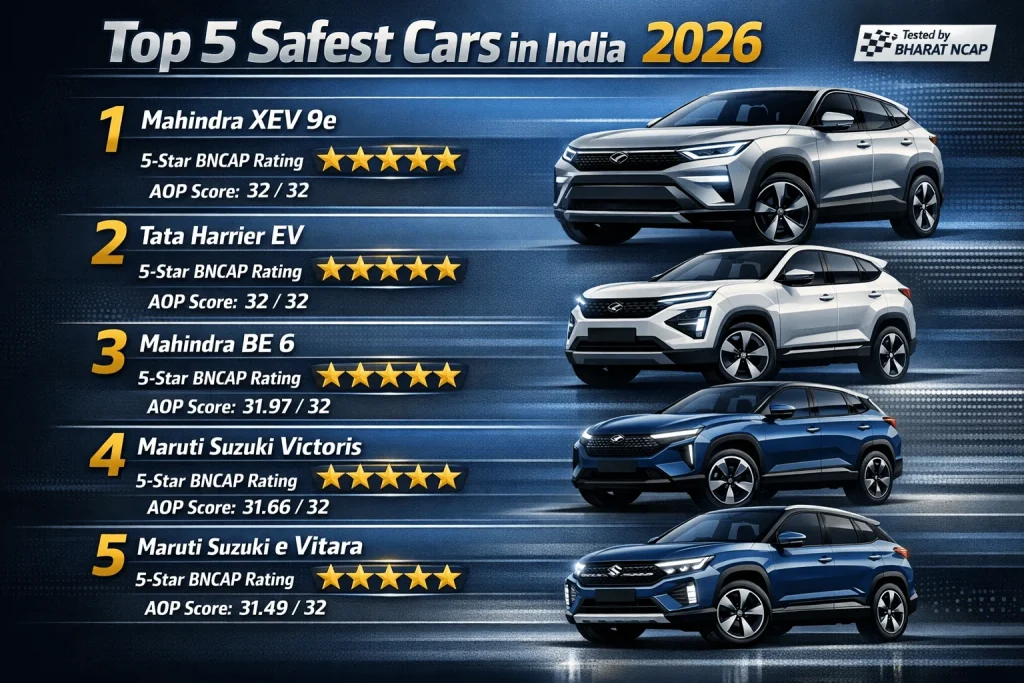
Here’s the ranked list of 5-star NCAP-rated cars in India right now:
- Mahindra XEV 9e
- Tata Harrier EV
- Maruti Suzuki Victoris
- Maruti Suzuki e Vitara
- Tata Sierra
- Tata Punch
- Mahindra BE 6
- Skoda Kylaq
- Tata Harrier / Safari
- Toyota Innova Hycross
- Mahindra Thar Roxx
- Kia Syros
- Tata Curvv EV
- Tata Punch EV
- Mahindra XUV 3XO
- Tata Nexon
- Maruti Suzuki Dzire
- Tata Altroz
- Honda Amaze
- Maruti Suzuki Invicto
All 5-Star Safety Cars in India
Not all 5-star ratings tell the same story. A car scoring 27.05 out of 32 in adult occupant protection (AOP) and one scoring a perfect 32 out of 32 both earn 5 stars. But would you feel equally safe in both? The gap in real-world crash survivability is massive. That’s why we’ve ranked every 5-star car by actual score, not just star count.
Two testing agencies operate in India. Bharat NCAP (BNCAP) tests cars manufactured specifically for the Indian market. It scores AOP out of 32 and child occupant protection (COP) out of 49. Global NCAP (GNCAP) uses different protocols, scoring AOP out of 34 under its updated 2024 methodology. Both test frontal offset crashes at 64 km/h and side impacts at 50 km/h.
What does it take to earn 5 stars? Under BNCAP, you need at least 27 out of 32 in AOP and 41 out of 49 in COP. For more on how NCAP ratings work, check our detailed explainer.
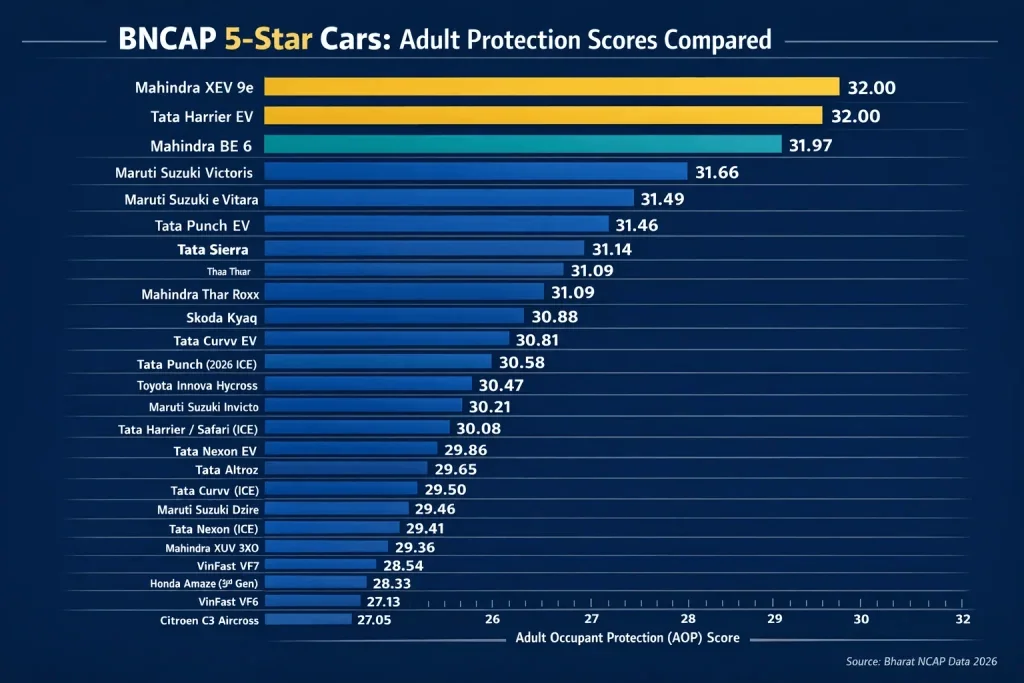
Bharat NCAP 5-Star Rated Cars (Ranked by AOP Score)
| Rank | Car | AOP Score (/32) | COP Score (/49) | Starting Price (Ex-Showroom) | Standard Airbags | Body Shell |
|---|---|---|---|---|---|---|
| 1 | Mahindra XEV 9e | 32.00 | 45.00 | ₹21.90 Lakh | 6 | Stable |
| 2 | Tata Harrier EV | 32.00 | 45.00 | ₹21.49 Lakh | 6 | Stable |
| 3 | Maruti Suzuki Victoris | 31.66 | 43.00 | ₹11.49 Lakh | 6 | Stable |
| 4 | Mahindra BE 6 | 31.97 | 45.00 | ₹18.90 Lakh | 6 | Stable |
| 5 | Maruti Suzuki e Vitara | 31.49 | 43.00 | ₹17.49 Lakh | 7 | Stable |
| 6 | Tata Punch EV | 31.46 | 45.00 | ₹10.99 Lakh | 6 | Stable |
| 7 | Tata Sierra | 31.14 | 44.73 | ₹11.49 Lakh | 7 | Stable |
| 8 | Mahindra Thar Roxx | 31.09 | 45.00 | ₹12.39 Lakh | 6 | Stable |
| 9 | Skoda Kylaq | 30.88 | 45.00 | ₹7.59 Lakh | 6 | Stable |
| 10 | Tata Curvv EV | 30.81 | 44.83 | ₹17.49 Lakh | 6 | Stable |
| 11 | Tata Punch (2026 ICE) | 30.58 | 45.00 | ₹5.59 Lakh | 6 | Stable |
| 12 | Toyota Innova Hycross | 30.47 | 45.00 | ₹19.99 Lakh | 6 | Stable |
| 13 | Maruti Suzuki Invicto | 30.43 | 44.90 | ₹25.21 Lakh | 6 | Stable |
| 14 | Kia Syros | 30.21 | 44.42 | ₹8.99 Lakh | 6 | Stable |
| 15 | Tata Harrier / Safari (ICE) | 30.08 | 44.54 | ₹12.89 Lakh | 6 | Stable |
| 16 | Tata Nexon EV | 29.86 | 44.95 | ₹12.49 Lakh | 6 | Stable |
| 17 | Tata Altroz | 29.65 | 44.90 | ₹6.89 Lakh | 6 | Stable |
| 18 | Tata Curvv (ICE) | 29.50 | 43.66 | ₹10.00 Lakh | 6 | Stable |
| 19 | Maruti Suzuki Dzire | 29.46 | 41.57 | ₹6.26 Lakh | 6 | Stable |
| 20 | Tata Nexon (ICE) | 29.41 | 43.83 | ₹7.32 Lakh | 6 | Stable |
| 21 | Mahindra XUV 3XO | 29.36 | 43.00 | ₹7.37 Lakh | 6 | Stable |
| 22 | VinFast VF7 | 28.54 | 45.25 | [VERIFY: price] | 7 | Stable |
| 23 | Honda Amaze (3rd Gen) | 28.33 | 40.81 | ₹7.48 Lakh | 6 | Stable |
| 24 | Citroen C3 Aircross | 27.05 | 40.00 | ₹9.99 Lakh | 6 | Stable |
| 25 | VinFast VF6 | 27.13 | 44.41 | [VERIFY: price] | 7 | Stable |
Global NCAP 5-Star Rated Cars (Updated Protocol, 2023 Onwards)
Global NCAP overhauled its testing in 2023, which means older scores aren’t directly comparable to newer ones. Here are the Indian cars tested under the stricter regime:
| Car | AOP Score (/34) | COP Score (/49) | Starting Price |
|---|---|---|---|
| Tata Harrier / Safari | 33.05 | 45.00 | ₹12.89 Lakh |
| Tata Nexon | 32.22 | 44.52 | ₹7.32 Lakh |
| VW Virtus | 29.71 | 42.00 | ₹11.56 Lakh |
| Skoda Slavia | 29.71 | 42.00 | ₹10.00 Lakh |
| VW Taigun | 29.64 | 42.00 | ₹11.42 Lakh |
| Skoda Kushaq | 29.64 | 42.00 | ₹10.66 Lakh |
| Hyundai Verna | 28.18 | 42.00 | ₹10.98 Lakh |
| Maruti Suzuki Dzire | 5-star | 5-star | ₹6.26 Lakh |
| Nissan Magnite (6-airbag) | 5-star | 3-star | ₹6.50 Lakh |
| Maruti Victoris | 5-star | 5-star | ₹11.49 Lakh |
The Tata Harrier and Safari hold the highest Global NCAP score ever recorded for an Indian car under the new protocol: 33.05 out of 34. The Nexon sits right behind at 32.22. Both are genuinely impressive results.
4-Star Safety Cars in India
Not every car clears the 5-star bar. Four stars still represents solid crash protection though. Where did these cars lose points? Usually child protection or side-impact performance.
Bharat NCAP 4-Star Cars
| Car | AOP Score (/32) | COP Score (/49) | Starting Price | Where It Lost Points |
|---|---|---|---|---|
| Maruti Suzuki Baleno (6-airbag) | 26.52 | 34.81 | ₹6.61 Lakh | Lower COP, pedestrian protection |
| Maruti Suzuki Baleno (2-airbag) | 24.04 | 34.81 | ₹6.61 Lakh | AOP dropped with fewer airbags |
| Citroen Basalt | 26.19 | 35.90 | ₹7.99 Lakh | Lower scores in both AOP and COP |
The Baleno result is worth paying attention to. Same car, same body shell, but with 6 airbags it scores 26.52 in AOP. Drop to 2 airbags and it falls to 24.04. That’s a 10% difference in crash protection. Always check which variant was actually tested before assuming your car matches the headline rating.
Cars You Should Think Twice About
Several popular, widely-sold models have failed independent crash testing. If you’re considering any of these, you should know what the data says.
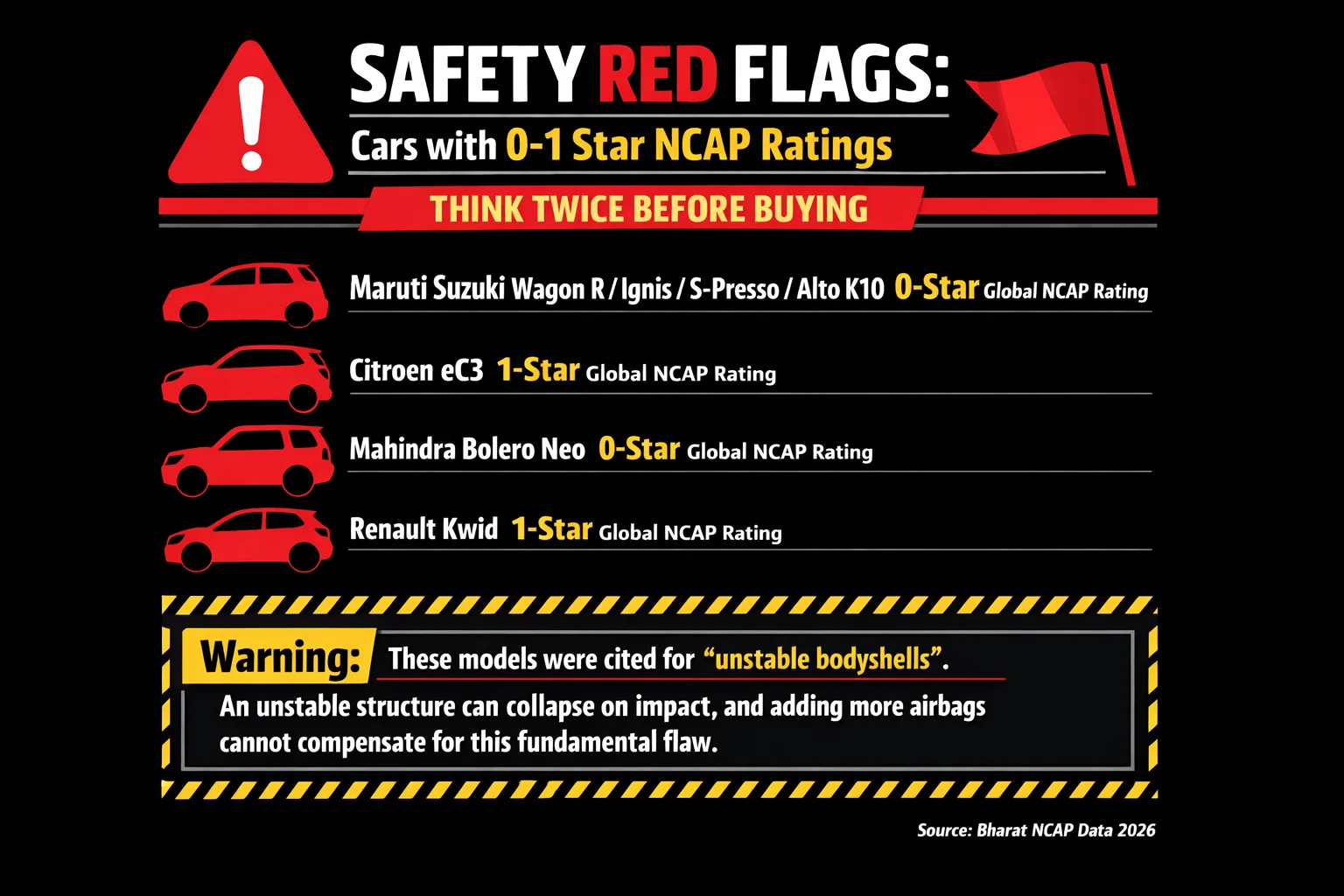
Maruti Suzuki Wagon R, Ignis, S-Presso, and Alto K10 scored just 1 star in Global NCAP. Crash forensics cited “unstable bodyshells” and “unstable footwell areas” that couldn’t withstand further loadings. What does an unstable footwell mean for you? The impact forces cause the floorpan to crumple inward, trapping the driver’s lower legs. Six airbags on an unstable body shell won’t change that.
Citroen eC3 received a 0-star GNCAP rating. Massive structural collapse. Shockingly poor chest protection for the driver. Being electric doesn’t guarantee basic crashworthiness.
Mahindra Bolero Neo scored only 1 star in GNCAP despite Mahindra’s strong record with monocoque platforms. The older ladder-frame architecture simply doesn’t hold up under modern crash standards.
Renault Kwid also scored 1 star, primarily due to insufficient chest protection.
Here’s the bottom line. Don’t let dealership sales staff convince you that “the new model has six airbags so it’s safe.” If the underlying platform hasn’t been independently tested, or it’s been rated unstable by NCAP, six airbags won’t compensate for a collapsing cabin.
Safest Cars Under 10 Lakhs
This is where most of you are probably shopping. Good news: genuine 5-star safety now starts under ₹6 lakh. But here’s something most buyers miss. That 5-star rating you see in headlines? It was earned by a specific variant. It doesn’t automatically apply to every trim level.
Ranked by Safety Score
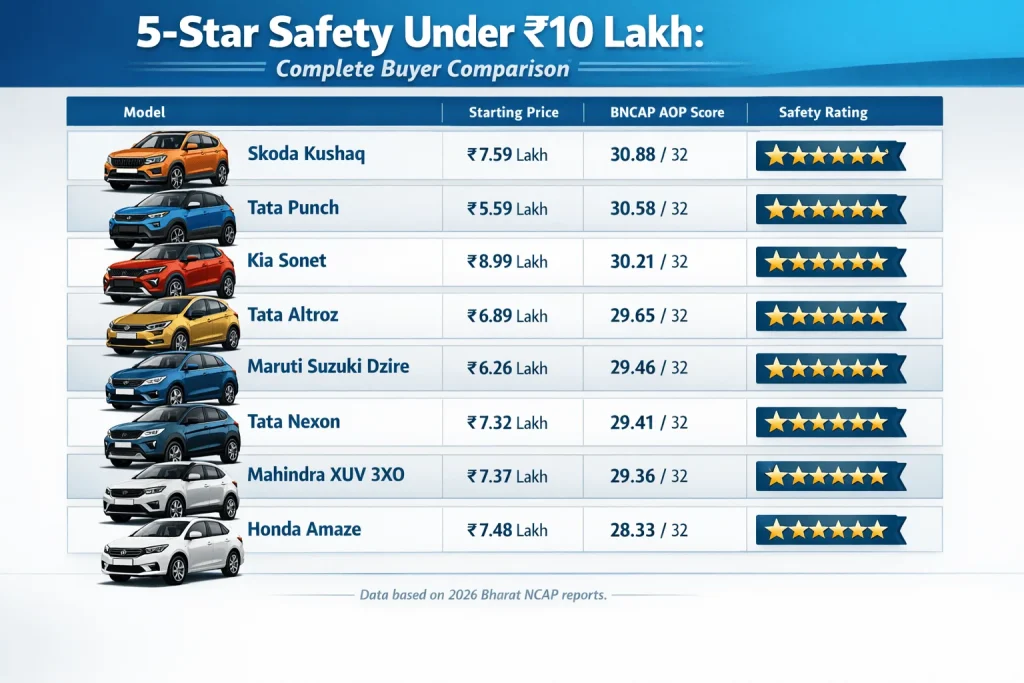
1. Tata Punch (from ₹5.59 Lakh), BNCAP: 30.58 AOP / 45.00 COP
The cheapest 5-star car in India. Period. The 2026 facelift scored 30.58 out of 32 in adult protection, which is remarkable at this price. What Tata has done well here is that even the base Smart variant gets 6 airbags, ESC, ISOFIX child-seat anchors, and TPMS as standard. No safety feature stripping across trims.
The base variant does miss a day/night interior rearview mirror and an infotainment screen. If you’re driving at night on unlit highways where high-beam abuse from oncoming traffic is constant, stepping up to the Adventure trim for the anti-glare IRVM and reverse camera makes practical sense.
2. Skoda Kylaq (from ₹7.59 Lakh), BNCAP: 30.88 AOP / 45.00 COP
The Kylaq actually has a higher AOP score than the Punch (30.88 vs 30.58) and sets a new standard for base-variant safety. The Classic base trim gets 6 airbags, ESC, traction control, multi-collision braking, ISOFIX, and three-point seatbelts with adjustable headrests for all five seats. No other car at this price matches that level of safety completeness out of the box. Highway stability feels genuinely confident for a sub-4 metre SUV, with instrumented tests confirming superior 100-0 km/h braking versus segment rivals.
3. Maruti Suzuki Dzire (from ₹6.26 Lakh), BNCAP: 29.46 AOP / 41.57 COP
This car shattered Maruti’s long-running safety reputation problem. The new-generation Dzire scored 5 stars in both BNCAP and Global NCAP, using advanced high-tensile steel reinforcement. You get 6 airbags, ESC, and hill-hold assist from the absolute base LXI trim. For city commuters who need a proper sedan with a usable boot, this is a safe and practical choice.
4. Tata Altroz (from ₹6.89 Lakh), BNCAP: 29.65 AOP / 44.90 COP
The premium hatchback segment’s safety leader. With a near-perfect child protection score of 44.90 out of 49, the Altroz deserves a close look if you’re transporting young children regularly. Higher trims add a 360-degree camera and blind-spot monitoring.
5. Tata Nexon (from ₹7.32 Lakh), BNCAP: 29.41 AOP / 43.83 COP | GNCAP: 32.22/34 AOP
The Nexon holds the second-highest Global NCAP score ever recorded for an Indian car. Its body shell has been proven across multiple generations of testing. Standard across all variants: 6 airbags, ESC, ABS with EBD, and ISOFIX. Want a compact SUV with a well-documented crash safety track record? The Nexon is hard to argue against.
6. Mahindra XUV 3XO (from ₹7.37 Lakh), BNCAP: 29.36 AOP / 43.00 COP
The XUV 3XO is the only car in its class offering four-wheel disc brakes as standard across every trim, from the base MX1 upward. That directly improves your panic-braking performance and reduces brake fade on long highway descents. If you want ADAS, the AX7 and AX7 Luxury trims bring radar-and-camera fusion Level 2 ADAS that works reliably even in dusty or rainy conditions because it doesn’t rely on cameras alone.
7. Honda Amaze (from ₹7.48 Lakh), BNCAP: 28.33 AOP / 40.81 COP
The third-generation Amaze scored 5 stars in AOP and 4 stars in COP. Standard features include 6 airbags, ISOFIX, ESC, and rear parking sensors. A solid sedan choice, but worth noting that its COP score of 40.81 is the lowest among 5-star cars on this list. If child protection is your priority, the Altroz or Punch score considerably higher.
8. Kia Syros (from ₹8.99 Lakh), BNCAP: 30.21 AOP / 44.42 COP
Kia engineered out the structural issues from its older platforms with this one. The reinforced hot-stamped steel base structure pushed AOP to 30.21. Standard across the range: 6 airbags, ESC, and TPMS.
Safest Cars Under 15 Lakhs
Once you cross the ₹10 lakh mark, your options open up considerably. Midsize SUVs, premium sedans, cars with Level 2 ADAS. Something worth knowing if you do highway driving: sedans in this bracket are inherently safer than tall SUVs because of their lower centre of gravity and better rollover resistance.
Sedans: The Highway Safety Picks
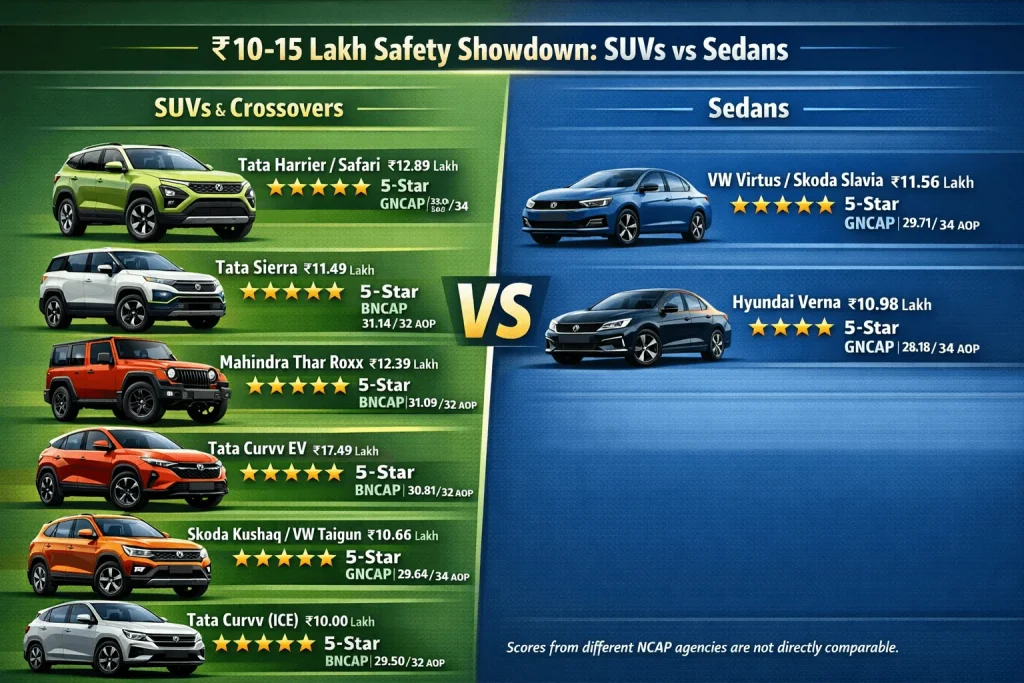
Volkswagen Virtus / Skoda Slavia (from ₹10.00-11.56 Lakh), GNCAP: 29.71 AOP / 42.00 COP
These platform twins are your best bet for sustained highway driving under ₹15 lakh. Tested under Global NCAP’s stricter updated protocol, both scored 5 stars. Their low centre of gravity and tuned suspension provide unmatched emergency lane-change stability compared to any tall SUV at this price. Multi-collision braking and ESC come standard. If your commute involves regular expressway runs, a sedan like the Virtus or Slavia offers fundamentally lower rollover risk than similarly priced SUVs.
Hyundai Verna (from ₹10.98 Lakh), GNCAP: 28.18/34 AOP / 42.00 COP
The Verna scored 5 stars under Global NCAP’s new protocol. It’s one of the few cars in its segment offering an optional centre airbag, which prevents head-clash injuries between driver and front passenger during severe side impacts. A strong choice if you value both technology and crash protection in a premium sedan package.
SUVs and Crossovers
Skoda Kushaq (from ₹10.66 Lakh) and Volkswagen Taigun (from ₹11.42 Lakh), GNCAP: 29.64 AOP / 42.00 COP
Both share the MQB-A0-IN platform and score identically in crash tests. Standard ESC and multi-collision braking across their ranges. Solid mid-range SUV options with proven crash performance.
Tata Sierra (from ₹11.49 Lakh), BNCAP: 31.14 AOP / 44.73 COP
The Sierra stands out in this bracket. Seven airbags (including a driver knee airbag), all-wheel disc brakes, and an electronic parking brake with auto-hold. That’s the kind of equipment list you’d normally expect at double the price. The child protection score of 44.73 is near-perfect. If you’re a family with two child seats, the Sierra’s wider cabin allows both to be fitted without cramping the front row. It scored full marks for dynamic child protection in simulated crashes.
Tata Harrier / Safari (from ₹12.89-13.29 Lakh), BNCAP: 30.08 AOP / 44.54 COP | GNCAP: 33.05/34 AOP
These two hold the highest Global NCAP score of any Indian car under the updated protocol. 33.05 out of 34. Near-perfect. The updated models get Level 2 ADAS with autonomous emergency braking, rear cross-traffic alert, and blind-spot detection. Available in petrol (1.5L turbo, 168 bhp) and diesel. If long-distance family touring is your primary use case, the Harrier and Safari are hard to beat on safety credentials. The Safari adds a third row if you need it.
Mahindra Thar Roxx (from ₹12.39 Lakh), BNCAP: 31.09 AOP / 45.00 COP
A perfect 45 out of 49 in child protection paired with 31.09 in AOP. The AX5L and AX7L trims add ADAS with radar-camera fusion. The Thar Roxx combines off-road capability with genuinely strong crash performance.
Tata Curvv (from ₹10.00 Lakh ICE / ₹17.49 Lakh EV), BNCAP: 29.50 AOP (ICE) / 30.81 AOP (EV)
The coupe-SUV design doesn’t compromise safety. Built on a heavily evolved Tata platform, the Curvv ICE scores a solid 29.50 in AOP. The EV version does noticeably better at 30.81, and adds an acoustic vehicle alerting system for pedestrian safety.
Safety Features That Matter Most
Star ratings tell you how a car performed in a controlled lab crash. But what about real Indian roads, with their speed breakers, stray cattle, and monsoon-soaked highways? Here’s what you should actually look at when making your buying decision.
Body Shell Integrity: The One Thing That Matters Above All Else
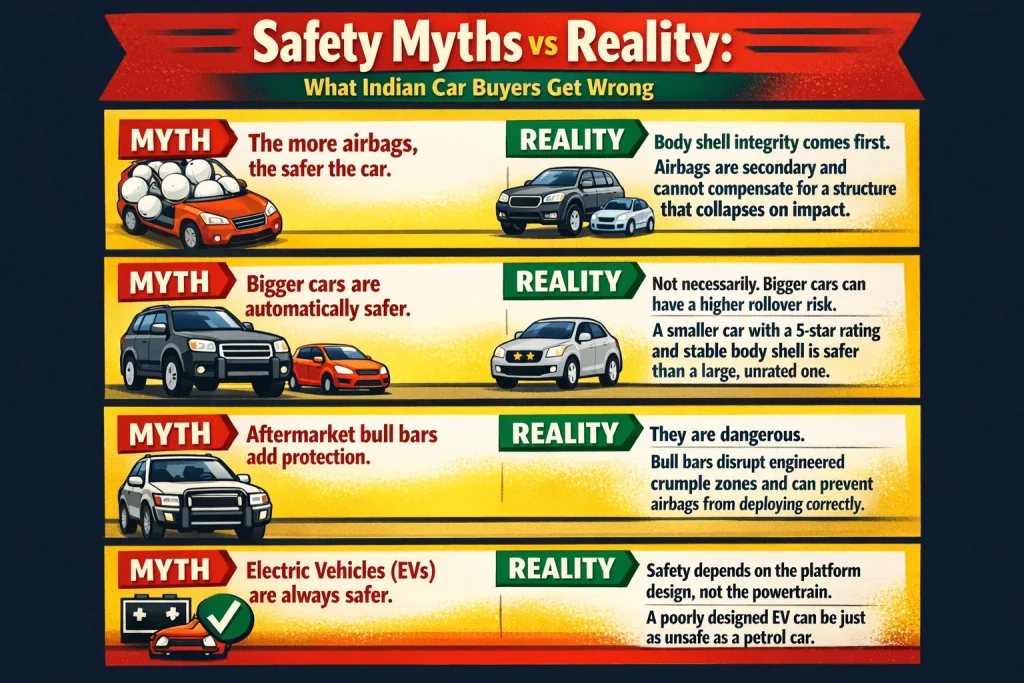
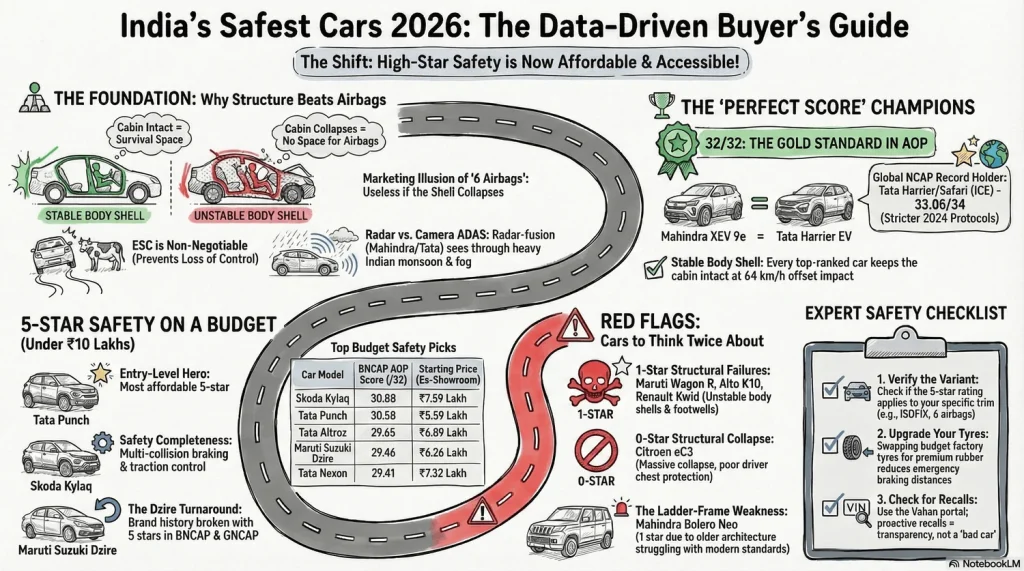
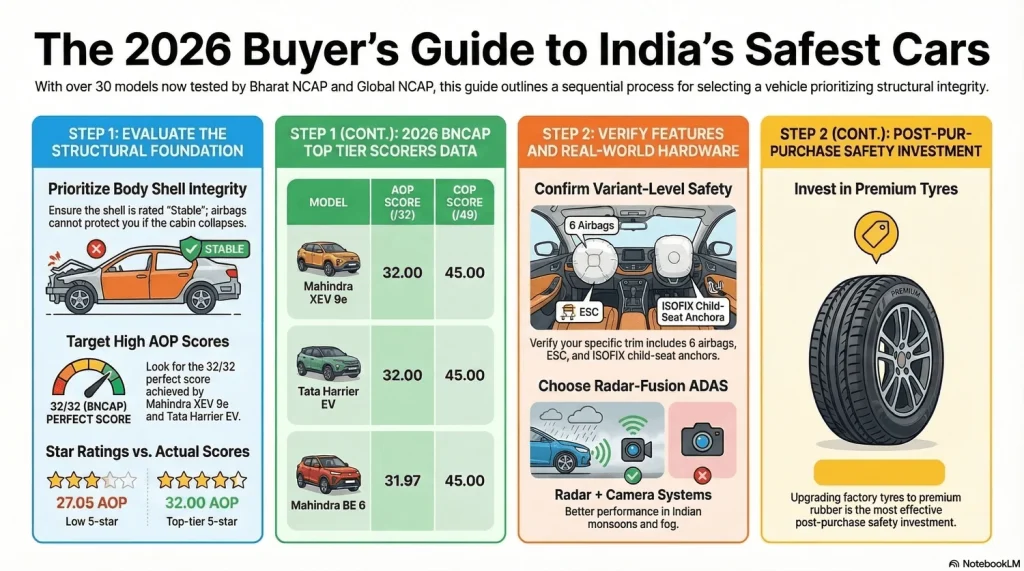
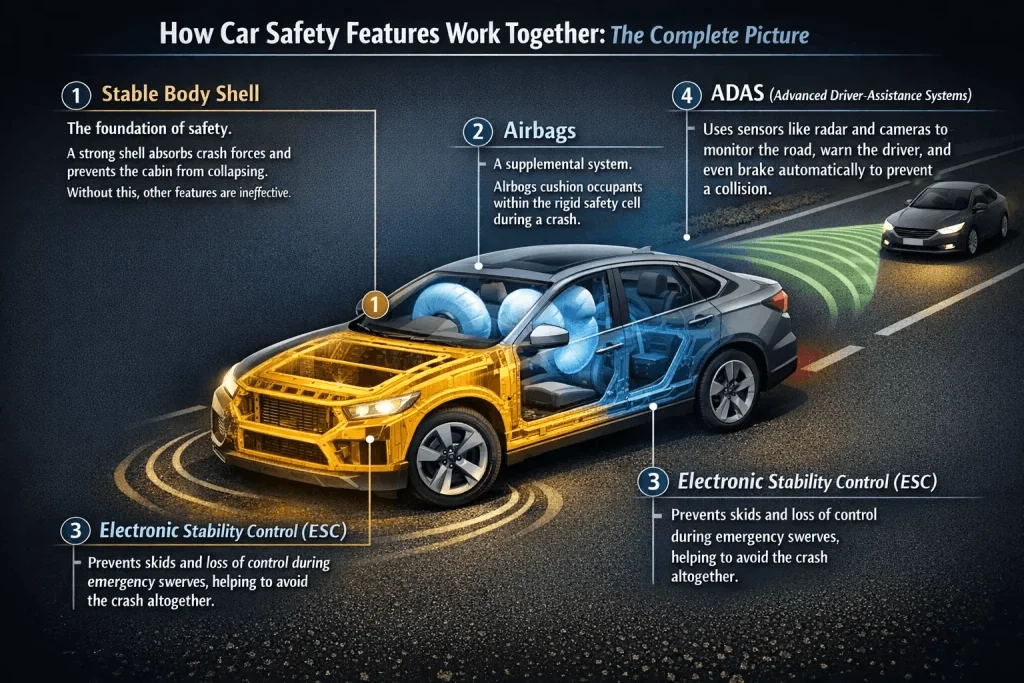
Everything else depends on this. Your airbags, your seatbelts, your crumple zones, they’re all secondary systems. The primary protection is the structural cage around you. If a car’s body shell is rated “unstable,” the cabin collapses inward during a high-speed impact. At that point, 6 airbags or even 8 won’t help you. They deploy into a shrinking space and can’t prevent the crushed dashboard from reaching you.
Sounds counterintuitive, but a vehicle with only 2 airbags and a confirmed stable 5-star body shell offers you better survivability than a structurally unstable vehicle packing 6 airbags. Every car in our 5-star tables above has a confirmed stable shell.
Six Airbags Don’t Make a Car Safe Automatically
This is probably the biggest marketing illusion in the Indian car market right now. Manufacturers have raced to standardize six airbags, and you’ve probably been conditioned to treat airbag count as the primary safety metric. That thinking can get you hurt.
Airbags are supplemental restraint systems. They cushion your body’s deceleration within a rigid, intact cabin. But what happens if the vehicle’s skeleton collapses on impact? The airbags deploy into a shrinking space. They can’t stop the crushed dashboard and intruding steering column from reaching you.
Your priority should always be a stable body shell and good AOP score over raw airbag count.
ESC: Non-Negotiable for Indian Roads
Indian highways throw hazards at you that no crash test simulates. Sudden pedestrian crossings. Unmarked concrete barricades. Stray cattle on pitch-dark stretches. ESC prevents catastrophic loss of control during emergency swerves, and every 5-star car in India now offers it as standard. If any car you’re considering doesn’t have ESC, walk away.
Are Bigger Cars Automatically Safer?
Not really. You’ve probably noticed the surge in compact SUV popularity across India. A big driver of that trend is the perception that heavier, taller vehicles keep you safer. But research from the Insurance Institute for Highway Safety (IIHS) tells a different story. Once a vehicle’s curb weight exceeds the fleet average, the marginal safety benefit to your occupants flattens out. The added mass does, however, exponentially increase damage to smaller vehicles and pedestrians in a collision.
SUVs also carry higher rollover risk. Their elevated centre of gravity makes them more prone to tipping during high-speed emergency swerves. Low-slung sedans and hatchbacks handle emergency lane changes more predictably.
So what should you base your decision on? Crash test data and body shell integrity. Not size.
ADAS: Check What Hardware It Uses
ADAS is increasingly common in cars above ₹12 lakh. But here’s what most buyers don’t ask: what hardware does it actually use?
Camera-only ADAS (common in budget cars) struggles badly in dense North Indian winter fog, heavy monsoon rain, and dusty rural unpaved roads. When the camera lenses can’t see, the system switches off. You’re on your own.
Radar + camera fusion ADAS (Mahindra uses this in the XUV 3XO AX7L, XEV 9e, and BE 6; Tata uses it in the Harrier/Safari) can see through heavy rain and fog because radar doesn’t depend on optical clarity. If you’re buying a car with ADAS for genuine highway safety, ask the dealer whether it uses radar fusion or camera-only.
Something else you should know: ADAS sensor recalibration after even a minor bumper scuff or windshield replacement costs ₹25,000-50,000 at authorized service centres. Many owners in smaller cities skip this because they don’t know it’s required or can’t afford it. An uncalibrated ADAS system can misjudge distances or trigger false emergency braking on a highway. That’s worse than having no ADAS at all.
Your Tyres Matter More Than You Think
Most Indian cars under ₹15 lakh ship from the factory with OEM tyres optimized for low rolling resistance. These inflate the brochure’s ARAI mileage figure, sure. But they have poor wet grip and longer braking distances on actual roads.
Upgrading to premium rubber (Michelin Primacy or Bridgestone Turanza) right after delivery is arguably the single most effective safety investment you can make. Good tyres directly reduce your emergency stopping distances and cut aquaplaning risk during monsoon highway driving. It’s a relatively small expense that makes a measurable difference to how your car behaves in an emergency.
Aftermarket Accessories Can Compromise Your Car’s Safety
Rigid aftermarket bull bars disrupt your car’s crumple zones and block impact sensors needed for airbag deployment. Oversized alloy rims increase unsprung mass, which extends your braking distances.
What about electrical modifications? Hardwired dashcams, aftermarket 360-degree cameras, ambient lighting kits. These tap into the vehicle’s CAN-bus digital network. Improper wiring can disrupt electronic control units. In the milliseconds of a crash, a compromised ECU may fail to trigger airbag deployment.
Put your money into premium tyres instead. Keep the electrical system factory-original.
Don’t Assume All Variants Get the Same Safety Kit
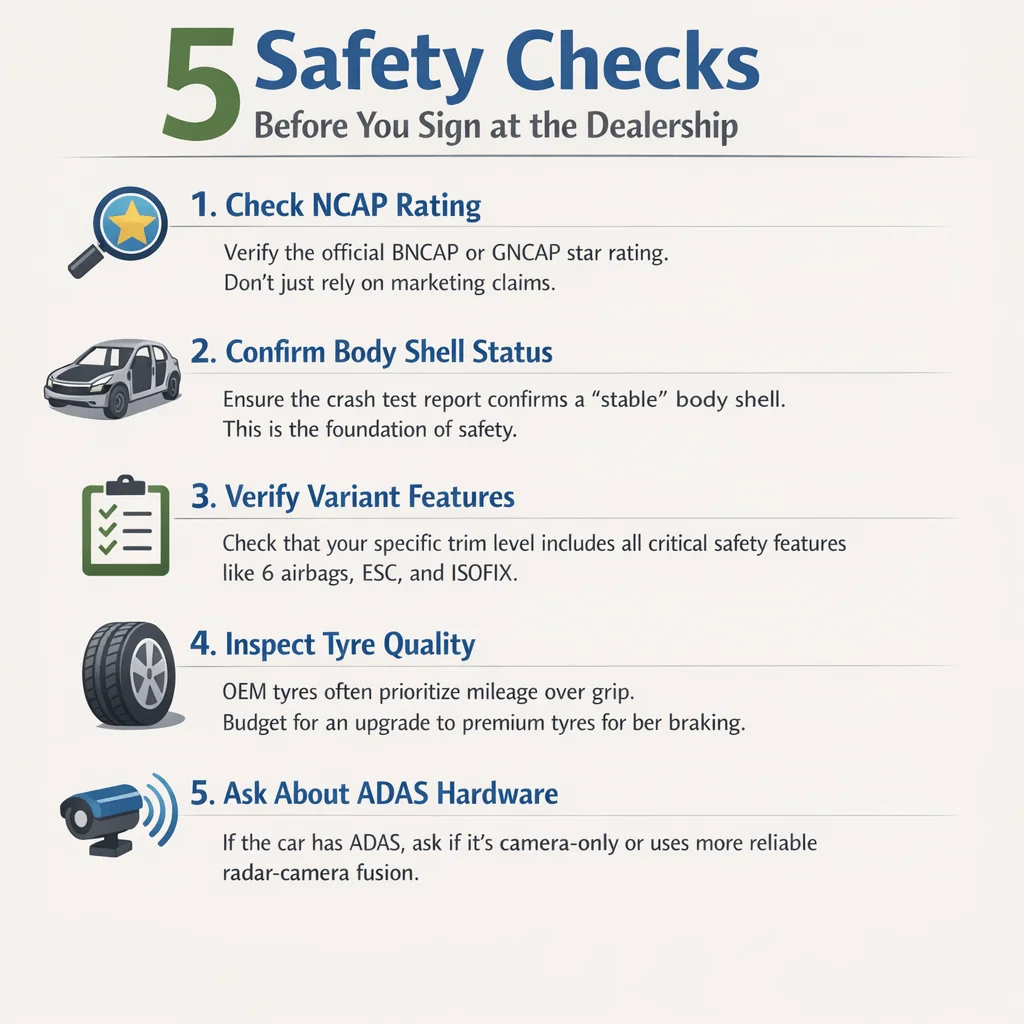
A 5-star rating earned by a top-spec variant doesn’t guarantee the same protection in the base model. Some manufacturers strip critical features from lower trims to hit attractive starting prices. Before you sign at the dealership, verify that your specific chosen variant includes:
- 6 airbags (minimum)
- ESC / ESP
- ISOFIX child-seat anchors
- Three-point seatbelts for all five occupants (not a lap belt for the rear middle seat)
- Adjustable rear headrests (fixed headrests can increase whiplash risk)
Which brands get this right? Tata (Punch, Nexon), Skoda (Kylaq), and Mahindra (XUV 3XO) offer all critical safety features from their base variants. The Hyundai Exter, on the other hand, omits ISOFIX and uses fixed rear headrests in its lower trims. That’s worth knowing if you’re cross-shopping in the micro-SUV space.
Recalls Are Good News, Not Bad
In 2025, over 119,000 vehicles were recalled in India. Maruti recalled nearly 40,000 Grand Vitaras for fuel gauge inaccuracies that could cause highway stalling from fuel starvation. Skoda-Volkswagen recalled 49,000 vehicles for potentially faulty rear seatbelt components. Hyundai recalled thousands for airbag sensor calibration.
Should that concern you? Actually, a proactive recall is good news. It means the manufacturer is monitoring post-sale telemetry and fixing defects before they cause harm. The manufacturers you should worry about are the ones that silently patch critical issues during routine servicing without telling you. Check your VIN against the government’s Vahan portal to make sure no pending recalls are sitting unaddressed on your car.
FAQs
Which is the safest car in India right now?
By pure crash test scores, the Mahindra XEV 9e and Tata Harrier EV share the top spot with a perfect 32 out of 32 in Bharat NCAP adult occupant protection. If you’re looking for the most affordable safest car, the Tata Punch at ₹5.59 lakh with a score of 30.58/32 is the strongest value-for-safety pick in the country. Under Global NCAP’s updated protocol, the Tata Harrier/Safari leads all Indian cars at 33.05 out of 34.
What is the safest car under 10 lakhs?
The Tata Punch (30.58 AOP, from ₹5.59 lakh) offers the best safety-to-price ratio. If you want the highest BNCAP score under ₹10 lakh, the Skoda Kylaq (30.88 AOP, from ₹7.59 lakh) edges it out and comes with unmatched base-variant safety equipment including traction control and multi-collision braking.
Does Maruti have any 5-star rated car?
Yes. Maruti now has four 5-star rated models:
- Maruti Suzuki Victoris with 31.66 AOP in BNCAP (their highest score)
- Maruti Suzuki e Vitara with 31.49 AOP in BNCAP
- Maruti Suzuki Invicto with 30.43 AOP in BNCAP
- Maruti Suzuki Dzire with 5-star ratings in both BNCAP (29.46 AOP) and Global NCAP
The Dzire was the first Maruti car ever to achieve a 5-star Global NCAP rating.
What’s the difference between Bharat NCAP and Global NCAP?
Both agencies conduct frontal offset and side-impact crash tests. Bharat NCAP tests cars built specifically for the Indian market and scores AOP out of 32 and COP out of 49, with an optional side pole impact test. Global NCAP is an international body using slightly different protocols. Its updated 2023+ testing scores AOP out of 34. A car can be tested by both agencies. The scores from the two aren’t directly comparable because the testing protocols differ.
Are electric vehicles safer than petrol/diesel cars?
EVs carry heavy battery packs low in the chassis, which drops the centre of gravity and reduces rollover risk. The Mahindra XEV 9e and Tata Harrier EV are the two safest cars ever tested by Bharat NCAP, and both happen to be EVs. But their safety comes from purpose-built EV platforms with fortified battery housing, not from the electric powertrain itself. A poorly designed EV like the Citroen eC3 (0-star GNCAP) is just as dangerous as a poorly designed petrol car.
Should I avoid cars that haven’t been NCAP tested?
An unrated car isn’t necessarily unsafe, but you have no independent proof of its crash performance. Given that 5-star tested options now start from ₹5.59 lakh (Tata Punch), there’s little reason to take that gamble in 2026. If you’re still considering an unrated car, at minimum confirm that it offers 6 airbags, ESC, and sits on a modern monocoque platform from a manufacturer with a proven track record.
Do aftermarket bull bars improve safety?
No. They actively harm it. Rigid bull bars disrupt the vehicle’s crumple zones, which are engineered to absorb crash energy away from the passenger cabin. They also block impact sensors that trigger airbag deployment. After the 2017 Supreme Court ban, fitting aftermarket crash guards is technically illegal, though enforcement remains lax. If you want better protection, invest in premium tyres and maintain correct tyre pressure. That’ll do far more for your safety than any bull bar.