
If you want the short answer, the number you get in the used market usually comes down to four basics: what you bought, how well you maintained it, how clean the paperwork is, and when you decide to sell.
That’s why two similar five-year-old cars can get wildly different quotes.
If your car is a mainstream hatchback or compact SUV, has full service history, both keys and matching tyres, plus a neutral colour, you’ll likely get a stronger quote. A neglected car with patchy records and “fancy” modifications rarely does. Timing matters too. Sell too late, and you start losing money to big maintenance bills, a facelift announcement, or local regulation pressure.
This guide uses current 2026 used-car market data, seller platform trends, and India-specific resale patterns to show you what actually moves the price. Selling now? If you plan to replace the car soon, start there early. Use this next car guide so you don’t repeat the same resale mistakes on the next purchase.
You’re trying to protect money, not just move a car.
And yes, you can influence the final number more than most sellers think.
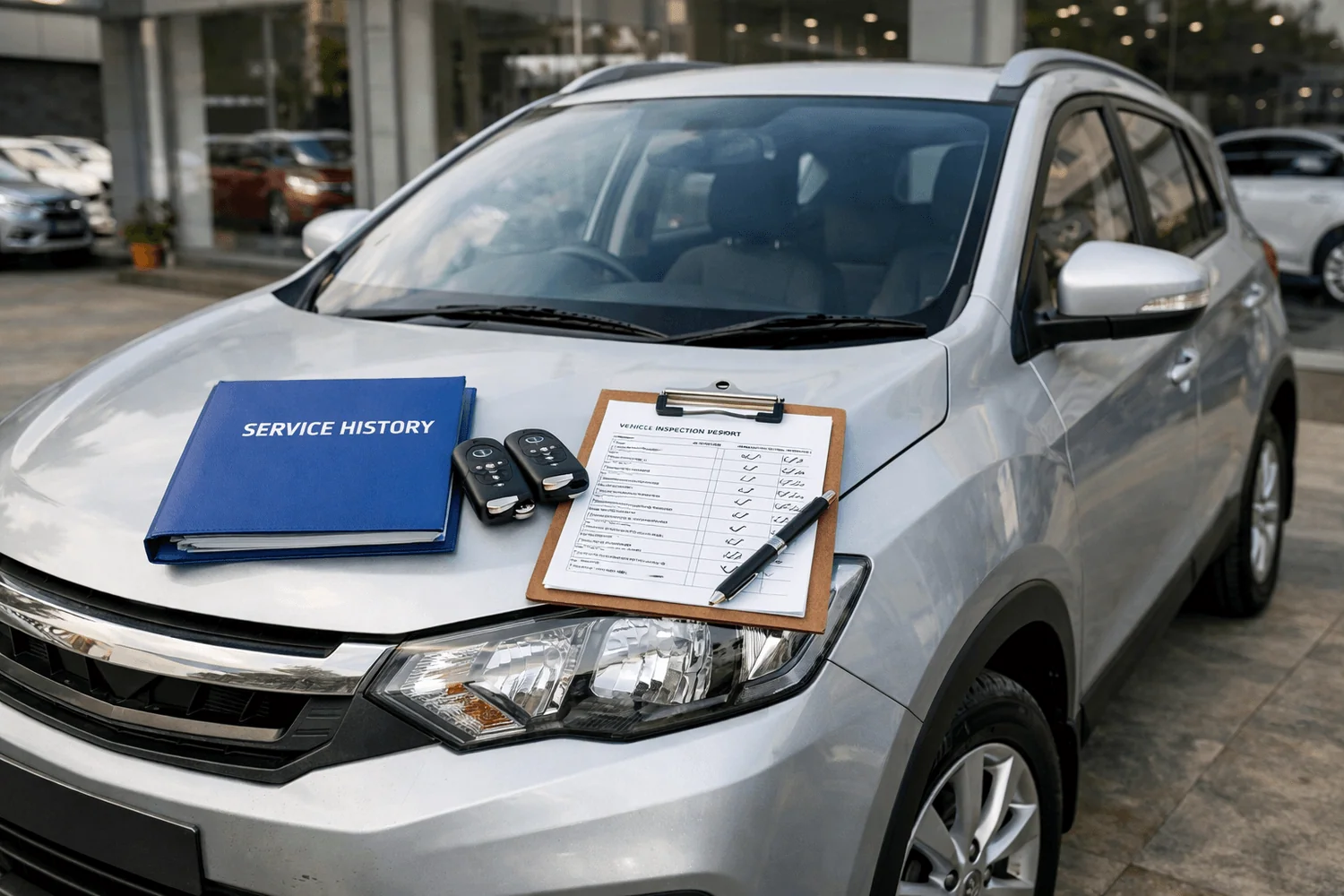
Cars With Best Resale Value in India
If your question is simply, “Which cars have best resale value in India?”, the safest answer is still mainstream, high-demand models from brands with wide service reach and predictable running costs.
In current used-car market data, hatchbacks continue to hold value very well over the long run, while SUVs stay strong in the first few years. That’s why the usual resale winners are not random. These are cars with strong demand in metro and tier-2 markets, easy parts availability, and a reputation for being painless to own.
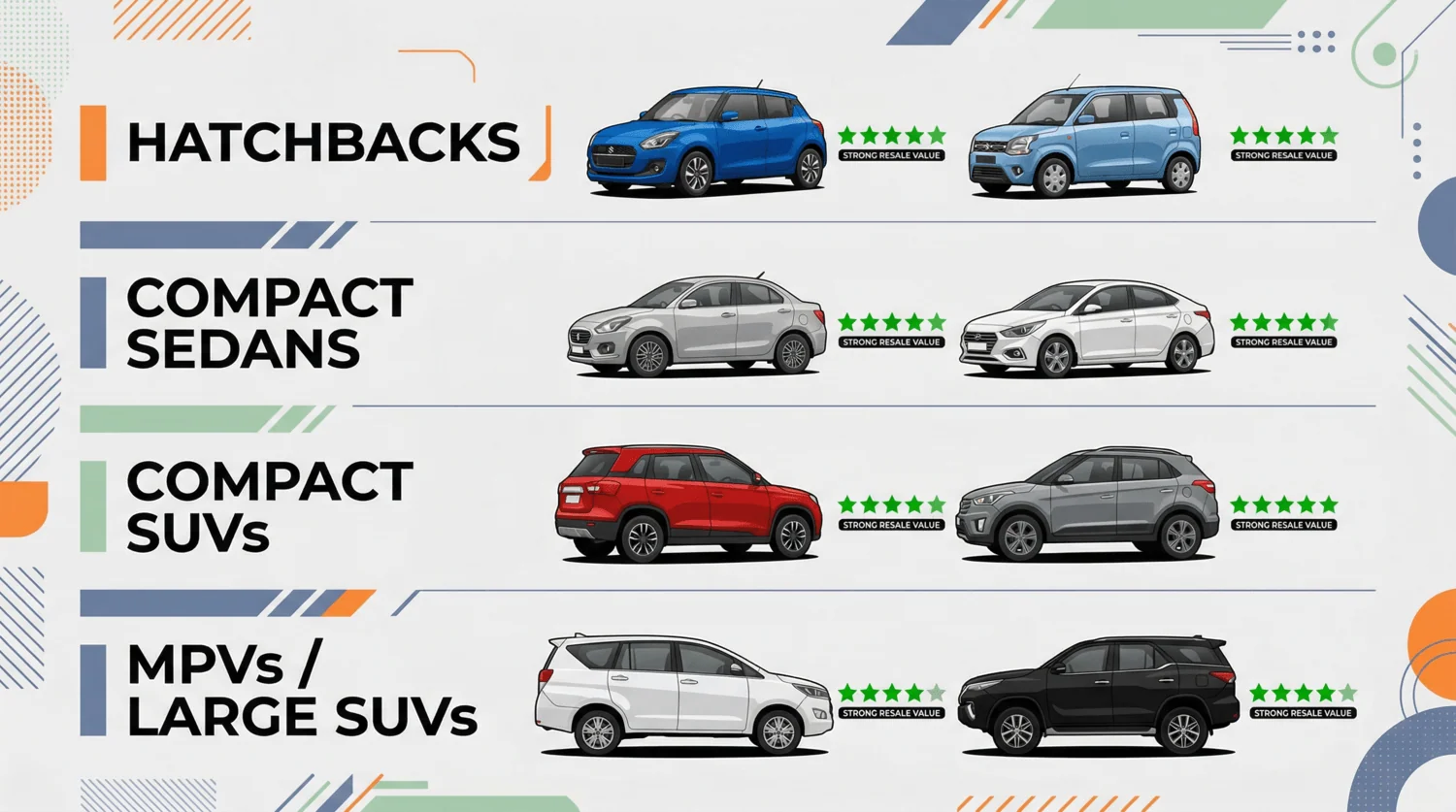
These names keep showing up when you look at broad market patterns rather than one-off dealer quotes:
| Segment | Strong resale examples | Why they hold value well |
|---|---|---|
| Hatchbacks | Maruti Suzuki Swift, Wagon R, Hyundai Grand i10 Nios | Easy to sell, low running cost, huge buyer pool, strong demand from first-time buyers |
| Compact sedans | Maruti Suzuki Dzire, Honda City | Reliable badge value, city demand, proven service support |
| Compact SUVs | Hyundai Creta, Maruti Suzuki Brezza, Tata Nexon | SUV demand stays high, family appeal, strong used-market interest |
| MPVs and large SUVs | Toyota Innova Crysta, Toyota Fortuner | Reliability image, premium demand, fleet and private buyer interest |
The pattern behind these names is more important than the names themselves.
- Maruti Suzuki models stay liquid because used-car shoppers trust the service network and parts prices.
- Hyundai cars do well too. The badge is familiar, and the service reach is broad.
- Toyota products sit in a class of their own for long-term value retention, especially the Innova Crysta and Fortuner.
- Tata and Mahindra can hold value strongly on specific SUVs, but resale depends more on the exact model and local demand.
Body style matters too. Simple as that:
- Hatchbacks tend to make the safest long-term resale bet because they appeal to the widest second-hand buyer base.
- SUVs often look strongest in the first three years because demand is high and buyers are willing to pay for road presence.
- Sedans still work, but mostly for specific models with loyal demand rather than the segment as a whole.
Fuel type changes the story. Petrol remains the cleanest used-market choice for most private buyers. Diesel still works in several markets, especially for bigger SUVs, but it carries more location risk. EV resale is improving slowly, but hesitation around battery health and replacement cost still keeps used EV prices under more pressure than comparable petrol cars.
If you already own one of the safer mainstream models, you’re starting from a much better place than you think. You already have buyer trust on your side.
One point many owners miss: retention is not only about percentage retained. Liquidity matters too. If your car sells in five days with minimal negotiation, that’s often better than waiting three weeks for a slightly higher quote.
Factors That Affect Resale Value
Most owners think depreciation in India is mostly about age and kilometres. That’s only half true.
Insurance follows a fixed depreciation framework, but the market does not. Your IDV is a useful insurance number. It won’t tell you what the market will actually pay. In the real world, dealers and platforms price in service history, accident record, tyre condition, ownership count, model demand, city preference, plus how much friction they expect during RC transfer.
If you remember only one thing here, remember this: your resale quote is really a trust score.
Start with the formal depreciation baseline:
| Vehicle age | IRDAI depreciation benchmark |
|---|---|
| Up to 6 months | 5% |
| 6 months to 1 year | 15% |
| 1 year to 2 years | 20% |
| 2 years to 3 years | 30% |
| 3 years to 4 years | 40% |
| 4 years to 5 years | 50% |
Now compare that with actual market behaviour. A new car takes its biggest hit in the first year. After that, depreciation becomes more model-dependent. A high-demand Wagon R, Swift, Brezza, Creta or City will age much better than a niche model, a discontinued badge, or a feature-heavy top trim with weak used demand.
This is what moves the price most in practice:
| Factor | What buyers or platforms look at | Effect on resale |
|---|---|---|
| Age and mileage | Model year, odometer, usage pattern | Bigger drop in the first year, then gradual decline |
| Service history | Authorised or documented maintenance records | Clean records build trust and improve the quote |
| Accident history | Repainted panels, structural repair, flood damage | Major value hit, especially for structural repair |
| Tyres and battery | Matching tyres, usable tread, healthy battery | Neglect here quickly triggers deductions |
| Ownership history | First owner vs multiple owners | Fewer owners often means better buyer confidence |
| Fuel type and gearbox | Petrol, diesel, CNG, EV, manual, automatic | Automatics do better in metros, while manuals stay easier in smaller markets |
| Colour and variant | Neutral colours, sensible trim | Easier resale and faster sale time |
| Documents | Insurance, NOC, challans, duplicate key, loan closure | Clean paperwork reduces friction and supports a better offer |
| Market timing | Facelift, year-end, festive season, local regulation | The same car can get different quotes in different months |
Some of these factors are more brutal than owners expect.
Service history matters more than “low km”
A car with slightly higher mileage and complete service records often looks safer than a low-km car with missing bills. That is particularly true on platform-based valuations, where incomplete history makes the evaluator assume deferred maintenance.
Small inspection issues become big money deductions
Mismatched tyres, faded headlights, torn seats, a weak battery, a dead infotainment screen, or a missing duplicate key all tell the inspector the same thing: this owner cut corners. Even if the engine is fine, the quote tends to drop because the next buyer now expects hidden issues.
Duplicate keys and paperwork are underrated
Missing a second key is not a trivial problem on a modern car. Replacement can cost real money, especially on cars with smart keys and push-button start. The same goes for pending challans, active hypothecation, or RC transfer complications.
NCR and rule-sensitive diesel cars face extra pressure
Diesel resale is not dead across India, but it is more location-sensitive than before. In and around Delhi-NCR, age-related diesel restrictions and enforcement uncertainty have made buyers more cautious. Outside that zone, large diesel SUVs can still sell well if the model remains desirable. Location-dependent, not fuel-dependent.
BH registration can slow a private sale
BH-series registration is useful while you own the car across states. But it can complicate resale to the next private buyer compared with a standard state registration. That does not kill the deal, but it can reduce your buyer pool.
If your car carries BH registration, be ready to explain the transfer process clearly when you talk to buyers.
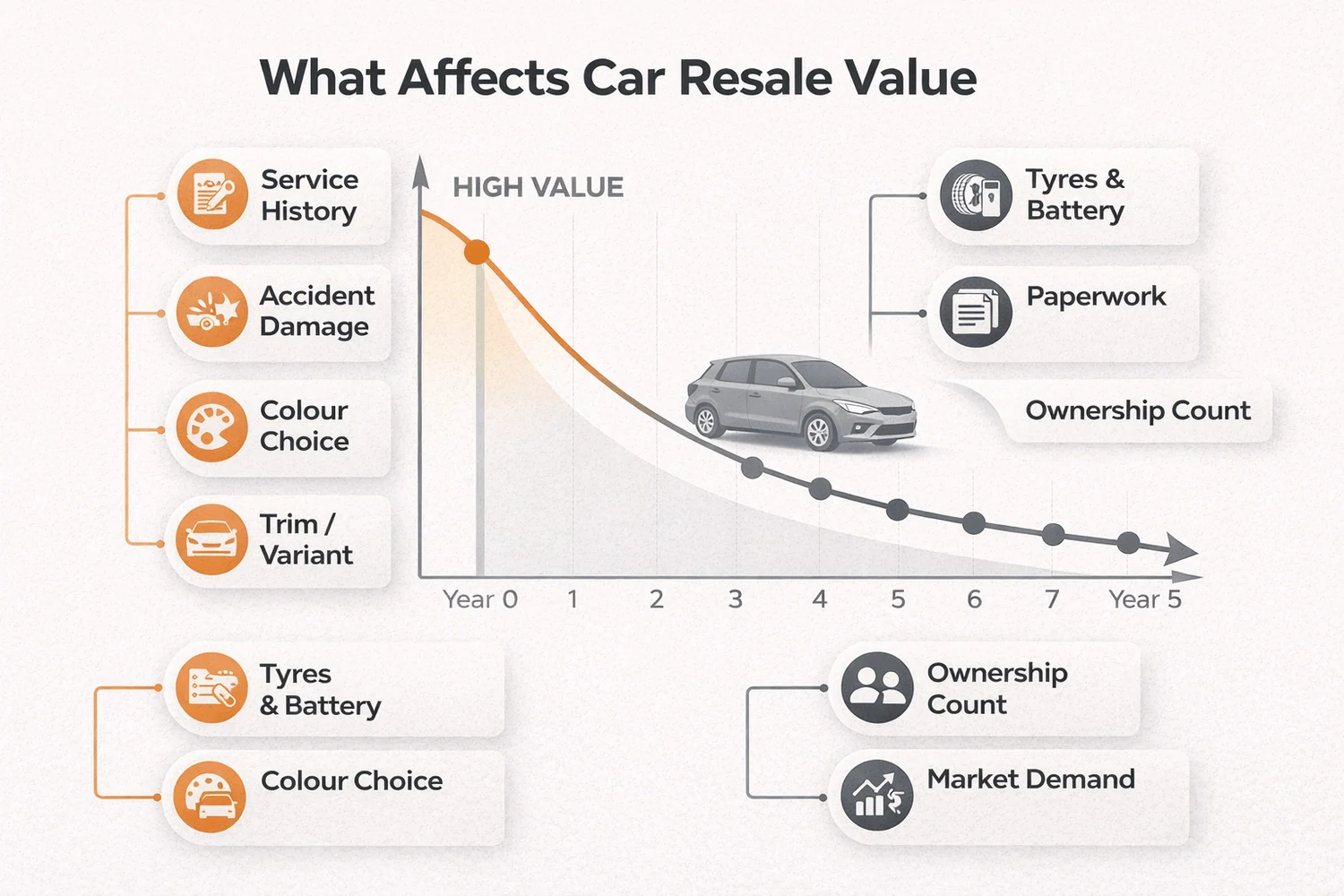
If you only want the quick answer to “How much does a car depreciate per year?”, use this rule of thumb:
- expect the sharpest drop in the first year
- expect steady decline over the next few years
- expect much better retention if the model stays in demand, and the vehicle stays stock, properly maintained, with simple paperwork
That is also why resale matters before you buy a new one, not only when you sell. Choose badly, and you’re fighting the market from day one.
An insurance table won’t buy your vehicle. A cautious used-car buyer will, and that’s the difference.
8 Tips to Maximize Your Car’s Resale Value
If you’re trying to lift the final quote, these are the moves that make the biggest difference in the Indian market.
1. Keep a complete service history
This is the most reliable lever you control from day one. Save invoices and keep the service booklet updated. Don’t ignore scheduled maintenance, because buyers trust documented cars and evaluators do too.
If you skip bills or delay routine work, you’re inviting a lower quote later.
2. Fix small visible issues, not expensive major repairs
Do not list the vehicle with obvious dents, bumper scuffs, broken lights, or badly worn wipers if the fixes are cheap. These flaws invite aggressive negotiation. But do not pour money into a major clutch, suspension, or engine job right before selling unless that repair is absolutely necessary to close the deal.
The smart play is simple: fix what makes the vehicle look neglected, not what you are unlikely to recover in the sale price.
You don’t need a perfect listing. You need one that looks honest and well-kept.
That works better than trying to impress the buyer with expensive last-minute work.
3. Get the car detailed before inspection
A clean cabin changes the buyer’s first impression immediately. Fresh upholstery helps. Clear headlights matter. So does polished paint. Even a decent wash and interior detailing job can make the car feel cared for instead of tired.
Just do not overdo the engine bay. An unnaturally steam-cleaned engine compartment can make experienced buyers suspicious.
4. Avoid bald or mismatched tyres
If the tyres are unsafe, replace them. If they are usable, at least make sure all four are matching and presentable. Mixed brands and uneven tread signal poor maintenance. That hurts the quote more than most owners expect.
5. Keep your keys and paperwork ready
This sounds small until you start getting offers. Two keys, a clean file, valid insurance, a loan-closure letter, and major invoices make you look like a serious seller. That lowers buyer hesitation. If your paperwork feels complete, the buyer relaxes faster.
You feel the difference quickly when the conversation moves from trust to price.
6. Clear paperwork problems before listing
Don’t wait for the buyer to discover pending challans or a bank loan still marked on the RC. Clear the mess first. A car with frictionless paperwork almost always gets stronger interest because the buyer knows the transfer will move faster.
7. Sell before the expensive ownership phase starts
The best time to sell is usually before the next owner starts pricing in tyres, battery, suspension work, clutch replacement, or a major scheduled service. Once the car enters that expense zone, your negotiation power drops.
8. Compare multiple selling channels and present the car honestly
Never depend on one valuation. Check Cars24, Spinny, local dealers. Try the private market too. A fast platform sale may suit you if you want convenience. A private buyer may pay more if the vehicle is popular, looks sorted, with simple history for them to verify.
Honesty helps here. Disclose repainting, service gaps, old claims, ownership details early. Serious buyers appreciate that, and it reduces last-minute price collapse at inspection.
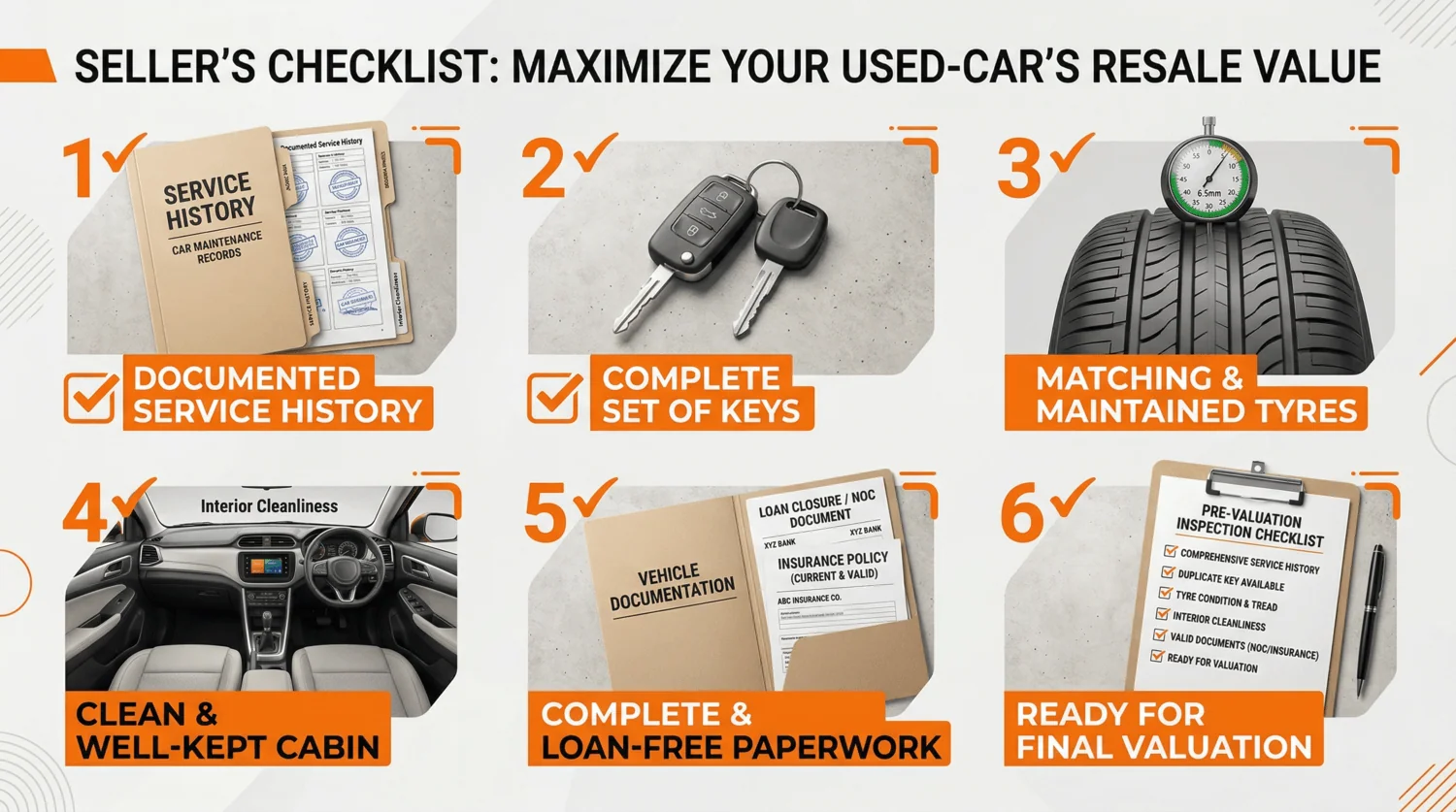
Here is the practical version most owners need:
| Do this | Avoid this |
|---|---|
| Keep the car stock and well-documented | Spend big money on major repairs you will not recover |
| Fix dents, scratches, bulbs and trim issues | Ignore visible defects and hope the buyer overlooks them |
| Compare multiple quotes | Accept the first lowball offer |
| Clear documents before listing | Start paperwork after taking a token |
| Sell while the car is still desirable | Wait until a facelift or big repair cycle hits |
If you also want to keep maintenance costs low on the next car, choose brands and models with predictable service cost. Lower running costs help used-market demand too.
Colors and Variants That Hold Value Best
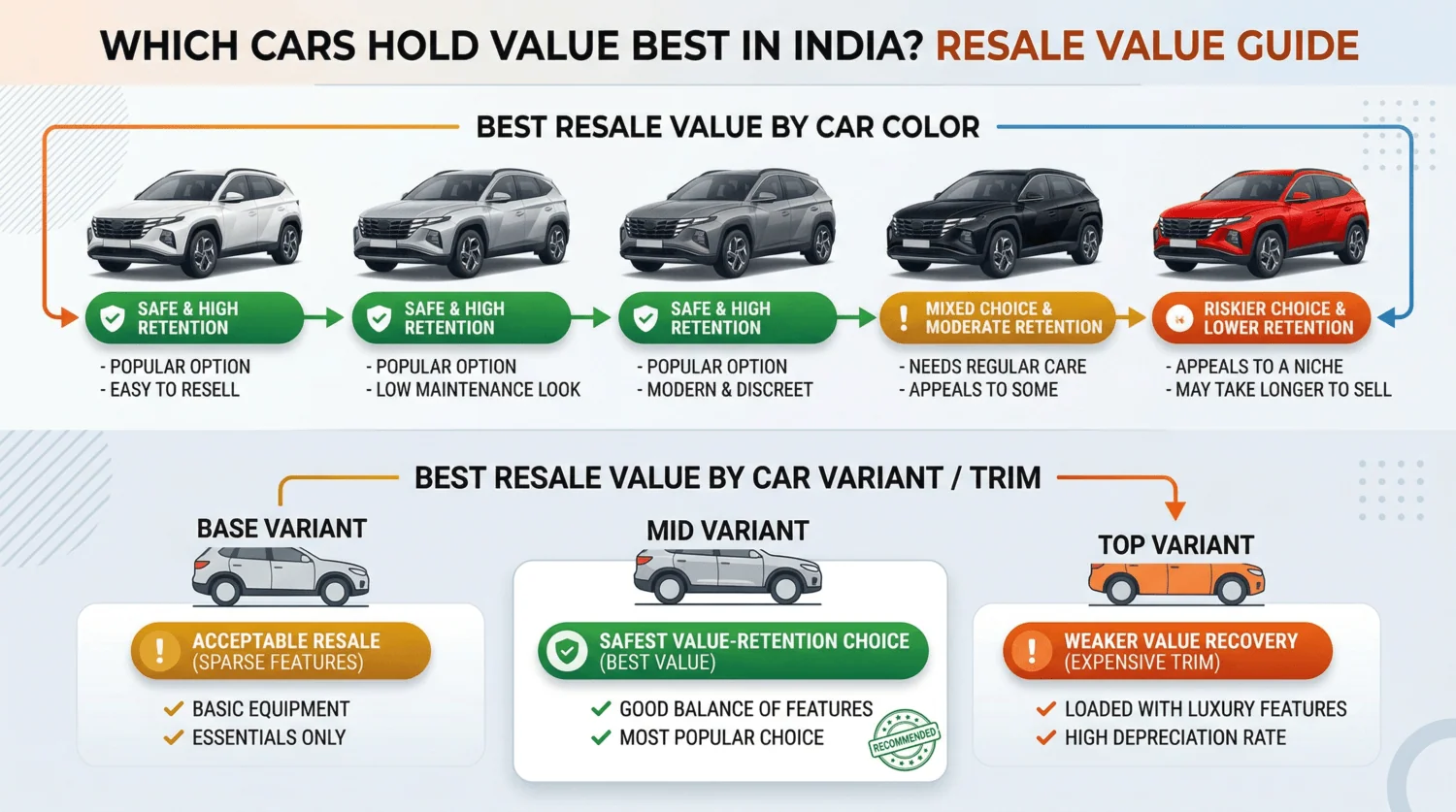
Yes, colour affects what buyers pay. In India, neutral shades still win. Very clearly.
If you want the least risky answer, white and silver remain the safest resale colours for mass-market cars. Grey works well too. Current used-car demand data shows silver doing particularly well, while white remains the easiest all-India choice because it stays cooler, looks cleaner for longer, and is easier to match if one panel needs repainting.
Black is more complicated. It can work well on premium sedans and bigger SUVs, more so in metro markets, but it shows dust and swirl marks very quickly. Scratches stand out too. Bright reds, oranges, yellows, or unusual dual-tone shades can look great when new, but they tend to shrink the buyer pool later.
Variant choice matters just as much.
The safer trim play is a sensible mid variant with the features buyers now expect:
- touchscreen and reverse camera
- alloy wheels or at least a presentable wheel setup
- rear defogger and basic comfort features
- automatic transmission if your car will be sold in a metro-heavy market
Base variants can work for budget buyers, but they often feel too bare in the used market if they miss basic convenience features. Top variants sell on aspiration, but the extra money paid for sunroofs, fancy audio, or advanced tech does not always come back in proportion when the car is five years old.
That is why a mid variant strikes the best balance between purchase price and exit ease.
If you’re buying today and resale matters to you, this is usually the smartest trim strategy.
If you love a niche shade, buy it. Just know you’ll probably wait longer when you sell.
Transmission choice has become more city-dependent:
- automatics are getting stronger resale support in metro traffic-heavy markets
- manuals still remain easier to justify in smaller towns and budget-led used-car markets
If you are buying with future resale in mind, don’t treat colour as a cosmetic decision only. It’s part of the exit math too.
When Is the Best Time to Sell?
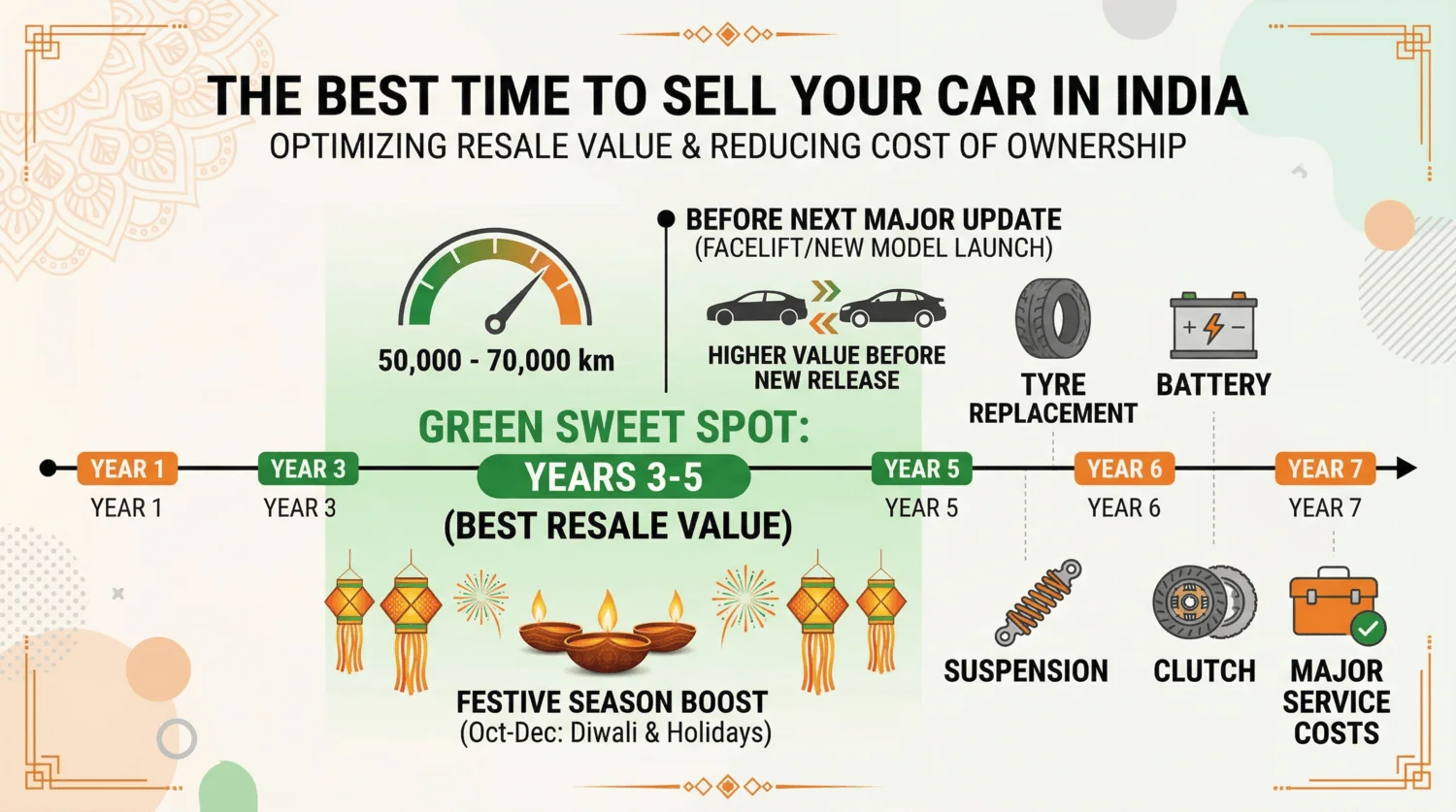
For most owners, the strongest selling window is between year three and year five, or before the odometer crosses roughly 50,000 to 70,000 km.
That’s the window where you still hold pricing power.
That is the sweet spot where:
- the car still feels modern to the next buyer
- the steep first-year depreciation is already behind you
- bigger maintenance bills are about to begin, not already spent
- the car still has decent demand if the model remains current
The market doesn’t reward late selling.
Once the next buyer mentally prices tyres, battery, brake work, suspension, clutch, insurance renewal, or an upcoming major service, your quote falls fast.
There are three more timing triggers you should watch. Miss them, and you’ll usually feel it in the quote.
1. Sell before a facelift or full model change
The moment a major facelift is announced, the outgoing version starts to look older. Buyers know this. Dealers know it too. If your model is near the end of its cycle, do not wait for the new one to hit the showroom.
2. Festive season can help sellers
Used-car demand picks up around the festive buying period, especially from Ganesh Chaturthi into the Dussehra-Diwali stretch. Buyers are more active, families are more willing to close quickly, and dealers turn stock faster.
3. March is often better for buyers than used-car sellers
This is the part many guides skip. March is great if you are buying a new car because showrooms push hard on year-end targets. But those new-car discounts can reduce the appeal of used cars at the same time. Watch that gap carefully. If the gap between a discounted new car and your used car narrows too much, resale gets harder.
One more useful market signal: current used-car reports show many first owners actually keep their car for around seven years. That may be normal behaviour, but it is not always the smartest resale point. If your priority is maximum value, the financial exit window often arrives earlier than the emotional one.
If you’re already in year four, get a benchmark quote now, even if you don’t plan to sell this month. You’ll know where you stand.
FAQs
Which cars have best resale value in India?
Mainstream hatchbacks and strong-selling SUVs do best. Think Wagon R or Swift on the small-car side, Brezza or Creta in SUVs, plus the Innova Crysta and Fortuner at the top end. They have broad demand, strong service support, and easier liquidity than niche nameplates.
Does color affect resale value?
Yes, and by a wide margin. White is the safe bet, silver stays strong too. Grey works well. Those shades appeal to more buyers and are easier to maintain visually. Bright or niche colours take longer to sell.
How much does a car depreciate per year?
The biggest drop comes in the first year, when a new car turns into a used one and takes its hardest hit. After that, depreciation becomes more gradual and more model-dependent. Insurance uses a fixed benchmark, but your actual resale depends on demand, condition, records, mileage, timing, and location.
Is IDV the same as resale value?
No. IDV is the insurance value used for policy and claim purposes. Market price is what a buyer or platform is willing to pay after checking condition, demand, paperwork, plus transfer ease.
Do automatic cars have better resale in India?
Often yes in metro cities, because daily traffic has made automatics more desirable. In smaller towns and budget-driven markets, manuals still remain strong because they are cheaper to buy and easier to maintain.
Does accident history reduce resale value a lot?
Yes, especially if the repair involved structural parts. A cosmetic repaint is easier to absorb than chassis, pillar, apron, or flood-related damage. Serious accident history almost always pushes the quote down.
Should I repair my car before selling it?
Fix the small visible issues that make the car look neglected. Avoid large repairs that you may not recover in the final price unless the car is otherwise unsellable without them.
What is the single best way to improve resale value?
Keep complete service records. If the vehicle is clean, stock, properly maintained, with simple transfer paperwork, you have already done most of the heavy lifting.
If you’re replacing the car after this sale, shortlist the next one with resale in mind from day one. Neutral colours, sensible variants, low running cost, plus strong service support still beat impulse buying almost every time. That pays off later.