
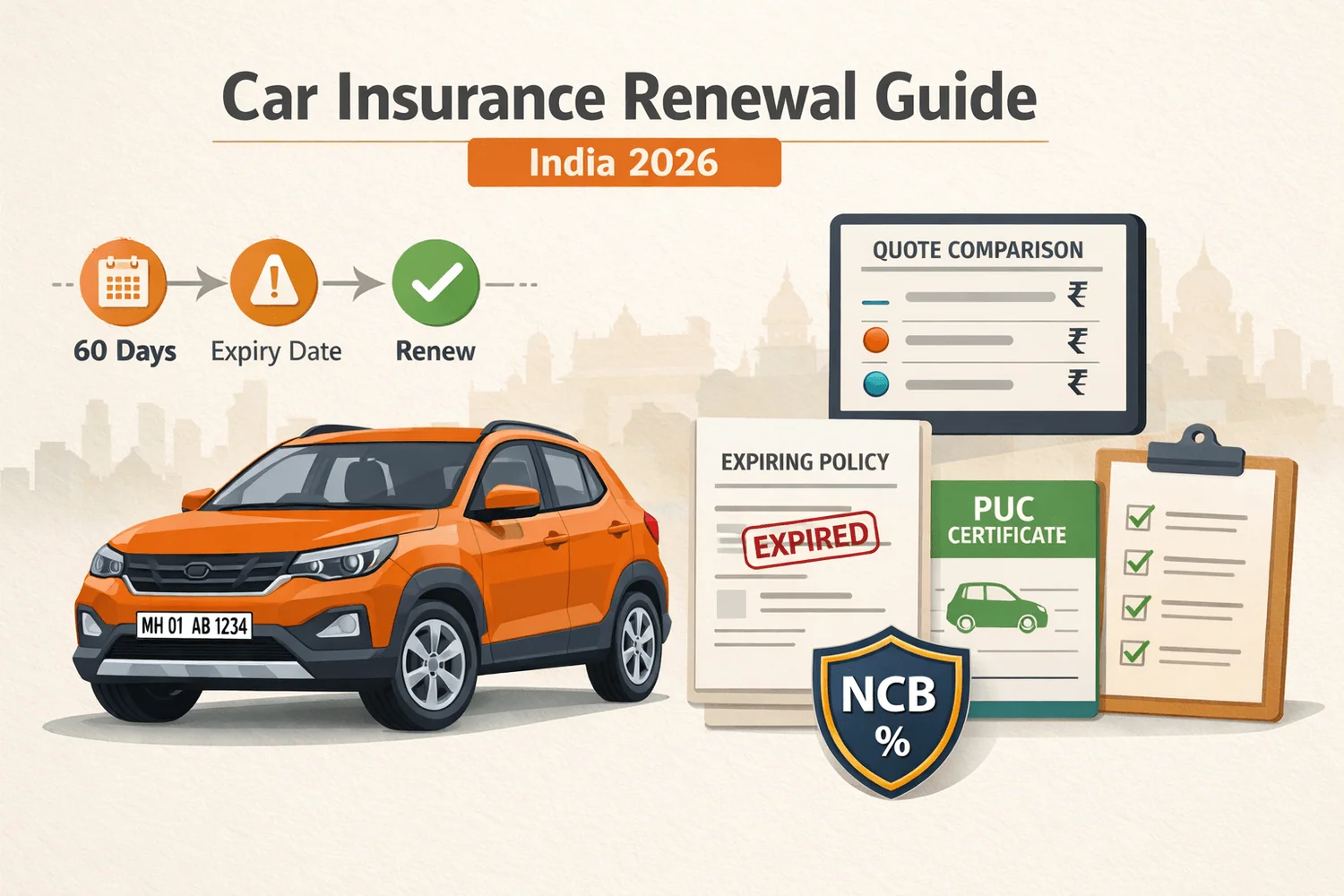
Car insurance renewal is the point where most owners either save money or quietly overpay for another year. Renew on time, keep your No Claim Bonus alive, review the IDV properly, and trim the add-ons you no longer need. Miss the expiry date and the process usually gets slower and more expensive.
Here is the short version:
- Start checking quotes 15 to 30 days before expiry.
- Keep your RC, old policy copy, and PUC ready. Keep KYC details handy too.
- Compare the same cover across insurers. Don’t compare only the cheapest premium.
- Renew before the policy expires. The 90-day NCB window is not the same thing as active cover.
If you want to renew car insurance online without making the usual mistakes, this guide is built for that exact job.
When to Renew Car Insurance
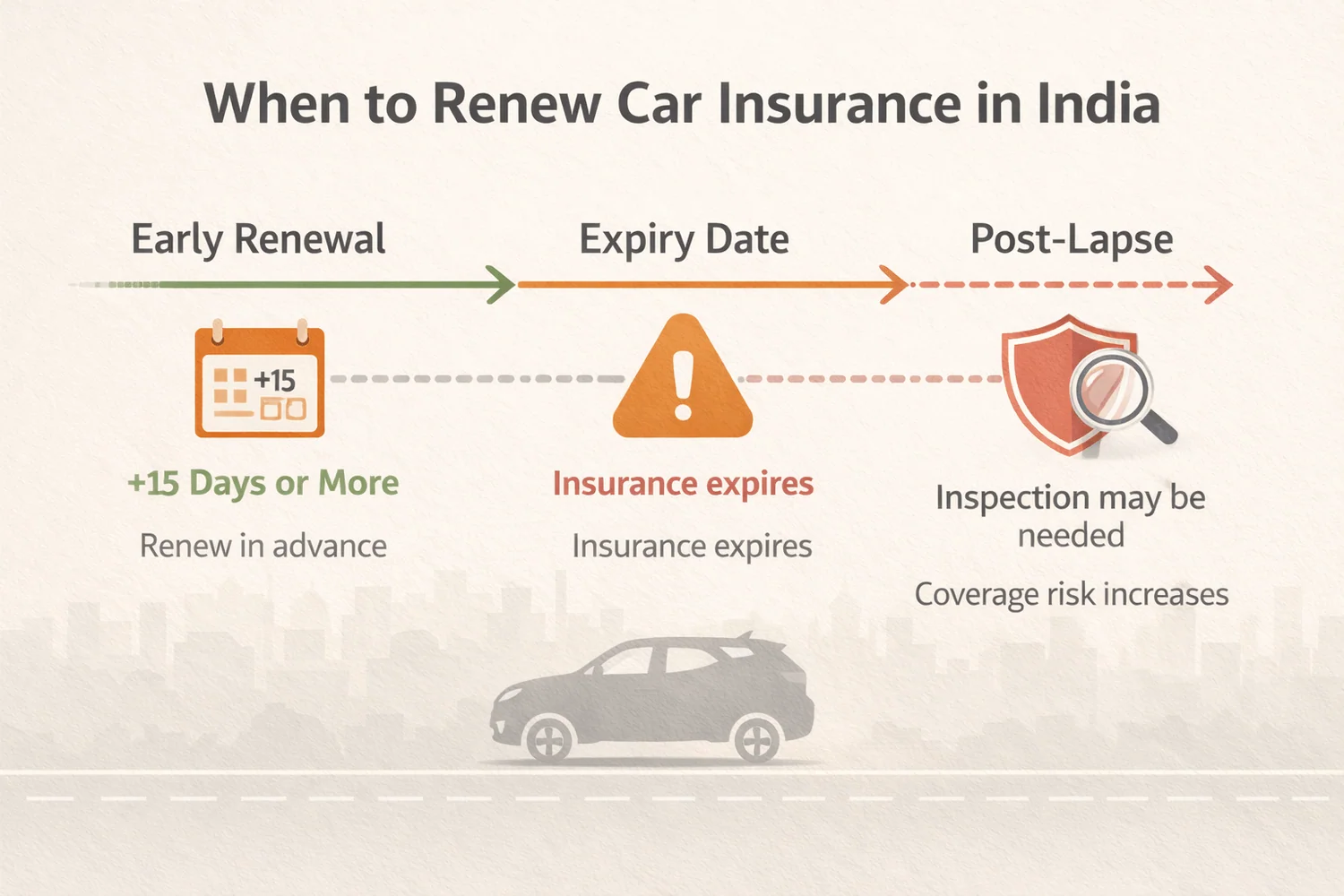
The safe answer is simple. Start your renewal process about 15 to 30 days before the expiry date, and finish it before the policy actually ends.
IRDAI’s consumer guidance says you should approach the insurer at least 15 days before expiry. In practice, 30 days gives you a better buffer if you want to compare quotes, switch insurers, review add-ons, or fix any mismatch in the vehicle details. If you leave it to the last day, even a small payment failure or data mismatch can push the policy into a lapsed state.
The renewal window that makes sense
Use this rule:
- 30 days before expiry: best if you want quotes from several insurers
- 15 days before expiry: still workable if you’re staying with the same insurer
- On the expiry date: risky and not worth it unless you have no other option
- After expiry: possible, but now you’re dealing with a break in cover
One point that trips up a lot of owners: your policy expiry is not a casual date on a reminder SMS. Once it expires, the car is not insured. If you drive it on the road after that point, you’re exposed on both sides. There is legal risk because third-party insurance is mandatory, and there is financial risk because your own car is no longer protected either.
What happens if your policy expires
This is where bad advice spreads fast online.
There is no active coverage “grace period” after expiry. What you do get, in many cases, is a limited window to keep your accumulated NCB alive if you renew within 90 days. That helps with your future premium. It does not protect you during the gap.
So if the policy lapses, the car is uninsured during the gap. Any accident is on you. Theft or flood during that period won’t be covered either. And before own-damage cover starts again, the insurer may ask for an inspection.
Many insurers now use self-video inspection for lapsed renewal. You record the car through the insurer app or a web link, show the registration plate clearly, capture each side of the vehicle, and wait for approval. That is faster than the older surveyor visit, but it still means delay. Better to avoid the lapse entirely.
New-car owners need to check the policy structure
If your car is relatively new, don’t assume both parts of the policy expire together.
For new private cars, the usual structure has been long-term third-party cover with a shorter own-damage term. That means you may need to renew the own-damage section earlier even though the mandatory third-party cover is still running. Owners often miss this and assume the car is fully covered for another two or three years. It isn’t.
If your third-party cover is active but your own-damage cover has expired, you’re still legally insured for third-party liability. But your own car has no protection against theft, accident damage, flood, or fire. That’s a bad surprise to discover after a claim.
Renewal time is also update time
Use the annual renewal cycle to fix the details most people ignore:
- new address after a city move
- hypothecation removal after loan closure
- fuel type or variant mismatch in policy records
- old nominee or owner details
Those corrections are much easier when you’re already touching the policy. If you already do a yearly service reset, keep the insurance reminder next to your car maintenance checklist 2026 so both jobs happen on the same schedule.
How to Renew Car Insurance Online
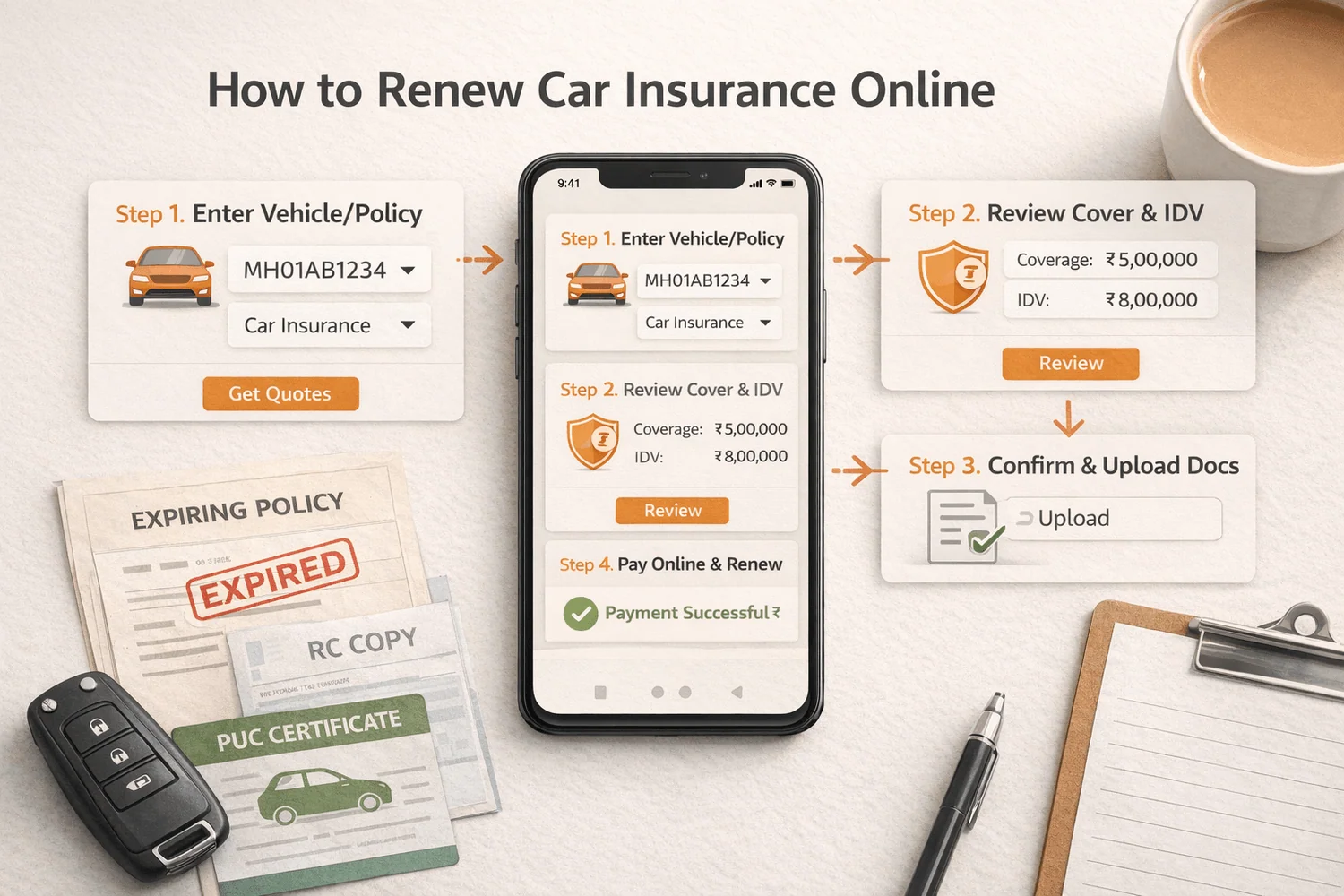
If you want to renew car insurance online properly, treat it like a short audit instead of a two-minute payment task. The renewal itself is easy. Choosing the right cover is the real work.
Here is the clean step-by-step process.
Step 1: Keep the right documents ready
Before you open any quote page, keep these details handy:
- RC number and registration details
- previous policy number and expiry date
- PUC certificate
- claim history for the current policy year
- PAN, Aadhaar, or CKYC details if the insurer asks for KYC
Some owners skip the PUC and only realise the problem at the last step. IRDAI’s consumer guidance says a valid PUC is required while renewing motor insurance, so don’t leave that loose.
Step 2: Decide whether you’re renewing or switching
There are two clean paths:
- Stay with the current insurer if pricing is fair, the claim experience was fine, and the local cashless garage network works for you.
- Switch insurers at renewal if another insurer gives you better pricing for the same cover or better support where you live.
If the current policy is still active, switching is usually straightforward. If the policy has already lapsed, you’ll probably face inspection first.
Step 3: Pull at least three quotes
Use direct insurer sites, one aggregator, or both. The point is not to chase the lowest number on page one. The point is to compare the same cover across a few options.
Check these items on every quote:
| Item | Why it matters |
|---|---|
| IDV | Changes your payout if the car is stolen or written off |
| NCB shown | Directly affects the own-damage premium |
| Add-ons | Can change claim value by a large amount |
| Voluntary deductible | Lowers premium, but increases what you pay during a claim |
| Garage network near you | Matters more than a huge national number |
| Inspection requirement | Important if the policy is already expired |
This is the point where many “cheap” renewal quotes fall apart. The premium looks attractive only because the IDV is pushed low, the deductible is raised, or useful add-ons are missing.
Step 4: Declare claims and NCB honestly
Your NCB is valuable, but it only works if the declaration is correct.
If you made an own-damage claim during the current policy year, don’t force a no-claim declaration just to reduce the renewal premium. Insurers verify previous policy data. If the declaration is wrong, the discount can be reversed later and claims can become messy.
Step 5: Set the IDV properly
IDV is the insured declared value of the car. In plain terms, it is the base figure the insurer uses if the car is stolen or treated as a total loss.
Don’t blindly accept the lowest IDV shown on the quote. A slightly lower premium is not worth a much weaker payout. Compare the quoted IDV with the car’s age and the insurer’s permitted range. Then ask a blunt question: if the car was stolen next month, would this IDV still feel fair? If your car is a few years old and resale prices are still firm, a very low IDV is a warning sign.
Here’s how IDV depreciation actually works. The insurer takes the manufacturer’s listed price for your exact variant and knocks off a standard percentage based on age.
| Vehicle Age | Standard Depreciation |
|---|---|
| Up to 6 months | 5% |
| 6 months to 1 year | 15% |
| 1 to 2 years | 20% |
| 2 to 3 years | 30% |
| 3 to 4 years | 40% |
| 4 to 5 years | 50% |
Quick example. Your car’s ex-showroom was ₹10 lakh three years ago. After 30 percent depreciation, the base IDV sits around ₹7 lakh. If the aggregator quote shows ₹5.5 lakh instead, that’s a red flag. You’d be underinsured by over a lakh for what, a ₹400 premium saving?
Step 6: Review add-ons based on your car and your city
Newer cars usually justify a wider add-on basket. Older cars do not.
As a quick rule:
- 0 to 3 years: zero dep is often worth a hard look, especially if the car is expensive to repair
- flood-prone city: engine protect deserves attention
- higher-value new car: return to invoice can still make sense in the early years
- older car: drop expensive add-ons that no longer match the car’s value
If you’re still fuzzy on the base structure of the policy, review the policy type and add-on mix carefully before you lock the renewal.
Step 7: Pay. Then verify the policy
Once you pay, don’t stop at the confirmation page.
Check the issued policy for:
- registration number
- engine and chassis number
- owner’s name spelling
- NCB shown
- IDV
- add-ons selected
- policy period
Download the policy PDF, keep it in your phone, and save it in DigiLocker or your usual document folder.
If the policy has already lapsed
You can still renew after expiry. The process is just less pleasant.
In most cases, you enter the old policy details first. Then the insurer asks for self-inspection if the policy is already expired. Approval can take a little time. Only after that do you pay and download the fresh policy.
If the lapse is long enough, your NCB may also be gone. That is why on-time renewal matters more than the small premium difference people spend hours chasing.
Tips to Get Lower Premium at Renewal
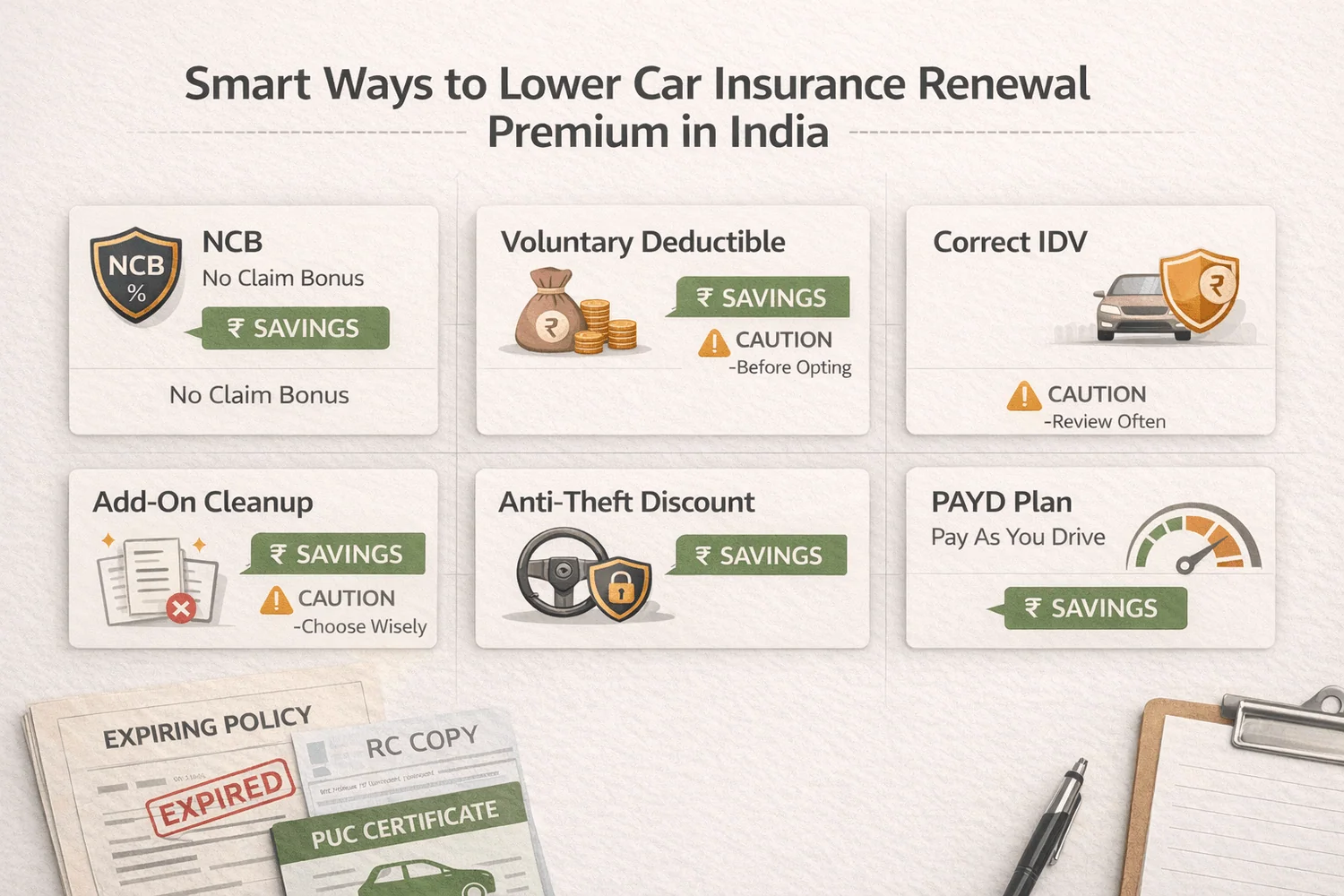
This is the section most owners actually need. Not vague advice. Real car insurance renewal tips that can reduce premium without leaving you underinsured.
1. Protect your NCB before chasing any other discount
The biggest premium lever is usually the one you already have.
If you’ve built up a decent NCB, don’t throw it away on a tiny own-damage claim. A small bumper repaint or a minor dent repair often costs less than the discount you’ll lose at the next renewal.
Simple way to think about it:
- small repair bill
- high existing NCB
- no safety or third-party issue involved
In that case, paying out of pocket can be the smarter call.
Let’s put real numbers on why small claims hurt. Say your OD renewal quote is ₹15,000, and you’ve earned 50 percent NCB over five careful years. Without that NCB, the premium would’ve been ₹30,000. Now imagine filing a claim for a ₹3,000 bumper scratch. One claim. NCB gone. Next year’s premium jumps back toward ₹30,000. You saved ₹3,000 on the repair but lost roughly ₹15,000 on renewal. Does that trade make sense? Almost never.
2. Don’t slash the IDV just to get the cheapest car insurance renewal
This mistake is everywhere.
Owners see two quotes, notice one is cheaper, and assume it is better value. Often it isn’t. The low premium is sometimes built on a lower IDV. That weakens your payout if the car is stolen or declared a total loss.
So yes, lower IDV can reduce premium. But you are also reducing protection. Use it carefully, not blindly.
That trade-off matters even more when the car still commands a healthy resale value.
3. Use a voluntary deductible only if your profile suits it
A voluntary deductible means you agree to bear a larger part of the claim amount yourself. In return, the insurer cuts the own-damage premium.
This can work very well for:
- experienced drivers
- low annual mileage users
- households that can handle a larger out-of-pocket bill if a claim happens
It can be a bad choice for:
- newer drivers
- cars used daily in dense city traffic
- owners who don’t want a surprise repair contribution later
Insurers commonly show discount steps for higher voluntary deductible amounts, but the exact saving and cap vary by insurer. Treat it as a calculated trade, not a default saving trick. If your car does daily Mumbai or Bengaluru traffic duty, think twice before choosing a high deductible just to shave a little off the premium.
What does each deductible step actually save you? The exact cap shifts between insurers, but here’s the general shape.
| Voluntary Deductible | OD Premium Discount (Typical) |
|---|---|
| ₹2,500 | ~20%, capped near ₹750 |
| ₹5,000 | ~25%, capped near ₹1,500 |
| ₹7,500 | ~30%, capped near ₹2,000 |
| ₹15,000 | ~35%, capped near ₹2,500 |
Don’t forget, the compulsory deductible already applies before any of this. That’s ₹1,000 for cars under 1500cc and ₹2,000 above. Your voluntary amount sits on top.
4. Remove add-ons that no longer make sense
Add-ons should track the age and risk of the car.
For example:
- zero dep is usually strongest in the early ownership years
- return to invoice becomes less useful as the car ages
- engine protect matters more in cities where waterlogging is a real risk
- roadside assistance is cheap and often worth keeping
Before you keep or drop that cover, run a simple cost-benefit check based on your car’s age, repair costs, and how often you actually claim.
5. Ask about discounts people routinely miss
These are not universal across every insurer, but they are worth checking:
- discount for an ARAI-approved anti-theft device
- lower premium structure on pay-as-you-drive plans for low-mileage users
- concession tied to recognised automobile association membership in some policies
- waiver or adjustment if you already have valid owner-driver personal accident cover elsewhere and the insurer permits it
None of these should be guessed. Ask the insurer to show the exact discount or waiver in the quote itself.
6. Review pay-as-you-drive if the car is used sparingly
If the car mostly sits parked through the week, a pay-as-you-drive plan can be worth checking at renewal.
This is especially useful for:
- work-from-home households
- second cars in the family
- city owners who rely on Metro, cab, or office transport most days
If your annual mileage is low, a usage-based structure may beat a normal flat renewal quote. If you drive a lot, it probably won’t.
7. Compare cashless support, not just price
The best renewal quote is not always the cheapest quote. It is the quote that gives you the right mix of premium and support, with the add-ons you actually need.
This matters more than ever now because repair bills have moved up sharply, especially for cars with ADAS hardware and costly lighting units. A huge garage count on a website doesn’t help much if the nearest useful cashless garage is far from where you live.
Mistakes that quietly cost money
Keep these off your list:
- an overly low IDV
- zero dep removed without any claim-cost review
- a high voluntary deductible without emergency cash available
- the cheapest quote chosen without matching the cover
- a wrong NCB declaration
NCB (No Claim Bonus) Explained
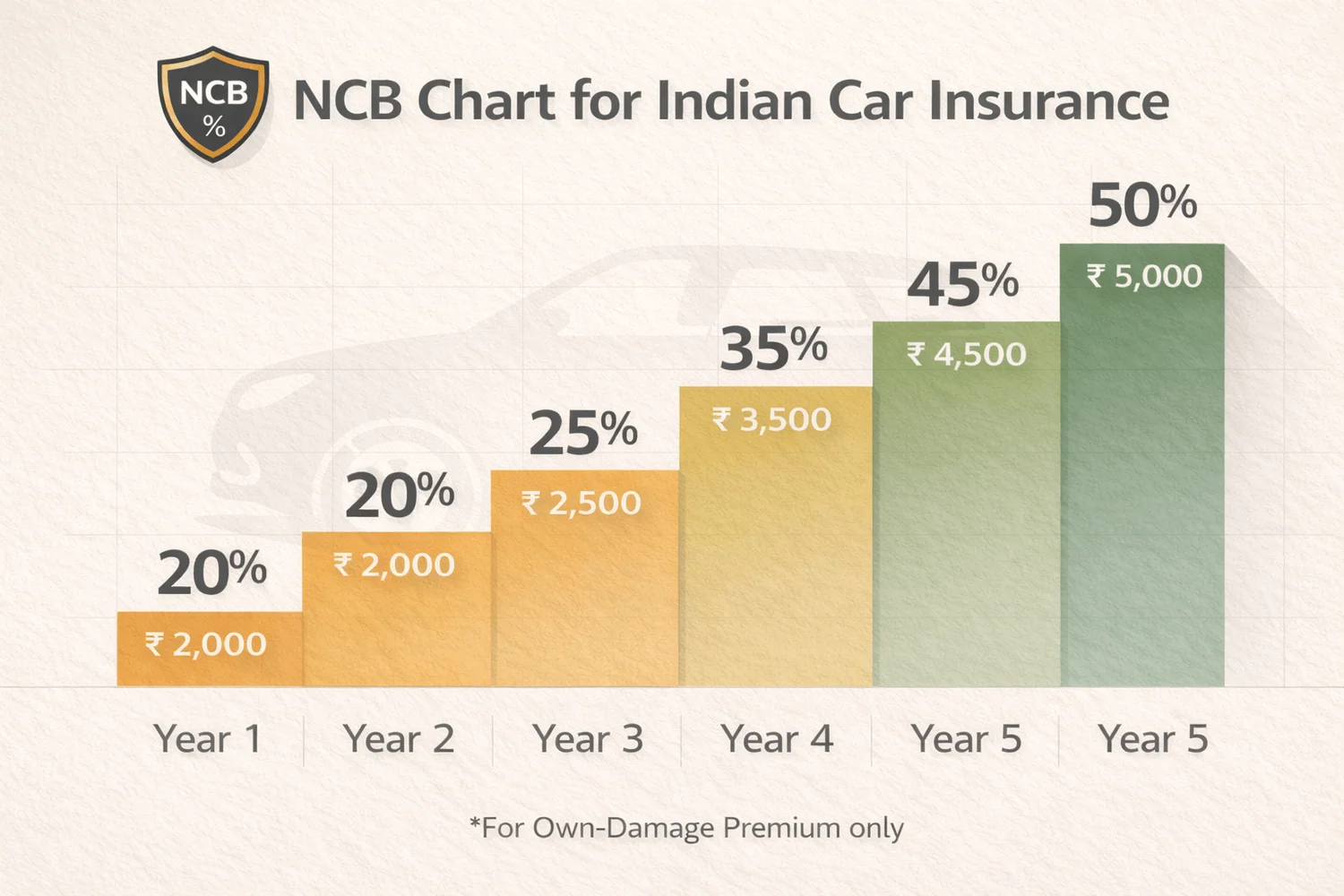
NCB is the reward for not making an own-damage claim during the policy year. It is one of the few discounts in motor insurance that becomes more powerful with time.
Just remember one thing. NCB reduces only the own-damage premium. It does not reduce the third-party premium.
The standard NCB ladder
| Claim-free years | NCB discount on own-damage premium |
|---|---|
| 1 year | 20% |
| 2 years | 25% |
| 3 years | 35% |
| 4 years | 45% |
| 5 years and above | 50% |
That 50% cap can make a real difference on renewal, especially if the car is still relatively valuable and you have a decent own-damage premium to begin with.
NCB belongs to you, not to the car
This point matters when you sell the car or move to another insurer.
Your NCB is attached to the insured person’s claim history. It does not stay behind with the old car. So if you sell your current car and buy another one, you can usually carry that benefit forward. If you change insurers at renewal, the NCB can move as well.
For a sale-and-repurchase situation, ask the current insurer for NCB retention proof or certificate and check what sale documents they need. Some insurers ask for transfer papers such as Forms 29 and 30 or equivalent sale proof. Don’t sell the old car and forget this step.
One own-damage claim can wipe it out
Under normal motor insurance rules, one own-damage claim resets the NCB at the next renewal. That is why many careful owners pay minor cosmetic repair bills themselves instead of filing a claim for every small panel job.
There is an exception in some policies. An NCB protector add-on can preserve the discount despite a limited number of claims. It costs extra, so it makes sense mainly when:
- your NCB is already high
- you drive in heavy city traffic
- you want to protect the accumulated discount
The 90-day point that people misunderstand
This is worth spelling out clearly.
If you renew within the allowed break after expiry, you may still retain the NCB. But that does not mean the car was insured during the gap. Very different things.
Can you transfer NCB to a new insurer?
Yes. In most normal renewals, you declare the current NCB and the new insurer verifies it using the previous policy details and supporting records. This is routine.
What you should not do is overstate the NCB just to get a lower premium. That can be corrected later, and it can become a problem at claim time.
Should You Switch Insurance Companies?
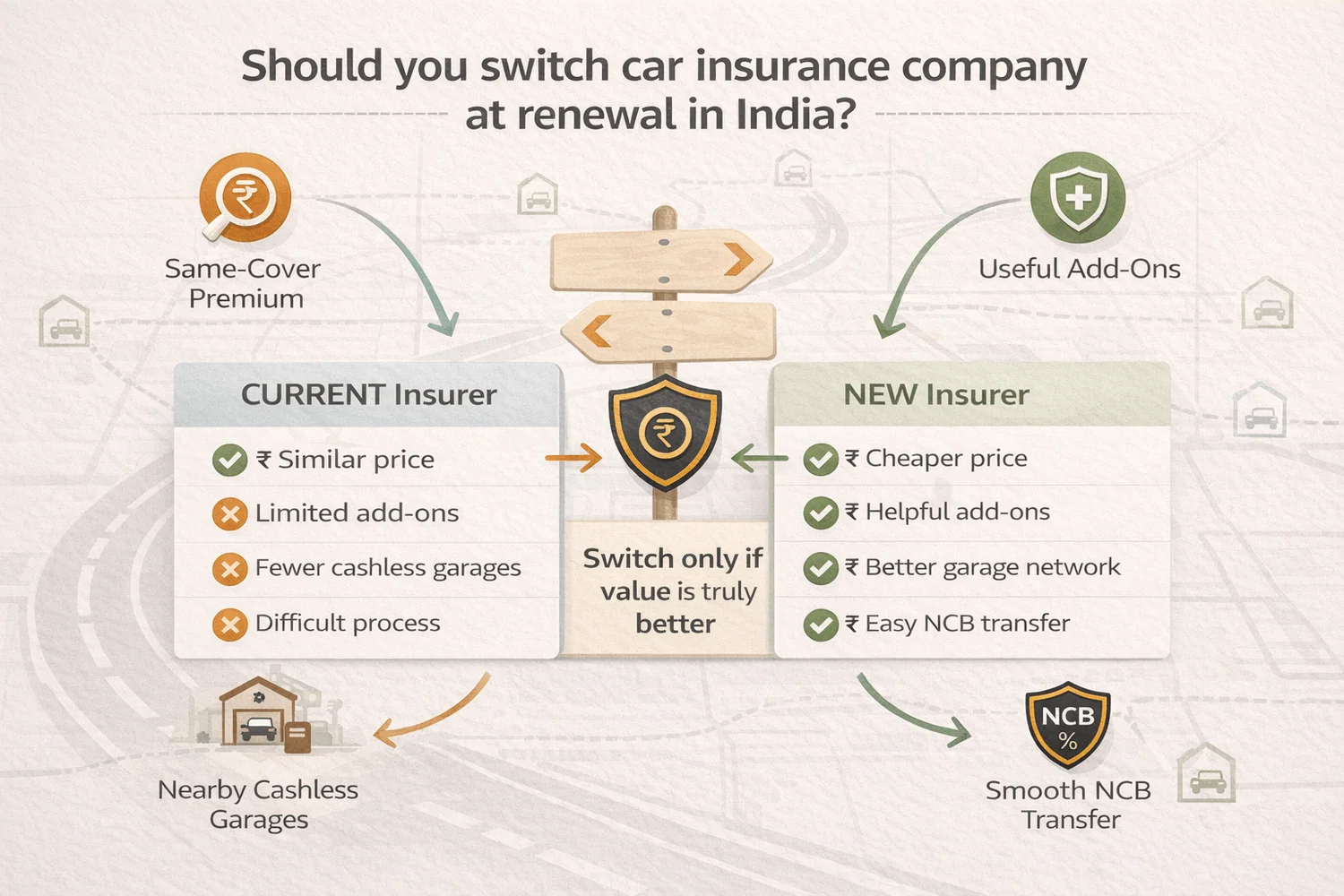
Yes, you can switch insurers at renewal. There is no penalty for moving if the existing policy is active and the new quote makes more sense.
The better question is this: should you switch just because the premium is lower?
Not always.
Good reasons to move
A move is worth it if:
- the premium gap is meaningful for the same cover
- your current insurer’s cashless support near your city is weak
- your previous claim experience was poor
- another insurer gives you better add-on value for your car and use case
Compare these items line by line
Line the quotes up against the details below:
| Compare this | Why it matters |
|---|---|
| IDV | Changes the payout in a total-loss or theft scenario |
| NCB shown | Affects the premium directly |
| Zero dep, engine protect, roadside assistance, RTI | Add-ons change the claim value materially |
| Voluntary deductible | Can make a low quote look better than it really is |
| Cashless garages near your home and usual route | This is what you’ll care about after an accident |
| Claim process and support | Easy purchase means nothing if claims become painful |
Don’t compare a stripped-down policy against a well-covered policy and call it a saving. That’s not saving. That’s buying less cover.
Don’t obsess over CSR alone
Claim settlement ratio is useful, but it is not enough on its own.
For a normal car owner, these practical questions matter more:
- Is there a good authorised garage near me in the insurer’s network?
- How quickly does the insurer respond after claim intimation?
- Is the digital process clear?
- Does the policy have the add-ons I actually need?
Those answers tell you more than a headline ratio.
That said, CSR does give you a floor. Where did major motor insurers land recently?
| Insurer | CSR (2025-26) | Network Garages |
|---|---|---|
| ACKO General | 99.39% | 4,000+ |
| Bajaj Allianz General | 98.50% | 4,000+ |
| Go Digit General | 94.75% | Repair Anywhere |
| SBI General | 93.50% | 16,000+ |
| HDFC ERGO General | 91.79% | 8,200+ |
| ICICI Lombard General | 85.65% | 5,900+ |
A high CSR sounds reassuring, but it bundles motor claims with health and other segments. What you really want to know is whether the insurer pays motor claims without dragging things out. Look up cashless garage reviews for your specific city before you commit.
The case for switching is stronger now than it used to be
IRDAI’s 2024 master circular tightened claim handling timelines across general insurance. That has made the market more even than it used to be. Newer digital insurers are easier to consider now, but you should still compare their local garage support and claim experience before moving.
One warning: don’t switch after a lapse if you can avoid it
If the policy has already expired, switching is still possible. It is just more likely to involve inspection, delay, or exclusions for existing damage. If you want a smooth insurer switch, do it while the current policy is still active.
FAQs
How to renew car insurance online?
Keep your RC, old policy details, and PUC ready. Keep KYC documents handy too. Then compare quotes. Start with the IDV, then look at the add-ons and deductible. If the policy has already lapsed, the insurer may ask for self-inspection first.
That’s the basic flow.
NCB is a discount on the own-damage premium for every claim-free policy year. It starts at 20% after one claim-free year and goes up to 50% after five claim-free years. It does not reduce the third-party premium.
Can I switch insurance companies at renewal?
Yes. If the current policy is active, you can move to another insurer without penalty. Just compare the same cover carefully and make sure the NCB is carried correctly.
What happens if my car insurance expires?
The car is uninsured during the gap. That means no protection for own damage, theft, or accident loss during that period. You may also need inspection before the insurer restores own-damage cover. If you delay too long, the NCB can be lost as well.
Is PUC required for car insurance renewal?
Yes, keep a valid PUC ready. IRDAI’s consumer guidance says it is required at renewal, and insurers may ask for it during the process.
Can I renew car insurance after expiry?
Yes, but expect more steps. Many insurers now use self-video inspection for lapsed policies before approving own-damage cover again. Renewing before expiry is always the easier route.
Is the cheapest car insurance renewal always the best?
No. Many cheap-looking quotes are cheaper because the IDV is lower, the deductible is higher, or useful add-ons are missing. Compare the cover, not just the number.
Should I keep zero depreciation cover at every renewal?
Not automatically. It is often most useful in the early years of ownership, especially on newer and costlier cars. As the car ages, the math changes. Review it every year instead of renewing it blindly.
If you’re about to renew now, do two things before you pay. First, compare the same cover across at least three quotes. Then check whether your NCB and IDV still make sense, and whether the add-ons suit the car you own today rather than the one you bought years ago.