
Your car won’t start. It’s a 45°C afternoon in Delhi, the engine won’t crank, and you’re stuck wondering which battery to buy. How much will it cost? Is the roadside mechanic about to overcharge you?
This guide has you covered. You’ll find the warning signs of a dying battery, a brand-by-brand price comparison covering Amaron, Exide, Livguard, Tata Green, and SF Sonic, plus a model-specific sizing chart so you pick the right fit for your exact car. We’ve also added a section on common scams. Why? Because the battery replacement market in India is full of them.
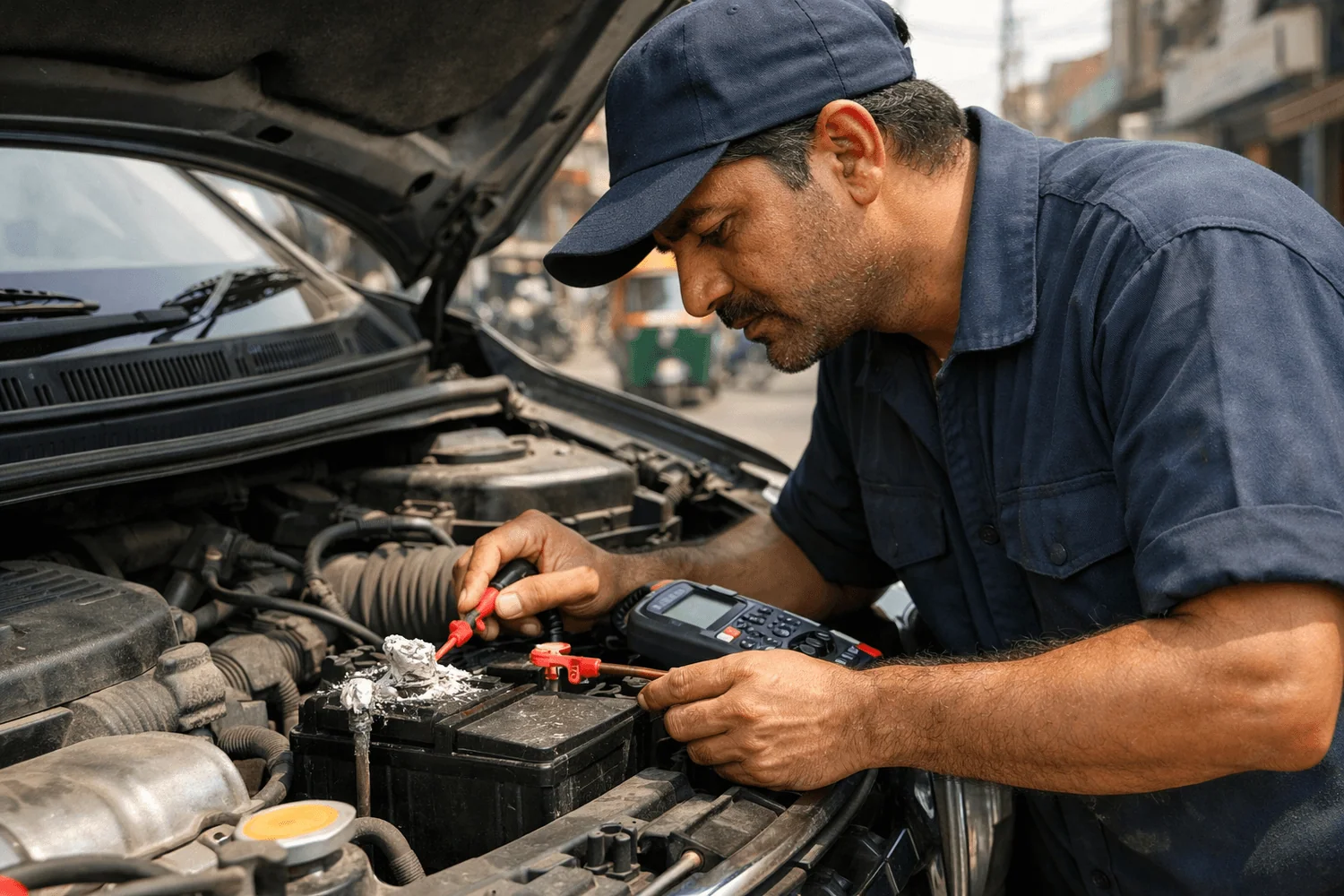
Signs Your Car Battery Needs Replacement
Car batteries don’t fail overnight. They give you clear warnings weeks before dying completely, and if you catch them early, you’ll save yourself from getting stranded on a highway. You’ll also avoid paying a premium for emergency roadside service.
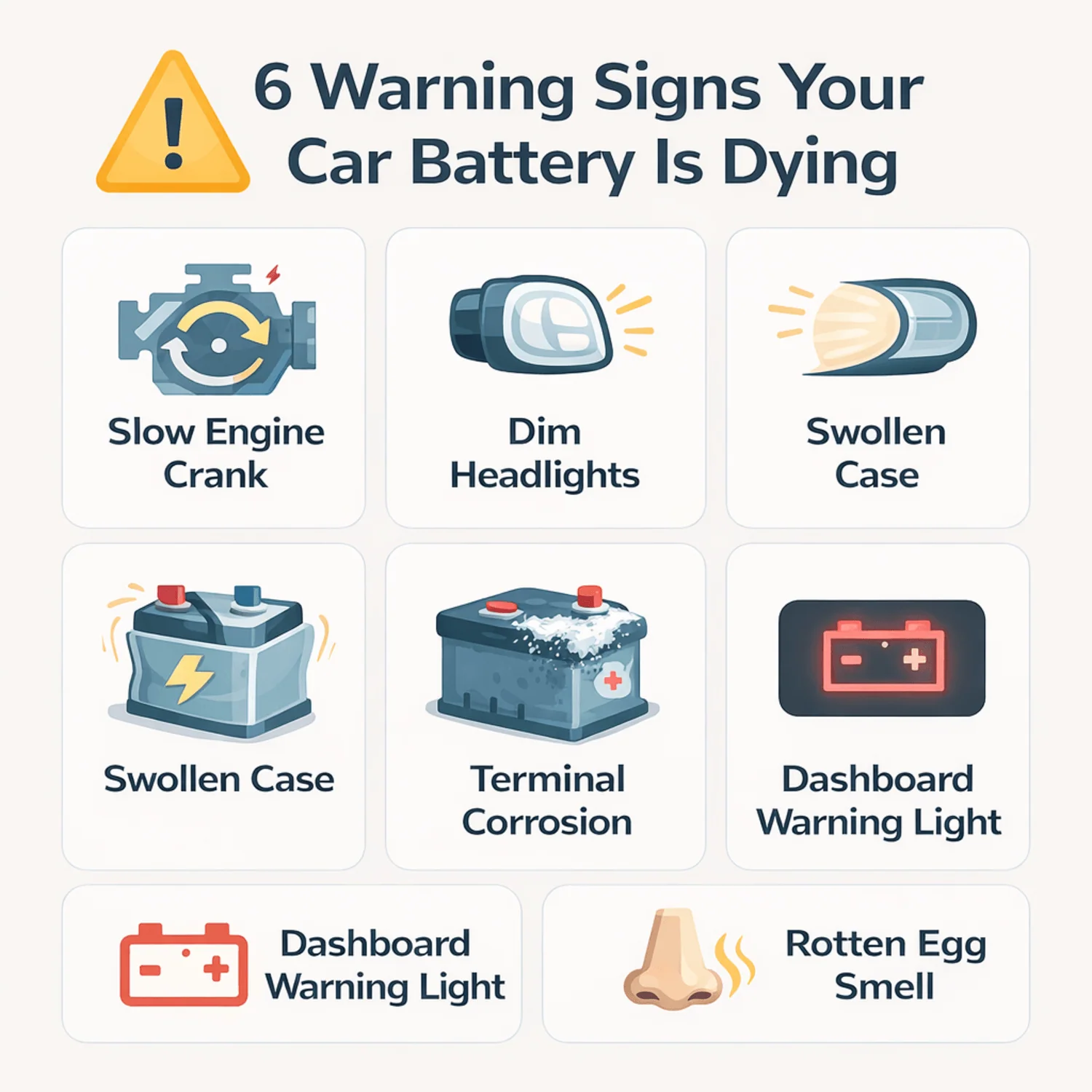
Slow Engine Cranking
This is the most common early sign. You turn the key or press the start button, and the engine takes noticeably longer to fire up. That strained, drawn-out “rrr… rrr” sound means the battery can’t deliver enough Cold Cranking Amps (CCA) to spin the starter motor at full speed anymore.
Indian summers compound the problem. The bonnet-level temperatures in cities like Delhi and Nagpur cause electrolyte fluid to evaporate faster, which increases internal resistance. You might notice a sluggish crank even in a unit that’s only two years old.
Here’s a useful test. Does your car start fine during the afternoon but struggle after sitting overnight? That’s a clear sign the battery is losing its charge-retention capacity. And if you’ve needed a jump-start more than once in a single month, the internal lead plates have likely undergone irreversible sulfation. Time for a new one.
Electrical Glitches and Dim Headlights
Your car’s battery doesn’t just start the engine. It also stabilizes voltage across the entire electrical network. When it weakens, you’ll notice dim or flickering headlights at idle. Your infotainment screen might randomly reboot. Power windows could feel sluggish. The instrument cluster may start acting erratically.
The red battery warning light on the dashboard is a direct alert. It triggers when overall network voltage drops below roughly 12.4V. On modern cars with a Battery Management System (BMS), the ECU will automatically disable Auto Start-Stop once the battery’s State of Health drops below a safe threshold. For many owners, a suddenly inactive start-stop feature is the very first clue something’s wrong.
Physical Signs You Shouldn’t Ignore
Swollen battery case. If the plastic casing looks bloated, extreme heat or alternator overcharging has caused dangerous internal gas buildup. This is a thermal runaway risk. Replace it immediately.
White or blue corrosion on terminals. That powdery crust around the battery posts is acidic corrosion from hydrogen gas reacting with moisture. Heavy corrosion restricts current flow and can mimic the symptoms of a completely dead unit.
Rotten egg smell. A sulfur odour from under the bonnet means hydrogen sulfide gas is venting out. This typically happens from severe overcharging or an internal short circuit. Don’t brush this off.
Is It Actually the Battery?
Before spending money on a new battery, rule out other problems:
- If the car starts via jump-start but immediately stalls when cables are disconnected, your alternator is the issue, not the battery
- If headlights are bright but the engine won’t crank at all, the starter motor or relay is more likely the culprit
- If your battery keeps dying despite being relatively new, check for parasitic drain from hardwired dashcams, GPS trackers, or aftermarket audio systems drawing power while parked
A parasitic drain just needs a controlled recharge, not a full replacement. Before you agree to buying a new battery, ask your mechanic to run a computerized load test. The printout will show you the exact voltage and State of Health percentage, which tells you whether replacement is genuinely needed.
Best Car Battery Brands in India
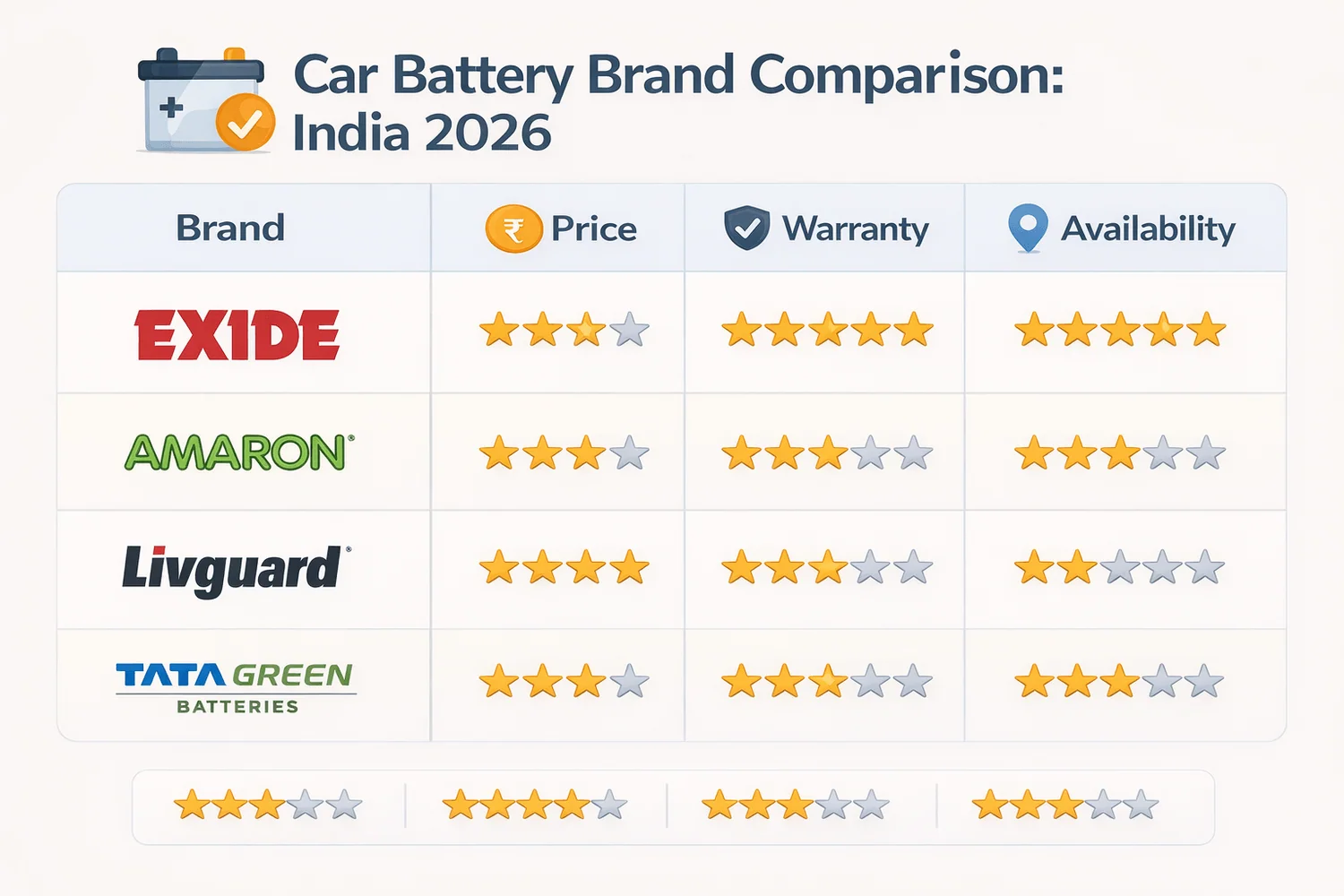
The Indian market is dominated by two big players, Exide and Amaron, with several strong challengers competing on price and technology. Here’s how they stack up.
Exide: The Market Leader
Exide is India’s oldest and largest battery manufacturer, supplying over 50% of OEMs including Maruti Suzuki and Hyundai. If you drive any popular Indian car, there’s a good chance your factory-fitted battery was an Exide. Their product range covers everything from budget hatchbacks to heavy diesel SUVs.
Key product lines:
- Exide Epiq (flagship): 77-month warranty, proprietary “Penta Alloy” technology built for extreme heat resistance
- Exide Matrix: Zero-maintenance, 72-month warranty
- Exide Mileage: Budget-friendly, 60-month warranty. This is the most popular aftermarket choice in India
Exide’s biggest strength? Distribution. Their “Exide Batmobile” doorstep service provides emergency battery replacement across tier-1 and tier-2 cities. If you live in a smaller town or rural area, Exide is often the only brand with genuine stock available locally.
Amaron: The Premium Challenger
Amaron (made by Amara Raja Energy & Mobility) disrupted the Indian market with genuinely zero-maintenance sealed batteries paired with longer warranties. Their patented “SilvenX” silver-calcium alloy reduces internal grid corrosion and minimizes water loss through gassing. That makes them particularly resilient in Indian summers and the punishing charge-discharge cycles of urban stop-and-go traffic.
Key product lines:
- Amaron Pro: 72-month warranty, high CCA output for diesel and SUV applications
- Amaron Flo: Mid-range, solid choice for petrol sedans and compact SUVs
- Amaron Go: Entry-level for budget hatchbacks
- Amaron Black: Commercial and fleet use
Amaron’s biggest advantage is truly maintenance-free operation. You never need to check water levels or top up with distilled water. Their “AMCARE” 24/7 helpline (1800-425-4848) and Pitstop retail network provide good urban service coverage, though Exide still has the edge in rural areas.
The honest comparison: For standard flooded lead-acid batteries in budget hatchbacks, real-world failure rates between Amaron and Exide are practically identical. Both reliably deliver 3 to 5 years with normal maintenance. The actual brand advantage depends on the battery technology type, not just the logo on the casing.
Value Alternatives: Tata Green, Livguard, SF Sonic
Tata Green Batteries (joint venture with Japan’s GS Yuasa) are known for lightweight construction and strong vibration resistance. Their Premio and Silver lines compete aggressively in the budget and mid-range segments. Do you drive regularly on rough rural roads? Tata Green is a practical pick.
Livguard has grabbed serious market share through aggressive pricing and modern calcium-calcium-silver grid technology. Their “Zing” series offers genuine zero-maintenance operation. Fleet operators and budget-conscious buyers frequently cite it as the best raw value per Ampere-Hour in the Indian market. Warranty goes up to 36+36 months.
SF Sonic is technically a separate brand, but it’s manufactured entirely under the Exide Industries umbrella. Positioned as rugged with exceptionally high instant cranking power. If you drive a large diesel SUV or a commercial off-road vehicle, SF Sonic is worth checking out.
Premium European Brands: Bosch and Varta
For luxury vehicles (BMW, Audi, Mercedes-Benz, Volvo) and cars with advanced start-stop systems that use regenerative braking, Bosch and Varta are the industry benchmark. They specialize in AGM (Absorbent Glass Mat) and EFB (Enhanced Flooded Battery) technologies. Domestic brands are still catching up in this space. Prices start from ₹12,000 and can go past ₹30,000 depending on the Ah rating and OEM spec.
Car Battery Price by Brand and Size
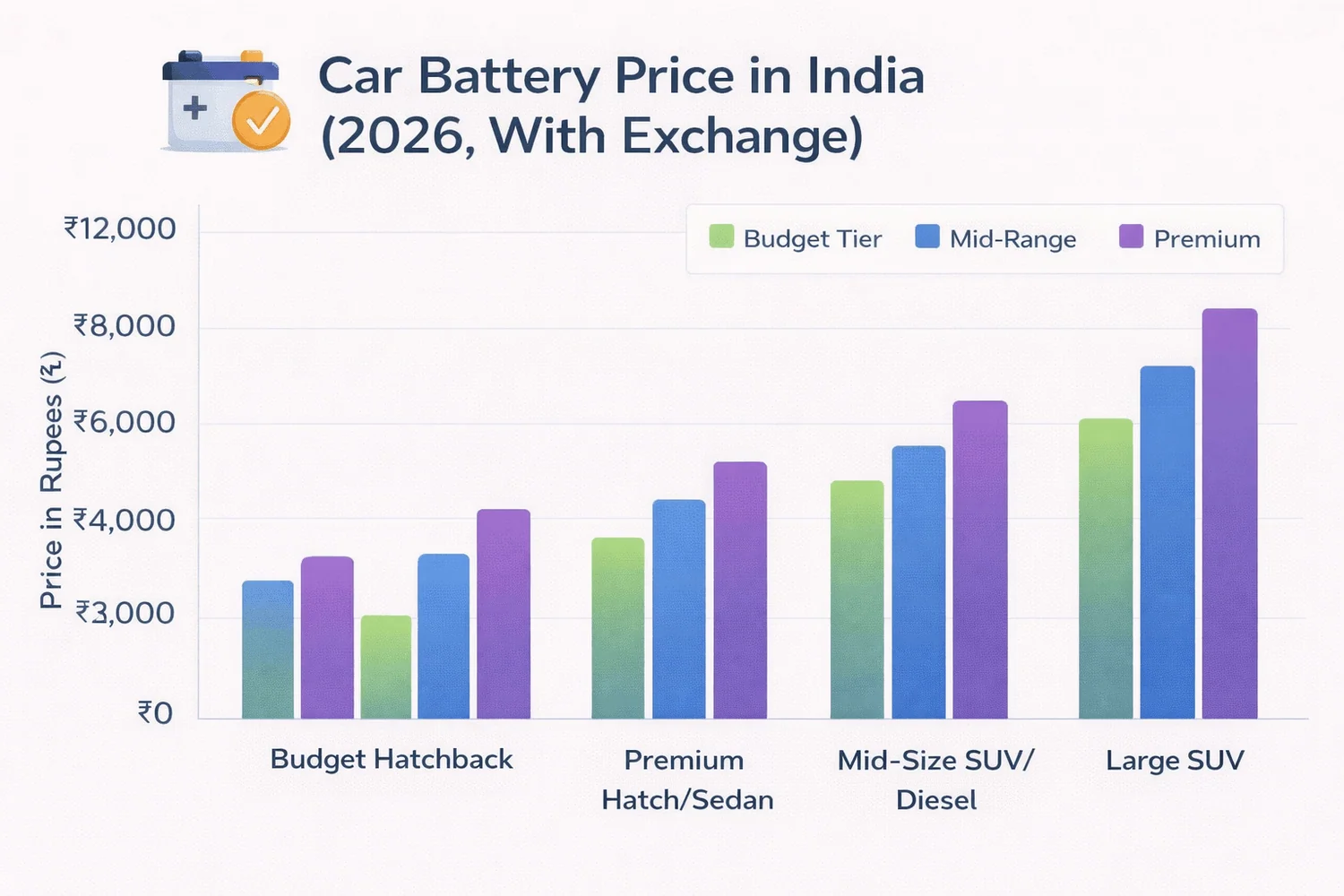
What you’ll pay for a new car battery in India depends primarily on two things: the Ah (Ampere-Hour) capacity your car needs and whether you’re exchanging your old unit. The battery technology type (standard flooded, EFB, or AGM) also matters, especially if your car has start-stop.
How Exchange Pricing Works
Almost all car battery prices in India are quoted “with exchange.” Why? Because the lead-acid battery recycling market here is highly formalized, and your old battery has genuine scrap value. Dead batteries contain recyclable lead, and in 2026, authorized recyclers pay ₹80 to ₹130 per kilogram of physical weight for them.
What does this mean in practice?
- Exchanging a small 35Ah hatchback battery gets you ₹1,000 to ₹1,500 off
- A heavy 65Ah to 80Ah SUV battery yields ₹1,500 to ₹2,600 credit
The bottom line? Always insist on the “with exchange” price. Online aggregators like BatteryBhai and BatteryBoss automatically apply this discount at checkout. At local shops, you can negotiate the scrap value separately for a better deal.
Price Table by Vehicle Segment (2026, With Exchange)
| Vehicle Category | Ah Rating | Common Fitments | Budget Tier | Mid-Range Tier | Premium Tier |
|---|---|---|---|---|---|
| Budget Hatchback | 35-40Ah | Alto, WagonR, Swift, i10, Tiago | ₹2,800-₹3,300 | ₹3,200-₹3,800 | ₹4,000-₹4,700 |
| Premium Hatch/Sedan | 45-55Ah | Baleno, City, i20, Verna, Nexon (P) | ₹4,000-₹4,600 | ₹4,600-₹5,500 | ₹5,500-₹6,500 |
| Mid-Size SUV/Diesel | 60-65Ah | Creta (D), Seltos (D), Scorpio Classic, Innova | ₹5,000-₹6,000 | ₹6,000-₹8,000 | – |
| Large SUV | 70-80Ah+ | XUV700, Fortuner, Endeavour, Scorpio-N | ₹8,000-₹11,000 | – | – |
| Start-Stop (EFB) | Varies | Brezza (Smart Hybrid), Tata Punch | +20% to 40% premium over standard | ||
| Luxury/AGM | Varies | BMW, Audi, Mercedes, Volvo | ₹12,000-₹30,000+ | ||
Budget tier brands: Livguard Zing, Tata Green Silver, AC Delco, Dynex
Mid-range tier: Exide Mileage, Amaron Go, SF Sonic Flash Start
Premium tier: Exide Epiq, Exide Matrix, Amaron Pro, Amaron Flo
Diesel Cars Cost More
Diesel powertrains have significantly higher compression ratios, which means the starter motor needs far more cranking torque to turn the engine over. A slightly degraded battery that still starts a petrol Maruti Baleno might completely fail to crank a diesel Hyundai Creta. You’ll typically pay ₹800 to ₹2,000 more for a diesel-spec battery because of the higher CCA requirement.
Where You Buy Matters
Where you buy has a real impact on what you’ll end up paying:
- Online aggregators (BatteryBhai, BatteryBoss, Tyresnmore): Most transparent pricing, fair exchange value, free doorstep fitment. Generally 20% to 35% cheaper than dealerships
- Local battery shops: Immediate installation, flexible scrap negotiation. But you face a higher risk of old stock or pressure to upsell
- Authorized dealerships: The most expensive route. Dealerships rarely negotiate on scrap value, tend to charge hidden “electrical diagnostic fees” and “labour/installation charges” (₹300-₹600) that independent channels typically waive
How to Choose the Right Battery
Picking a replacement battery goes beyond brand preference. Get the wrong size or wrong polarity and you could damage your car’s electrical system. Worse, it might void your vehicle warranty entirely.
JIS vs DIN: Know Your Battery Standard
This is the most critical fitment detail that most buyers overlook. What’s the difference?
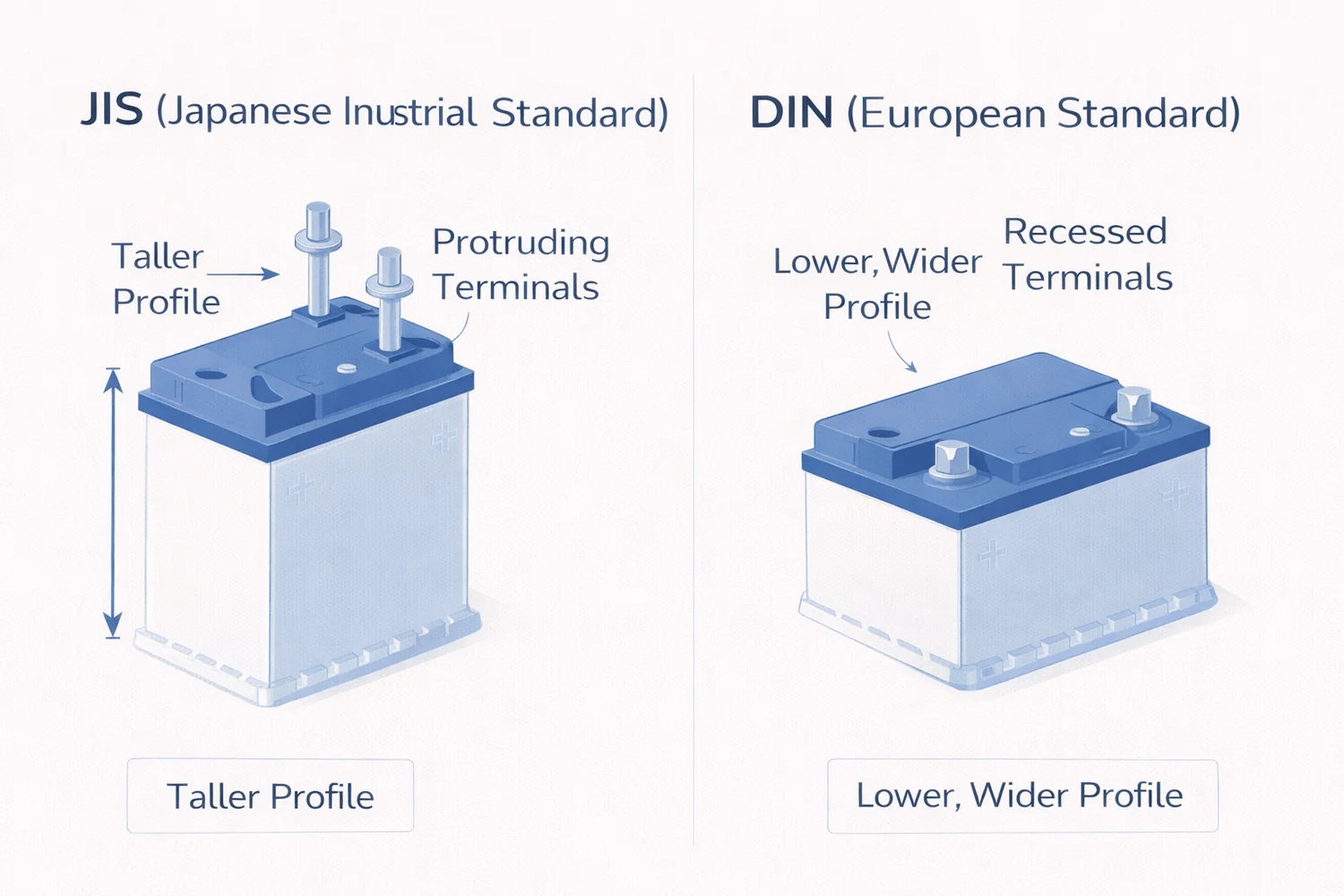
JIS (Japanese Industrial Standard): Taller, narrower batteries with lead terminals that protrude upward from the top surface. You’ll find this standard in most Maruti Suzuki and Honda vehicles. Hyundai and Toyota use it too.
DIN (European Standard): Wider, lower-profile batteries with terminals recessed or flush with the top cover. This is what you’ll find in Volkswagen and Skoda cars. Tata Motors and newer Mahindra models also use DIN.
Why does this matter? Forcing a JIS battery into a DIN tray can result in the tall terminals making contact with the closed metal hood. That’s a massive short circuit and a potential engine bay fire. Don’t take this lightly.
Three Specs You Must Match
- Ah (Ampere-Hour) Rating: This defines total energy storage capacity. Never downgrade below your car’s OEM specification. And here’s something most people don’t know: upgrading more than 10-15% beyond OEM spec is actually dangerous in modern cars. They use “smart alternators” programmed for a specific battery capacity. An oversized battery will remain chronically undercharged, which leads to rapid sulfation and premature failure.
- CCA (Cold Cranking Amps): The battery’s ability to deliver a massive surge of power to start the engine. Absolutely critical for diesel vehicles. Match or exceed your OEM specification.
- Terminal Polarity Layout: Marked as ‘L’ (Left) or ‘R’ (Right) in the battery model code. For example, 38B20L means the negative terminal sits on the left when facing the battery front. Wrong polarity means the vehicle’s cables physically can’t reach the correct posts.
Fitment Guide for Popular Indian Cars (2026)
| Vehicle Segment | Typical Capacity | Standard Type | Example Models |
|---|---|---|---|
| Small Hatchbacks (Petrol) | 35Ah | JIS (e.g., 38B20R, 40B20L) | Maruti Alto, WagonR, Hyundai Santro |
| Premium Hatch/Sedan (Petrol) | 35-45Ah | JIS & DIN (e.g., DIN44) | Maruti Baleno (JIS), Tata Altroz (DIN) |
| Compact SUVs (Petrol) | 45-50Ah | DIN & JIS | Tata Nexon (DIN), Hyundai Venue (JIS) |
| Compact SUVs (Diesel) | 60Ah | DIN & JIS (e.g., DIN60) | Maruti Brezza (DIN), Kia Seltos (JIS) |
| Mid/Large SUVs (Diesel) | 65-80Ah | JIS & DIN (e.g., 65D26L, DIN74) | Hyundai Creta, Mahindra XUV700, Scorpio-N |
| Strong Hybrids (Auxiliary) | 45-60Ah | DIN | Toyota Innova Hycross, Maruti Grand Vitara |
Quickest way to find your exact fitment? Check the label on your current battery for the model code. You can also use the online fitment tools on the Amaron or Exide website. Just enter your car’s make and model.
The Start-Stop Battery Trap
This is the most expensive mistake Indian car owners make in 2026. If your car has Auto Start-Stop, it must use an EFB or AGM battery. Never downgrade to a standard flooded unit, even if the physical dimensions match perfectly.
Why? Conventional batteries simply can’t handle the brutal micro-cycling of shutting down and restarting the engine dozens of times during a single urban commute. A standard battery subjected to start-stop traffic will degrade and die within 3 to 6 months.
The reverse works fine, though. An EFB or AGM battery is a perfectly safe premium upgrade for any conventional car.
Check the Manufacturing Date
A battery that’s been sitting on a dealer’s shelf for eight months has already lost significant capacity through natural self-discharge. Always verify the manufacturing date before buying:
- Exide date codes: Look for a three-character code like “4NM” stamped on the casing. The second character represents the month (A=January through M=December, skipping I and L). The third character is the year. You might also find a circular sticker with a three-digit code like “375” where the first digit is the year (6=2026)
- Amaron date codes: Find the two-character sequence in the serial number (e.g., “36U”). The letter corresponds to the manufacturing year (U=2020, V=2021, W=2022, A=2026), and the preceding digits indicate the week of manufacture
Our recommendation? Avoid any unit manufactured more than 3-4 months before your purchase date.
Battery Maintenance Tips
Good maintenance can stretch a battery’s life from a disappointing 18 months to a solid 4-5 years. Most of it comes down to managing heat and fixing your driving habits. Parasitic drains from aftermarket accessories are the other big factor. All of this is especially relevant if you’re driving in Indian conditions.
Beat the Indian Heat
Ambient heat is the single biggest battery killer. When you park in direct sunlight during a 45°C Indian summer, under-hood temperatures can push past 70°C. That literally bakes the battery casing. Electrolyte evaporates faster and internal chemical degradation speeds up. Self-discharge? It goes through the roof in these temperatures.
So what can you actually do to protect your battery from the Indian summer?
- Park in shade or covered parking whenever possible, and consider using a heat-reflective car cover for extended outdoor parking
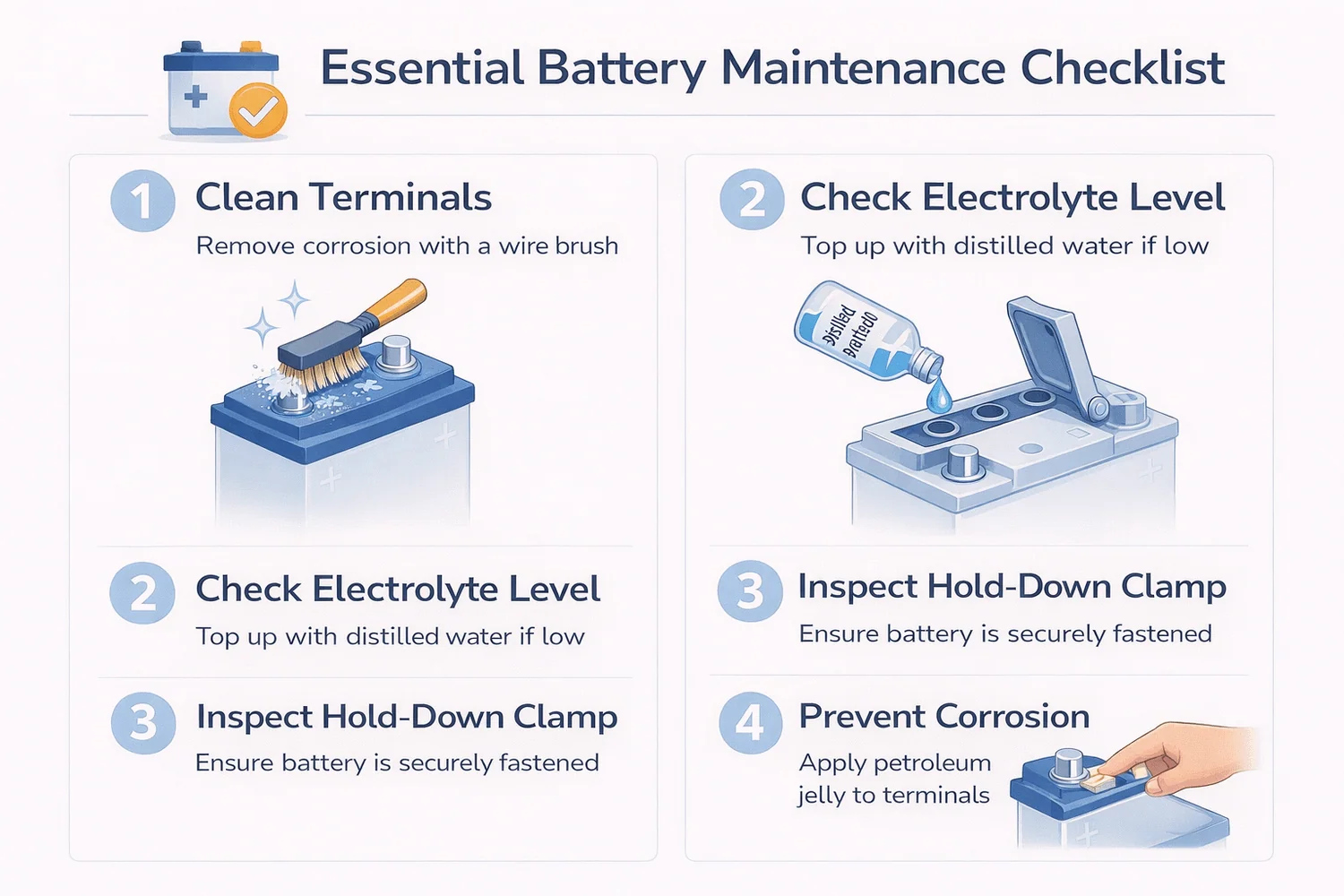
- For conventional (non-sealed) batteries, check electrolyte levels every 2-3 months during summer. Top up only with distilled water. Never use tap water. The minerals in tap water corrode battery plates
Fix the Urban Short-Trip Problem
Short 10-15 minute city commutes create what’s called a “charging deficit.” Starting the engine draws a massive burst of power, and your alternator needs a minimum of 20-30 minutes of steady driving at moderate RPMs to fully replenish what was lost. If you only drive short distances, the battery stays in a permanent state of partial discharge.
This leads directly to sulfation. What is sulfation? Hard lead sulfate crystals permanently encrust the plates, destroying the battery’s ability to hold a charge. It’s irreversible once it sets in.
The fix is straightforward. Take your car out for a continuous 30-40 minute highway drive every week or two. That gives the alternator enough uninterrupted time to complete a full deep-charging cycle and keep sulfation at bay.
Watch Out for Parasitic Drains
Aftermarket accessories are silent battery killers in India:
- Hardwired dashcams with 24/7 parking surveillance draw power continuously. Make sure your dashcam kit includes a “low voltage protection” module that cuts power when battery voltage drops to 12.0-12.4V
- GPS trackers and aftermarket audio systems wired directly to the battery’s positive terminal bypass the vehicle’s sleep protocols. Get all aftermarket electronics wired to switched ignition fuses that cut power when you remove the key
Physical Maintenance Routine
Clean terminal corrosion every 3-4 months. Scrub white or blue powder with a baking soda and water solution using a stiff wire brush. Once dry, coat the terminals with petroleum jelly (not regular automotive grease, which attracts dirt and traps it).
Check hold-down clamps at every service visit. Indian roads are notorious for potholes and speed breakers that subject the engine bay to severe vibration. A loose unit bouncing in its tray fractures the internal lead plates and cracks the outer casing over time.
For long parking periods (vacations, monsoon flooding), either disconnect the negative terminal or attach a smart trickle charger. One thing to note: disconnecting the battery resets your ECU’s adaptive memory and erases your radio presets and Bluetooth pairings. You’ll have to set those up again.
Post-Replacement: The BMS Reset
Do you drive a modern car with Auto Start-Stop, ADAS, or advanced infotainment? If so, physical battery installation is only the first step. The Battery Management System needs to be electronically “registered” or reset using an OBD-II diagnostic scanner. Which cars need this? The Mahindra XUV700, Kia Seltos (higher trims), all premium European vehicles, and any car with a BMS-controlled smart alternator.
Skip this step and you’re in trouble. The alternator keeps using aggressive charging profiles that were designed for the old degraded battery, pumping excessive voltage into your brand-new unit. That will literally boil the electrolyte and destroy it within weeks. So before you hand over money for installation, confirm that your mechanic or doorstep installer has an OBD-II diagnostic tool that can do this reset.
Common Battery Scams to Avoid
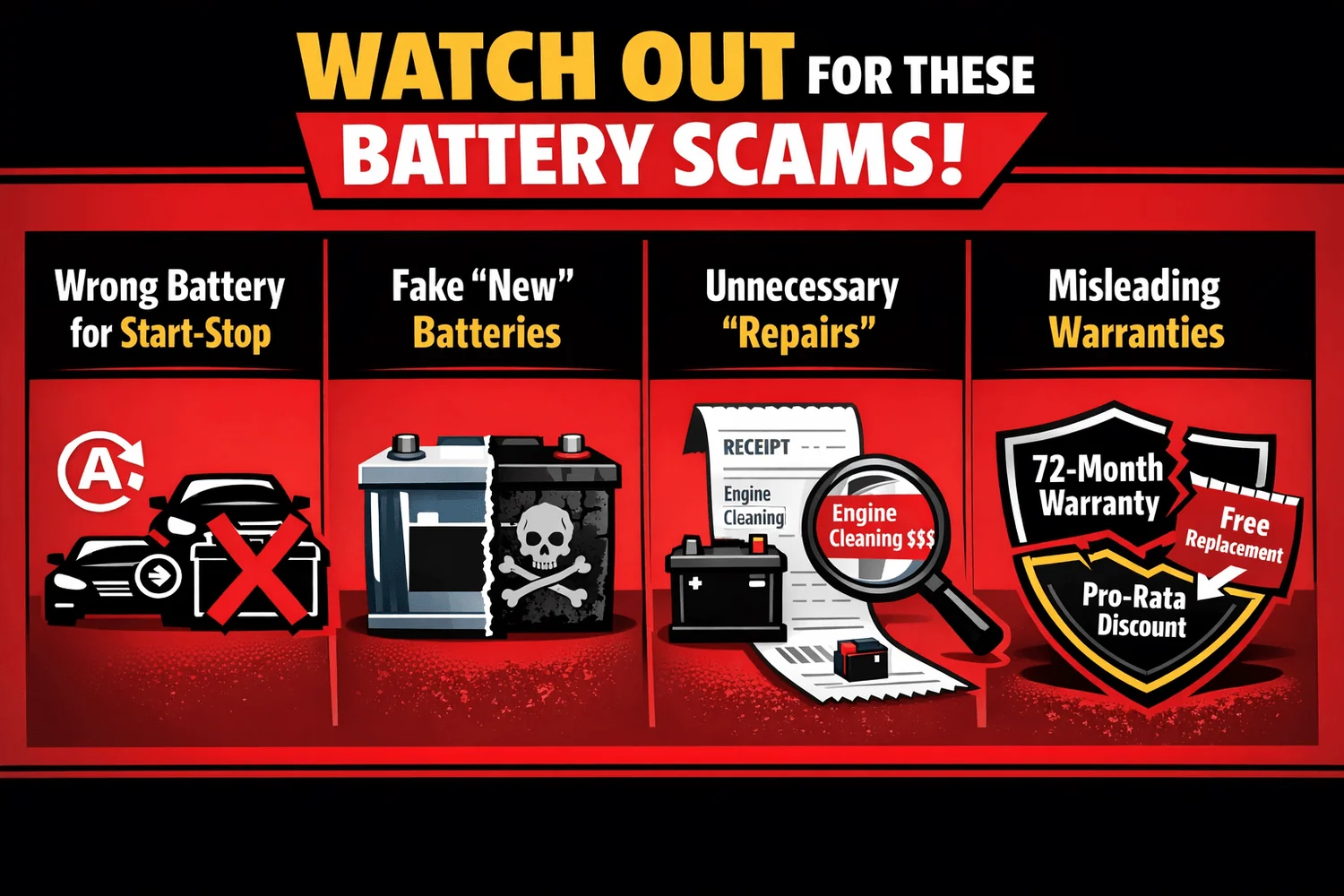
The battery replacement market in India is unfortunately full of shady practices. If you’re buying a replacement in 2026, watch out for these four common scams.
The Start-Stop Downgrade Scam. Local shops quote an attractively low price for a start-stop vehicle, then quietly install a standard flooded battery. It fits physically and runs fine for a few months. But conventional batteries can’t handle micro-cycling and die fast. Always verify that “EFB” or “AGM” is printed on the casing of the replacement.
Dealership Upselling. Authorized service centres sometimes blame a slow crank on carbon-clogged throttle bodies or dirty fuel injectors. They’ll bill you for expensive “engine decarbonization” when all you needed was a ₹4,000 battery. Always demand a battery load test printout before approving any engine diagnostic work.
Refurbished Batteries Sold as New. Scrap dealers sometimes clean dead units from kabadiwalas, refill them with fresh sulfuric acid, and shrink-wrap them for sale as “new budget brands.” These “zombie” batteries fail catastrophically within months. How do you spot them? Genuine new ones are noticeably heavier, because the lead plates in refurbished units have already dissolved into the old acid. Always check for the manufacturer’s heat-stamped seal and holographic anti-counterfeit stickers.
The Extended Warranty Illusion. A “72-month warranty” sounds incredible. But it’s split into two phases. The Free Replacement (FOC) period, typically 24-36 months, gives you a genuinely free replacement for manufacturing defects. The remaining Pro-Rata period only offers a sliding-scale discount on a new battery at current MRP. So the real value of any warranty is the FOC period, not the headline number. Don’t let the big number fool you.
FAQs
How long does a car battery last?
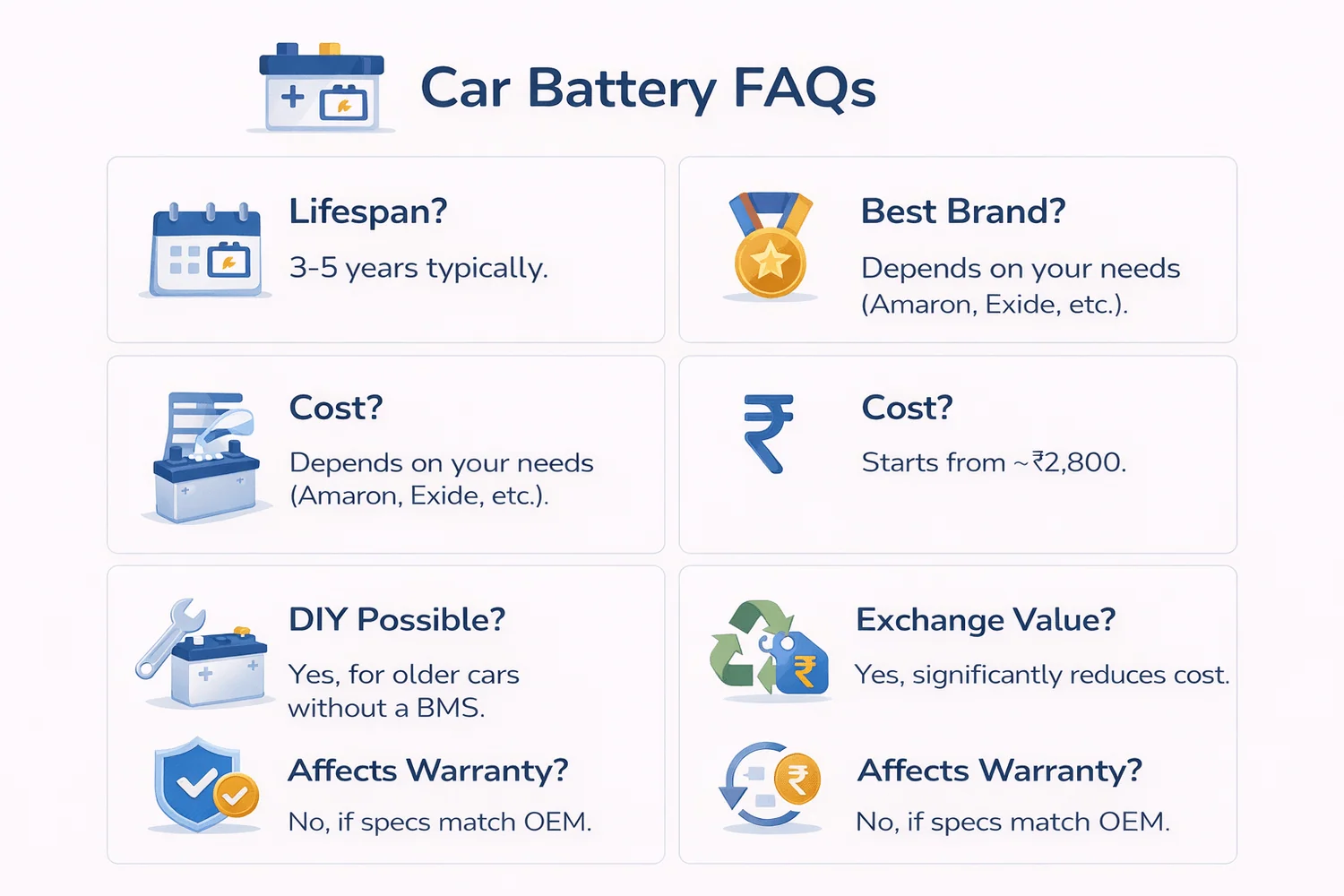
In standard Indian driving conditions, you can expect a conventional flooded lead-acid battery to last 3 to 5 years. But if you mostly do short trips and park outdoors in direct sunlight, that lifespan can shrink to 18-24 months. Heavy accessory use makes it worse. EFB and AGM batteries in start-stop vehicles tend to last 4 to 6 years with proper care.
Which car battery brand is best in India?
There’s no single “best” brand. It depends on what you’re looking for. If you want zero-maintenance convenience and heat resilience, go with Amaron. If you’re in a smaller town where availability matters, Exide’s service network can’t be beaten. On a tight budget? Livguard and Tata Green give you solid value. And if you drive a luxury or start-stop car, Bosch and Varta remain the benchmark.
How much does car battery replacement cost?
With old battery exchange, here’s what you can expect to pay. Hatchbacks (35-40Ah): ₹2,800 to ₹4,700. Sedans and compact SUVs (45-55Ah): ₹4,000 to ₹6,500. Diesel SUVs (60-80Ah): ₹5,000 to ₹11,000. Does your car have start-stop? EFB batteries add a 20-40% premium. AGM units for luxury cars range from ₹12,000 to ₹30,000+.
Can I replace my car battery myself?
For older, mechanically simple cars, yes. You’ll need basic socket wrenches and safety goggles. Acid-resistant gloves are a must too, since lead-acid batteries contain corrosive sulfuric acid. The key safety rule? Always disconnect the negative (black) cable first and reconnect it last. This prevents short circuits against the vehicle chassis. For modern cars (post-2018) with Auto Start-Stop, ADAS, or advanced ECUs, DIY isn’t recommended. These vehicles need a BMS reset via an OBD-II scanner after installation, and that’s not something you can do at home.
Does old battery exchange reduce cost?
Yes, significantly. Your old lead-acid battery contains recyclable lead valued at ₹80 to ₹130 per kg in the 2026 scrap market. Exchange credits range from ₹1,000 for a small hatchback battery to over ₹2,500 for a large SUV unit. Online aggregators automatically apply this at checkout. At local shops, negotiate the exchange value separately for the best deal.
Does replacing the battery affect car warranty?
No, as long as the replacement matches your car’s OEM electrical specifications. That means the correct voltage and Ah capacity, the right CCA rating, and the correct physical standard (DIN or JIS). But if you install an incorrect battery type or wrong polarity, or downgrade a start-stop vehicle to a standard battery, you risk voiding the warranty on the vehicle’s entire electrical wiring and connected ECUs.
What happens to ECU settings after battery replacement?
The ECU loses its adaptive memory when you disconnect the battery. Your saved idle speed profiles and air-fuel mixture trims reset to factory defaults. Same goes for automatic transmission shift patterns. Your car may idle rough or feel slightly sluggish for the first 50-100 km as the ECU “relearns” your driving habits. You’ll also need to re-pair your Bluetooth, reset radio presets, and redo your climate control preferences manually.
For a broader look at keeping your car in top shape, check out our complete maintenance guide.