Your first car purchase in India can go sideways fast if you don’t prepare. Confusing price labels, aggressive dealership tactics, unfamiliar paperwork. First-time buyers lose lakhs every year on mistakes that are completely avoidable.
Here’s a quick roadmap of the entire journey:
- Set your total budget (not just the sticker price)
- Research car models that match your daily needs
- Pick the right fuel type for your driving pattern
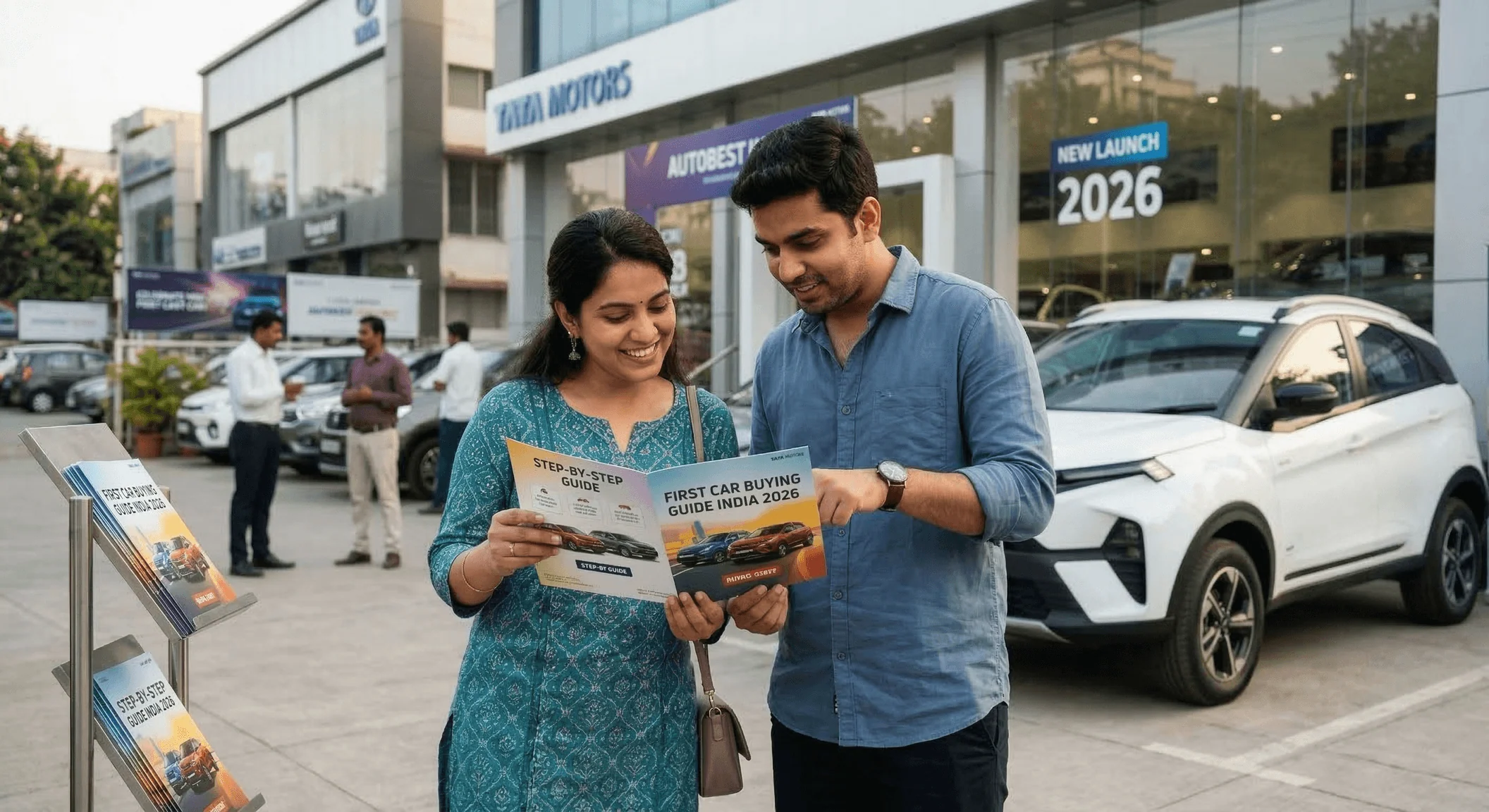
- Visit dealerships and take proper test drives
- Understand the real gap between ex-showroom and on-road price
- Arrange financing or decide to pay cash
- Sort out registration and paperwork
- Complete your pre-delivery inspection before signing anything
Each step covers what to do and where first-timers commonly slip up.
Set Your Budget Before Anything Else
Here’s the biggest mistake first-time buyers make. They walk into a showroom with a vague number, see a car they like, and stretch their budget to make it work. Don’t do this.
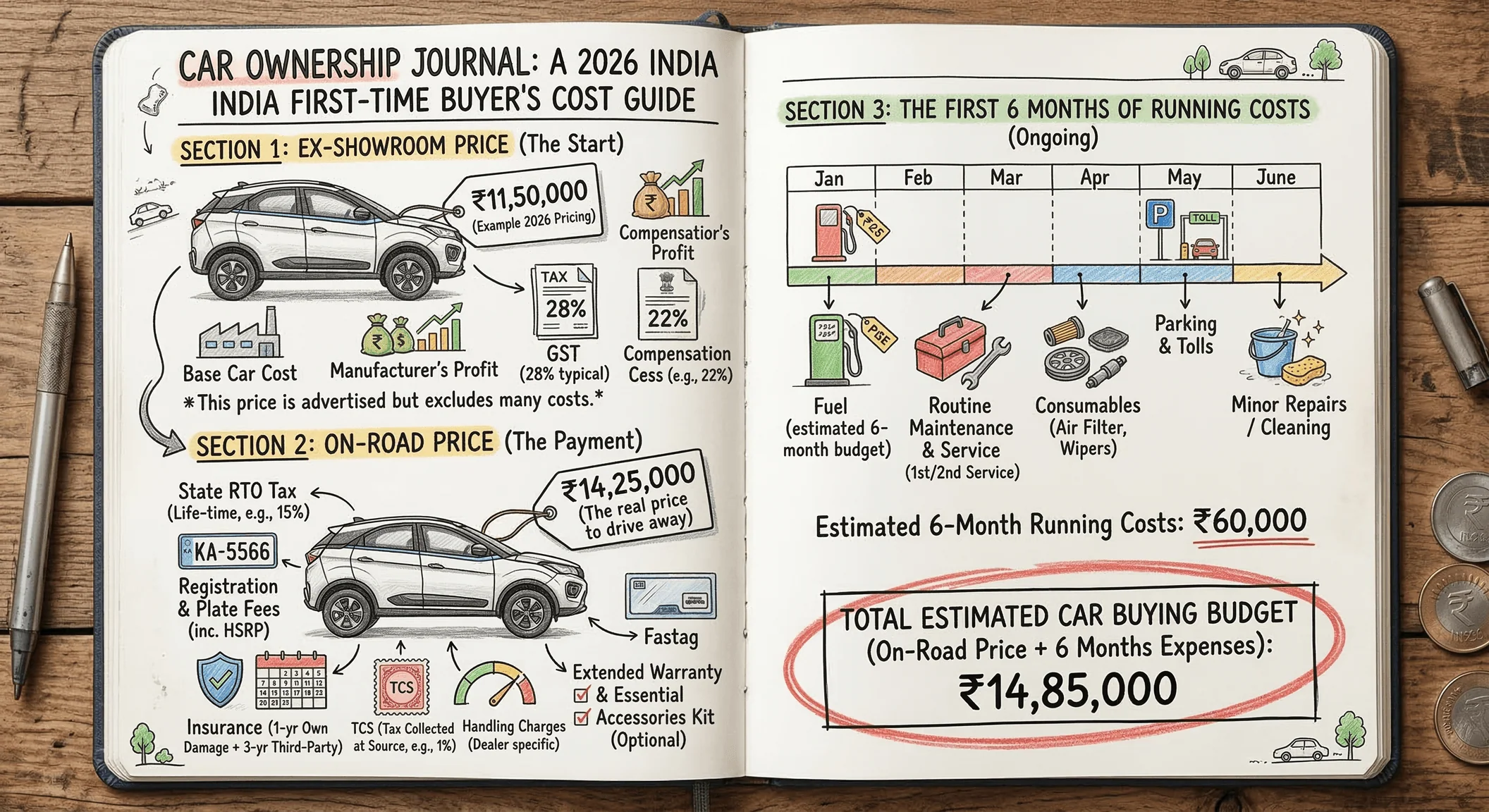
The Real Cost of Owning a Car
The sticker price you see online is the ex-showroom price, which is just the base cost plus GST. What you actually pay, the on-road price, runs 15-25% higher depending on your state.
Here’s what an ₹8 lakh ex-showroom car actually costs:
| Cost Component | Approximate Amount |
|---|---|
| Ex-showroom price | ₹8,00,000 |
| Road tax (varies by state) | ₹32,000 to ₹1,60,000 |
| Registration (RTO) | ₹600 + HSRP charges |
| Full insurance (Year 1) | ₹25,000 to ₹40,000 |
| Dealer accessories (if any) | ₹10,000 to ₹30,000 |
| Total on-road estimate | ₹8,70,000 to ₹10,30,000 |
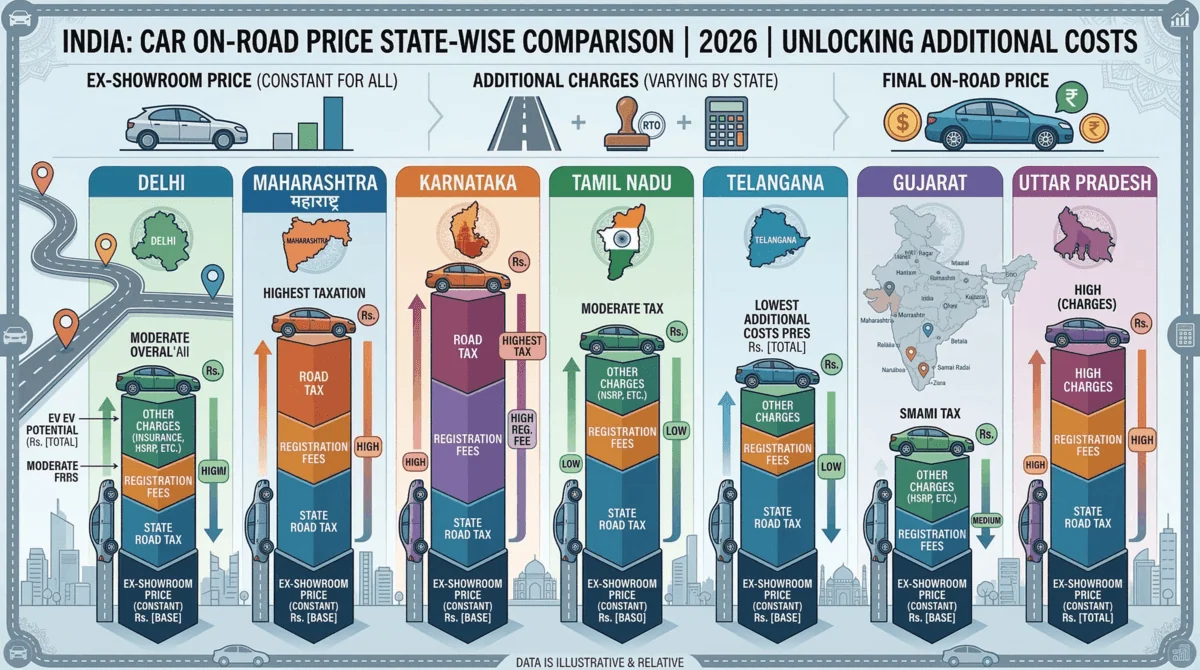
Road tax alone can swing your budget by over a lakh. Delhi charges just 4%. Karnataka charges 14% for cars in this price bracket. Tamil Nadu goes up to 20%. Same car, wildly different final price.
The 20% Down Payment Rule
Most banks ask for 10-20% of the on-road price as a down payment. On a ₹9 lakh on-road car, that’s ₹90,000 to ₹1.8 lakh upfront, plus the EMI commitment every month for the next 3 to 7 years.
Work backwards from your monthly income. Your car EMI shouldn’t exceed 15% of your take-home pay. Earning ₹60,000/month? Keep the EMI under ₹9,000.
Running Costs Add Up Fast
Beyond the purchase, you’ll spend money every single month:
- Fuel: ₹3,000 to ₹8,000/month depending on commute and fuel type
- Insurance renewal: ₹8,000 to ₹20,000/year after Year 1
- Servicing: ₹3,000 to ₹9,500/year (Maruti Suzuki is cheapest at ₹3,000-₹7,000. Kia and Mahindra run ₹7,000-₹9,500)
- Tyres, tolls, parking, minor repairs: another ₹10,000 to ₹20,000/year
Add it all up before you commit.
Research Car Models That Fit Your Needs
Once your budget is locked, resist picking whatever looks good on Instagram. Your first car needs to match your actual daily life.
Questions to Ask Yourself
- How far do you drive daily? Under 30 km of city commuting? A hatchback or micro-SUV works fine. Regular highway trips of 200+ km? You need something with better stability.
- How many people ride regularly? Just you, or a family of four? That changes the rear-seat and boot space you need.
- Where do you park? Tight apartment basement? A compact hatchback under 3,800 mm saves daily headaches.
- Do you sit in heavy traffic? If your Bangalore or Mumbai commute means crawling for an hour each way, seriously consider an automatic. The ₹50,000 to ₹1.5 lakh premium pays for itself in reduced fatigue.
Hatchback vs. Micro-SUV
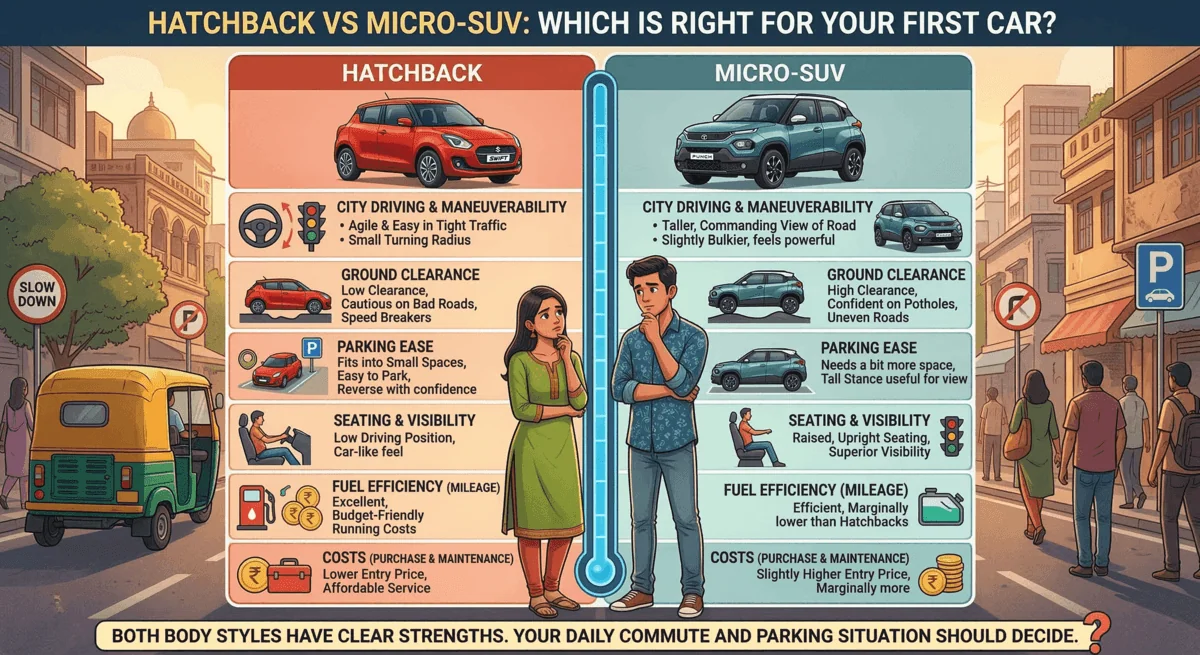
This is the big dilemma for most first-time buyers right now. Both sit in the ₹5-10 lakh range but drive differently.
Hatchbacks (Maruti Swift, Hyundai Grand i10 Nios, Tata Tiago) give you a lower centre of gravity for sharper handling, lighter weight for better mileage, easier parking in tight spaces, and strong resale. The Swift retains up to 65% of its value after 3 years.
Micro-SUVs (Tata Punch, Hyundai Exter, Nissan Magnite) give you 180mm+ ground clearance that handles speed breakers and potholes better. The higher seating position improves visibility, which genuinely helps nervous first-time drivers. Safety ratings are strong too. The Tata Punch holds a 5-star Global NCAP rating.
What About Transmission?
If you’re in heavy city traffic daily, an automatic is worth the extra money. Quick comparison:
| Transmission | Premium Over Manual | Best For | Watch Out For |
|---|---|---|---|
| AMT | ~₹50,000 | Budget buyers, city crawling | Jerky shifts at low speeds |
| CVT | ~₹1 lakh | Smooth city driving | “Rubber-band” feel during overtakes |
| Torque Converter | ~₹1-1.5 lakh | All-round refinement | Slightly lower fuel efficiency |
| DCT | ~₹1-1.5 lakh | Performance, fast shifts | Can overheat in stop-go traffic |
For most first-time buyers on a budget, AMT gives you automatic convenience at the lowest cost.
Choose Your Fuel Type
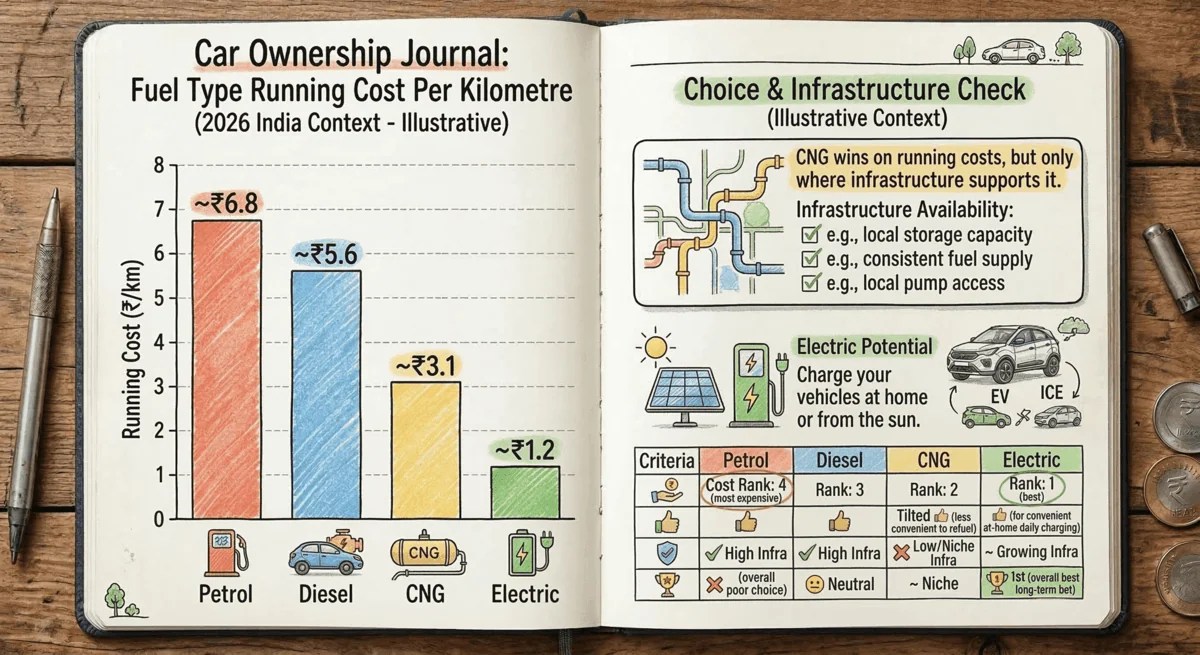
Don’t pick based on what your neighbour drives. This decision should come down to your kilometres and your city.
Petrol: The Safe Default
Drive under 15,000 km a year (roughly 40 km/day)? Petrol is the straightforward choice. Lower purchase price, cheaper maintenance, pumps everywhere. The GST 2.0 reforms (September 2025) dropped tax on small petrol cars from 29% to a flat 18%, making them more affordable than before.
Running cost: about ₹7-9 per km.
CNG: Lowest Running Cost, With Conditions
CNG costs drop to ₹2.5-3 per km. If you clock 50+ km daily and live somewhere with solid CNG infrastructure (Delhi-NCR, Gujarat, Mumbai, Pune, Lucknow), the savings stack up.
But there are trade-offs. Always go factory-fitted (Maruti S-CNG, Tata iCNG). Aftermarket kits void your warranty and lack proper engine calibration. Boot space takes a hit from the cylinder, though newer twin-cylinder designs have improved this. And CNG pumps thin out fast once you leave major metros.
Diesel: Only for Highway-Heavy Users
Diesel is losing ground. BS6 Phase II norms made diesel engines more expensive, and manufacturers are dropping diesel from entry-level lineups. The 10-year diesel deregistration rule in NCR is another headache.
It makes financial sense only if you consistently drive over 25,000 km a year, mostly on highways. Running cost: about ₹5-7 per km.
A Quick Note on EVs
EVs are emerging but the price gap is still steep. A Tata Punch EV costs ₹14-16 lakh vs. ₹5.60 lakh for petrol. Running cost drops to ₹0.6-1.5 per km if you’ve got home charging. EVs attract just 5% GST, and several states waive road tax. But for most first-time buyers in 2026, petrol or CNG remains the practical starting point.
Visit Dealerships and Take Test Drives
Online research only tells you half the story. The other half? Sitting in the car, driving it on actual roads, and seeing how the dealership treats you.
How to Test Drive Properly
Don’t treat this as a casual joyride. It’s a diagnostic evaluation.
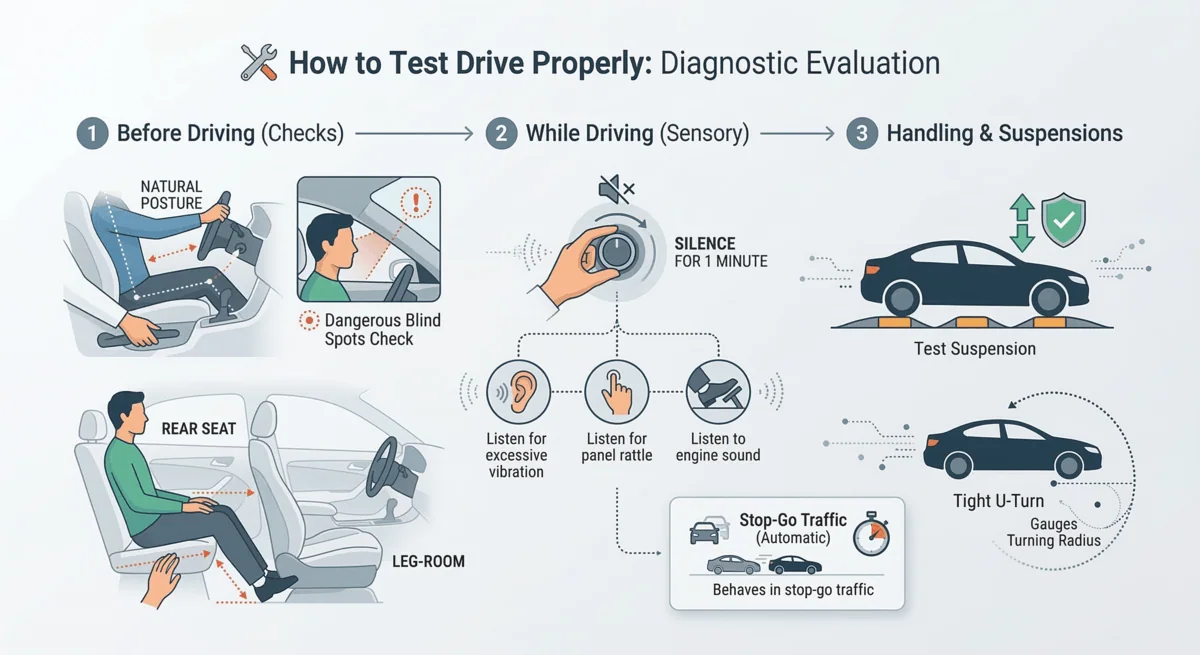
Before driving: Adjust the seat and steering to your natural posture. Check if the A-pillars create dangerous blind spots. Sit in the rear seat and check legroom.
While driving: Turn off the music system for a minute. Listen. Is there excessive vibration? Do the dashboard panels rattle at speed? Drive over speed breakers to test suspension. Try a tight U-turn to gauge the turning radius. If it’s an automatic, notice how it behaves in stop-go traffic.
5 Negotiation Tactics That Actually Work
- Get quotes from at least 3 dealerships for the same variant. Prices vary by ₹10,000-₹30,000 for the identical vehicle.
- Refuse handling/logistics charges. These are illegal. The Supreme Court has ruled that ex-showroom price covers all logistics. In a landmark Delhi Consumer Forum case, a Mahindra dealer was fined ₹2 lakh for charging ₹7,500 in handling fees. If the dealer pushes back, email the manufacturer’s customer care.
- Ask about corporate discounts. Work at TCS, Infosys, Wipro, HDFC, SBI, or similar? Most manufacturers offer ₹5,000 to ₹65,000 off. Often extends to your spouse and parents.
- Buy at the right time. Month-end, quarter-end (March, June, September, December), and year-end bring the best deals.
- Skip the overpriced accessory kit. Dealers make fat margins on floor mats and body covers. Negotiate them as freebies or buy aftermarket at 30-40% less.
Understand On-Road Price vs Ex-Showroom Price
You’ve shortlisted a car at ₹7.5 lakh, but the dealer hands you a quotation for ₹9.2 lakh. What happened?
The ex-showroom vs on-road price difference comes from mandatory government charges layered on top.
You can’t avoid these:
- Road tax: Ranges from 4% (Delhi) to 20% (Tamil Nadu). Karnataka charges 13-14% for the ₹5-10 lakh bracket.
- Registration fee: ₹600 for a private car, plus HSRP charges.
- Insurance: Minimum third-party is mandatory. For a new car, always get full coverage with zero-dep.
You can negotiate or decline these: Extended warranty, AMC, accessories package, ceramic coating.
GST 2.0 Changed the Math
| Vehicle Category | Old Tax | New GST 2.0 |
|---|---|---|
| Small petrol/CNG (under 1200cc, under 4m) | 29% | 18% |
| Small diesel (under 1500cc, under 4m) | 31% | 18% |
| Mid-size cars/SUVs (over 4m or larger engine) | 43-50% | 40% |
| Electric vehicles | 5% | 5% |
Same Car, Different Price by State
| State | Road Tax | Tax on ₹8L Car | Est. On-Road |
|---|---|---|---|
| Delhi | 4% | ₹32,000 | ~₹8,70,000 |
| Gujarat | 6% | ₹48,000 | ~₹8,85,000 |
| Maharashtra | 10-12% | ₹80,000-₹96,000 | ~₹9,20,000 |
| Karnataka | 14% | ₹1,12,000 | ~₹9,50,000 |
| Tamil Nadu | 20% | ₹1,60,000 | ~₹10,00,000 |
That’s ₹1.3 lakh difference between Delhi and Tamil Nadu for the exact same vehicle.
Arrange Financing or Pay Cash
Unless you’ve got the full on-road amount sitting comfortably in savings, you’ll probably need a car loan.
Car Loan Rates (March 2026)
| Lender | Rate (p.a.) | Max Tenure |
|---|---|---|
| SBI | From 8.75% | 7 years |
| HDFC Bank | From 9.40% | 7 years |
| ICICI Bank | From 8.75% | 7 years |
| Market best | 7.45% onwards | 7 years |
SBI also offers a “Green Car Loan” at 8.60% for EVs.
Get Pre-Approved Before Visiting the Dealer
This is the single most important financing tip. Walk in with a pre-approved loan from your own bank.
Why? Dealer finance desks run on commission. They’ll push loans from partner NBFCs carrying inflated rates and hidden penalties (like HDFC’s 2% per month charge on overdue amounts). Walk in with a pre-approved offer and you’re effectively a cash buyer. Massive difference in negotiating power.
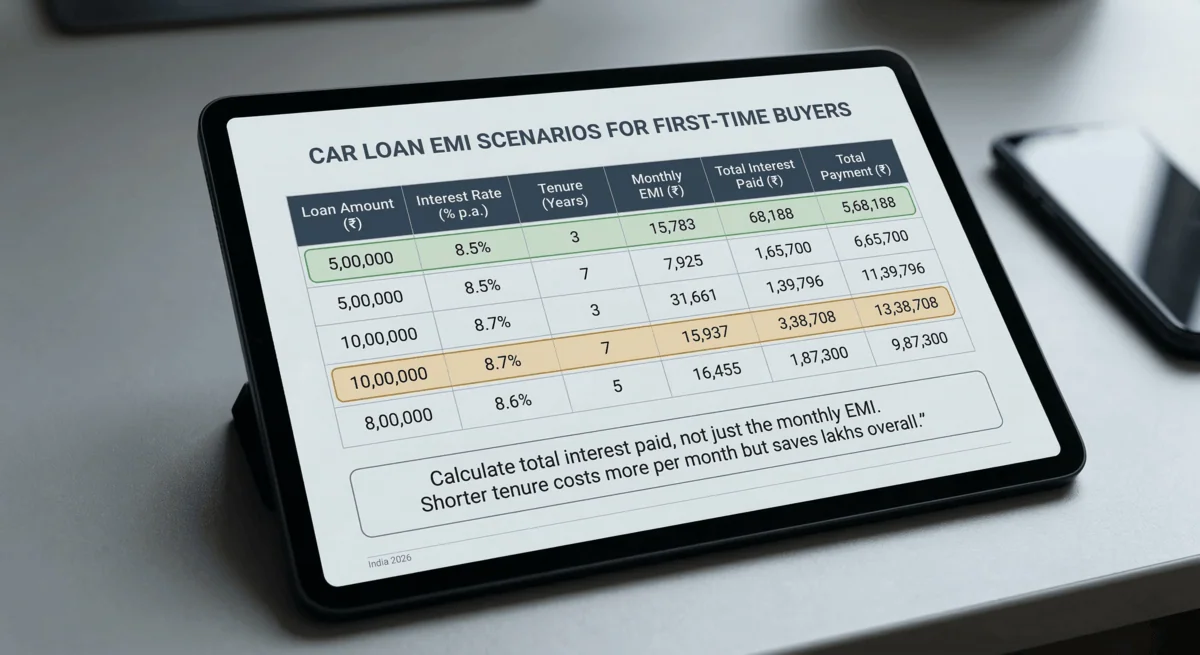
EMI Examples
| Down Payment | Loan | Rate | Tenure | Monthly EMI |
|---|---|---|---|---|
| ₹1.8L (20%) | ₹7.2L | 8.75% | 5 years | ~₹14,850 |
| ₹1.8L (20%) | ₹7.2L | 8.75% | 7 years | ~₹11,500 |
| ₹90K (10%) | ₹8.1L | 9.40% | 5 years | ~₹16,900 |
Longer tenure = lower EMI but more total interest. The 7-year option saves ₹3,350/month but costs roughly ₹1.25 lakh extra overall.
Don’t Cheap Out on Insurance
- Third-party is the legal minimum. Covers damage to others. Nothing for your own car.
- Full coverage (comprehensive) covers your car too, from accidents to theft to natural disasters.
- Zero-depreciation add-on is critical for a new car. Without it, the insurer deducts depreciation on parts during claims. You end up paying a big chunk from your pocket.
- Return to Invoice (RTI) covers the gap between current market value and original invoice price if the car is totalled or stolen.
- Engine protection is worth it in flood-prone areas (Mumbai, Chennai, parts of Bangalore).
The premium gap between basic third-party and full coverage with zero-dep? About ₹8,000-₹15,000/year. On a car worth ₹8-10 lakh, that’s worth every rupee.
Complete Registration and Insurance
Finalised the car? Arranged financing? Now comes paperwork. The dealership handles most of it, but you should know what’s happening.
Documents to Keep Ready
For booking: Aadhaar card, PAN card, address proof (utility bill or rent agreement), 4-6 passport photos.
For a car loan (additional): 3-6 months bank statements, 2-3 salary slips (salaried) or 2 years ITR (self-employed), Form 16.
RTO forms the dealer handles: Form 20 (registration application), Form 21 (sale certificate), Form 22 (road-worthiness certificate), Form 34 (hypothecation agreement if financed).
You’ll get a temporary registration number immediately. The permanent RC smart card and HSRP plate typically arrive within 30-60 days.
The BH Series Option
Work for a company with offices in 4+ states? In government or defence? You’re eligible for Bharat (BH) Series registration. It eliminates re-registration hassles when you relocate.
BH uses biennial (2-year) tax instead of lifetime road tax. Rate for cars under ₹10 lakh: 8% every two years. Much lower upfront cost, but recurring payments. One caution: some state RTOs (Karnataka, Telangana, Kerala) have been known to challenge BH plates and demand tax differentials. Keep your employment proof and payment receipts handy.
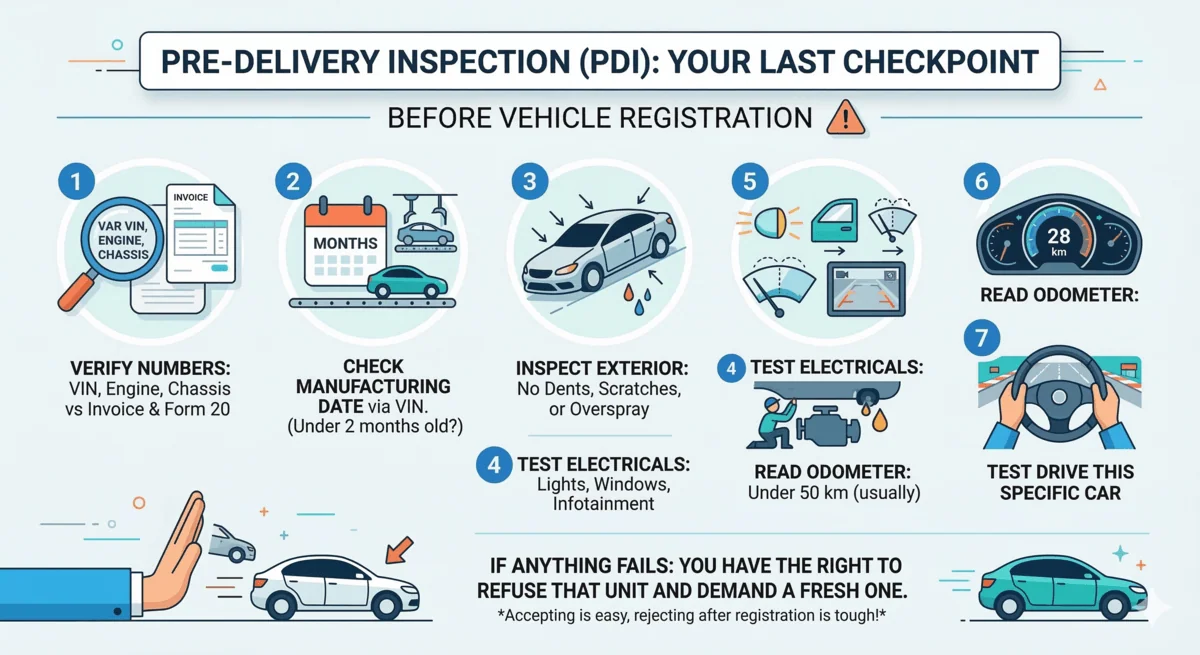
Pre-Delivery Inspection: Your Last Checkpoint
Before the final invoice gets signed and the car is registered in your name, insist on a thorough PDI at the stockyard. Once the RTO registers it, rejecting the car becomes a legal nightmare.
Check these:
- VIN, engine number, chassis number on the car vs. invoice and Form 20
- Manufacturing date via VIN decoder. More than 2 months old? Ask why.
- All body panels from an angle for dents, scratches, inconsistent paint. Check door hinges and wheel arches for paint overspray (sign of transit damage repair).
- Under the engine for fluid leaks
- Every electrical component: lights, power windows, wipers, infotainment, reverse camera
- Odometer should read under 50 km
- Test drive this specific car, not a different unit
If anything fails, you’ve got the right to refuse that unit and demand a fresh one.
FAQs for First-Time Car Buyers
What budget should I set for my first car?
Most first-time buyers land between ₹6 lakh and ₹12 lakh on-road. That gets you a well-equipped hatchback or mid-variant micro-SUV with modern safety features. Budget 15-25% above ex-showroom for taxes and registration costs. Keep 6 months of running costs as a buffer.
Is it better to buy petrol or diesel as a first car?
Petrol, for almost everyone. Cheaper to buy, cheaper to maintain, pumps everywhere. Diesel only works financially if you drive 25,000+ km/year on highways. Want the lowest running costs and drive 50+ km daily with CNG access nearby? Consider CNG. Read our guide on choosing the right fuel type for the full breakdown.
Should I take a car loan or pay cash?
If paying cash would drain your savings below 3-6 months of expenses, take a loan. Rates start at 7.45% for strong credit profiles. Make a 20% down payment, keep the tenure to 5 years or less, and get pre-approved from your own bank before visiting the dealer.
What documents do I need to buy a car in India?
Aadhaar, PAN card, address proof, passport photos at minimum. If taking a loan, add bank statements (3-6 months), salary slips or ITR, and Form 16. The dealer handles all RTO forms. Keep both digital and physical copies of everything.
How long does delivery take after booking?
Depends on the model. Maruti Dzire often means 1-3 months. Tata Punch and Hyundai Exter average 1-2.5 months. Newly launched models take longer. Get a written commitment from the dealer on timeline and price protection in case the manufacturer raises prices during your wait.
What are the best first cars in India in 2026?
Some consistently strong picks: Maruti Swift for mileage and resale, Tata Punch for safety and ground clearance, Hyundai Grand i10 Nios AMT for budget automatic, Maruti Alto K10 S-CNG (from ₹3.7 lakh) for absolute economy. Check our list of best first cars in India for the detailed comparison.
Your first car doesn’t have to drain your savings or give you buyer’s remorse. Do the math, negotiate hard, and don’t let anyone rush you into signing.